Korea-Japan Summit Scheduled for 16-17
Ruling Party Faction: "Japanese PM Must Present Advanced Proposal"
Japanese Apology and Reflection Met with Skepticism
As the Korea-Japan summit scheduled for the 16th to 17th approaches, conflicts surrounding the government's solution to the forced mobilization issue during Japanese colonial rule continue. The government stated that this compensation plan was a 'magnanimous decision' aimed at improving Korea-Japan relations and intends to secure active participation from Japanese companies. However, due to the lack of a sincere apology from Japan, domestic opposition is expected to persist.
On the 12th, the Presidential Office released a statement saying that President Yoon Suk-yeol emphasized the forced labor compensation negotiations with Japan as a "decision for the future." It was described as a difficult decision made to improve the long-stagnant Korea-Japan relationship.
However, criticism has poured in regarding the government's forced labor compensation plan. On the 11th, Lee Jae-myung, leader of the Democratic Party of Korea, attended the "Second Nationwide Rally Condemning the Forced Mobilization Solution and Urging Japan's Apology and Compensation" and criticized, "This forced mobilization compensation plan is the greatest victory for Japan and the greatest humiliation for the Republic of Korea. It is a humiliation comparable to the Gyeongsul National Humiliation."
The victims' side is also strongly opposing the plan, stating that they cannot accept a solution that does not guarantee the participation of Japanese defendant companies in compensation.
Public opinion is also negative. According to a Gallup Korea survey conducted nationwide on the 8th and 9th among 1,002 men and women aged 18 and older, 59% of respondents opposed the government's forced labor compensation issue, citing "no apology or compensation from Japan." Only 35% responded that they supported it "for the sake of Korea-Japan relations and national interests."
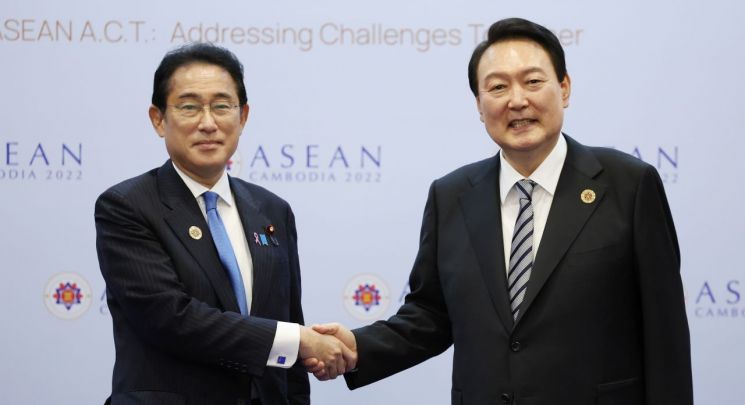 President Yoon Suk-yeol is shaking hands with Japanese Prime Minister Fumio Kishida and taking a commemorative photo at a Korea-Japan summit held at a hotel in Phnom Penh, Cambodia, on November 13 last year (local time).
 [Image source=Yonhap News]
The ruling party has stepped up support, emphasizing President Yoon's decision. On the 13th, Joo Ho-young, floor leader of the People Power Party, said regarding the government's third-party compensation plan for forced labor during Japanese colonial rule, "This is only the beginning of a solution, not the final destination. President Yoon plans to obtain corresponding measures from the Japanese government through a summit with Japanese Prime Minister Fumio Kishida."
Jang Dong-hyuk, the party's floor spokesperson, also released a statement the previous day, saying, "This decision is President Yoon Suk-yeol's diplomatic pledge to Japan made during the last presidential election and a representative foreign policy of the Yoon administration. We will proudly accept evaluation."
The ruling party also predicts that more advanced discussions than previous government plans will emerge at the upcoming Korea-Japan summit. Kim Geun-sik, former head of the People Power Party's Vision and Strategy Office, said on CBS Radio's "Kim Hyun-jung's News Show" that "The Japanese Prime Minister must present (an advanced plan), and I believe he will. There will be behind-the-scenes talks. If the government made this decision to resolve Korea-Japan relations despite domestic opposition, Japan should respond accordingly."
Some analyses suggest that the outcome of President Yoon's visit to Japan, including securing cooperation from Japanese companies, will be crucial. The Korea-Japan summit is expected to address various economic issues such as Japan's exports to Korea, normalization of the General Security of Military Information Agreement (GSOMIA), and the establishment of a Future Youth Fund.
Park Young-sun, former Minister of SMEs and Startups, believes that the summit's achievements should be based on the forced labor compensation negotiations. She said, "If the Yoon administration has extended goodwill to Japan regarding the forced mobilization issue, now it must obtain something from Japan. If nothing is achieved at the Korea-Japan and Korea-US summits, Korea will inevitably remain caught in a sandwich position." She added, "The forced labor compensation negotiations, the Korea-Japan summit, and the Korea-US summit are interconnected issues. President Yoon carries a very heavy burden."
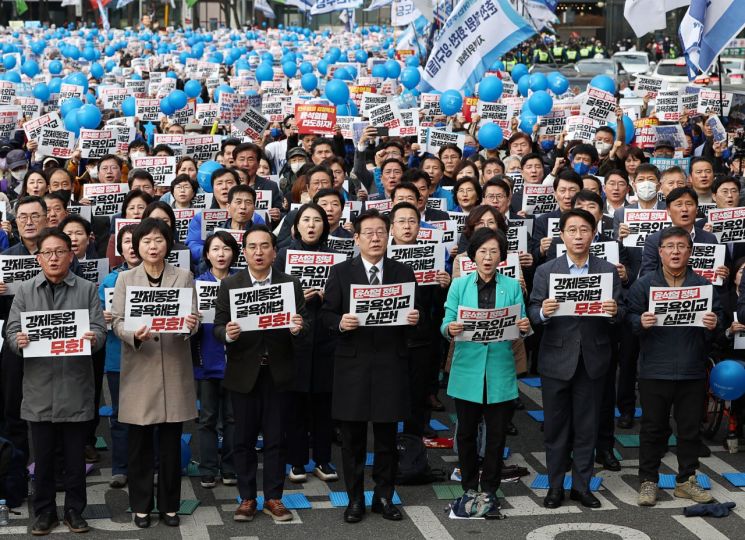 On the afternoon of the 11th, participants including Lee Jae-myung, leader of the Democratic Party of Korea, shouted related slogans at the "2nd Nationwide Rally to Demand Nullification of the Humiliating Solution to Forced Mobilization" held on the east side of Seoul City Hall Plaza.
 [Image source=Yonhap News]
However, many analyses suggest that a sincere apology from the Japanese government is unlikely. According to a report by Japan's Jiji Press the previous day, Prime Minister Kishida is expected to express only the Japanese cabinet's stance of inheriting historical awareness rather than offering an apology on historical issues at the Korea-Japan summit.
On the 6th, when the Korean government announced its solution to the forced labor issue, Prime Minister Kishida stated, "We will inherit the historical awareness of past cabinets, including the Korea-Japan Joint Declaration," but did not use direct apology expressions.
Furthermore, Japanese Foreign Minister Yoshimasa Hayashi denied the forced labor itself just three days after the Korean government proposed the compensation solution. On the 9th, during a question session at the House of Representatives Security Committee, he responded, "It does not constitute forced labor, and the term 'forced labor' is inappropriate." Regarding the government's third-party compensation plan, he said, "Our position remains that this issue was completely resolved by the Korea-Japan Claims Agreement."
Former Ambassador to Japan Kang Chang-il believes the possibility of a direct apology from Japan at this Korea-Japan summit is low. On MBC Radio's "Kim Jong-bae's Focus," Kang criticized, "With statements like Foreign Minister Hayashi's 'there was no forced labor,' what could President Yoon and Prime Minister Kishida possibly discuss? In principle, due to government continuity, since it is a Liberal Democratic Party government, they will just say they inherit the previous stance and try to gloss over the issue."
Kang agreed with some evaluations calling it a "humiliating diplomacy" or "diplomatic failure," saying, "Normalizing Korea-Japan relations is good for Japan too; it wouldn't benefit only one country. However, it appears as if we are begging for the summit even though Japan did not want it." He added, "The intention to normalize Korea-Japan relations is truly good, but the process completely omitted seeking victims' consent and fully accepted Japan's demands."
Hyun Geun-taek, deputy director of the Democratic Party's Democratic Research Institute, also dismissed predictions of more advanced discussions at the summit, saying, "I don't think that will happen at all. What President Yoon expects is probably just the succession of the 'Kim Dae-jung-Obuchi' declaration, and even that might not be explicitly stated." On CBS's "Kim Hyun-jung's News Show," he forecasted, "The core elements?Japan government's apology and Japanese companies' compensation?are all missing. We can fully expect that there will be no apology or reflection from Japan."
© The Asia Business Daily(www.asiae.co.kr). All rights reserved.
![Clutching a Stolen Dior Bag, Saying "I Hate Being Poor but Real"... The Grotesque Con of a "Human Knockoff" [Slate]](https://cwcontent.asiae.co.kr/asiaresize/183/2026021902243444107_1771435474.jpg)
















