Exports have decreased by more than 15% compared to the same period last year as of the 10th of this month, increasing the likelihood that the trade deficit will continue for the 13th consecutive month.
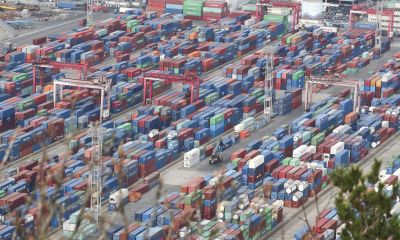
According to the Korea Customs Service on the 13th, the export value from March 1 to 10 (provisional customs clearance basis) was $15.791 billion, down 16.2% from the same period last year, while imports increased by 2.7% to $20.786 billion.
During this period, the number of working days was 7.5, one day more than the 6.5 days in the same period last year. Considering the number of working days, the average daily export value was $2.11 billion, a decrease of 27.4%.
Exports have been declining for six consecutive months from October last year to this month. With exports decreasing and imports increasing, the trade deficit reached $4.995 billion as of the 10th of this month.
The cumulative annual export value this year is $112.286 billion, and imports are $135.061 billion, with exports down 12.6% and imports up 0.6% compared to the same period last year. As a result, the annual trade deficit for this year recorded $22.775 billion. The trade deficit is likely to continue for 13 consecutive months from March last year to the 10th of this month.
By item, exports of semiconductors, Korea’s largest export item, plunged 41.2% compared to the same period last year as of the 10th of this month, marking the eighth consecutive month of decline. Passenger cars increased significantly by 133.7% compared to last year, but most major items such as petroleum products (-21.6%), wireless communication devices (-31.9%), and precision instruments (-23.9%) decreased.
By region, exports increased to the United States (5.6%) and India (5.5%), while they decreased to China (-35.3%), the European Union (-6.2%), Vietnam (-16.4%), and Japan (-7.3%).
During the same period, imports increased for semiconductors (1.5%), machinery (11.8%), and coal (31.9%), but slightly decreased for major energy sources such as crude oil (-3.1%) and gas (-1.9%). Imports increased from China (10.1%), the United States (4.3%), and Taiwan (27.6%), but decreased from the European Union (-8.8%), Japan (-5.4%), and Australia (-9.7%).
© The Asia Business Daily(www.asiae.co.kr). All rights reserved.