The Seoul housing market is showing signs of revitalization following the government's January 3rd real estate measures, which include deregulation in the Seoul area and easing of non-priority subscription requirements. Seoul's housing complexes are experiencing competition rates of dozens to hundreds to one, and sales transactions have increased for three consecutive months. In contrast, the provinces and the Gyeonggi-Incheon areas are still facing a severe downturn. Unsold units are piling up in every complex launched for sale, and transactions are declining. The concentration effect due to deregulation appears to be centered on Seoul, while demand in the provinces and Gyeonggi-Incheon is actually decreasing.
Seoul 'Sold Out', Provinces 'Unsold Units'
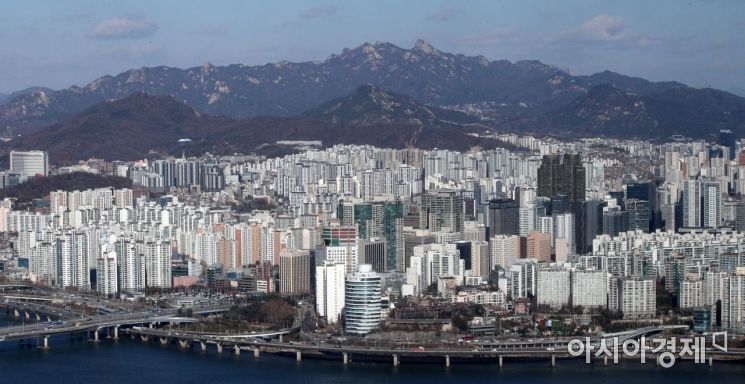 The Seoul housing subscription market is showing signs of revitalization due to the government's 1.3 real estate measures. The photo shows the view of Seoul apartments from 63 Square. Photo by Hyunmin Kim kimhyun81@
According to the Korea Real Estate Board's subscription homepage on the 13th, all three complexes launched in Seoul after the January 3rd real estate measures were completely sold out in subscription.
Yeongdeungpo Xi Dignity recorded an average competition rate of 198.76 to 1, with 19,478 applicants for 98 units in the first priority subscription on the 7th. Centreville Asterium Signature (Yeokchon 1 District Reconstruction) had 2,430 applicants for 214 units in the first priority subscription, recording an average competition rate of 11.3 to 1. Although Deungchon Ji Wine, which offered 81 units, failed in the first priority subscription, a total of 493 applicants participated in the second priority subscription.
On the other hand, the provincial housing market is experiencing frequent subscription shortfalls. Among 10 complexes launched in the provinces after the January 3rd real estate measures, only two succeeded in first and second priority subscriptions: Bokdae Xi The Sky (Chungbuk) and Eco Delta City Prugio Lin (Busan).
Complexes such as Hillstate Dongdaegu Central (Daegu), Hagwi Puremir Apartment (Jeju), Iksan Busong Desiang Private Participation Public Housing (Jeonbuk), Seosan Haemi Ia Edu Town (Chungnam), Gwangju Sangmu Station Gold Class (Gwangju), Jincheon Deoksan Woobang IU Shell (Chungbuk), Gyeongsan Seohee Star Hills (Gyeongbuk), and Damyang Central Park Namyang Hutton (Jeonbuk) all have unsold units.
The Gyeonggi and Incheon metropolitan areas are also experiencing severe subscription temperature differences depending on the sale price. Since the January 3rd real estate measures, a total of 11 complexes have been launched in the metropolitan area, but only three?Guri Station Lotte Castle Signature (Gyeonggi), Green Narae (Gyeonggi), and Dongincheon Station Park Prugio 10-Year Sale Conversion Public Rental Housing (Incheon)?have succeeded in subscription recruitment.
Eight complexes, including Pyeongchon Centum First (Gyeonggi), Songdo Station Kyungnam Honorsville (Incheon), Yangju Hoecheon District A-20BL Daekwang Roseviang Central (Gyeonggi), Suwonseong Joongheung S-Class (Gyeonggi), The Sharp Arte (Incheon), Hillstate Pyeongtaek Hwayang (Gyeonggi), The Sharp Bupyeong Central City 10-Year Sale Conversion Public Rental Housing (Incheon), and Hillstate Pyeongtaek Hwayang (Gyeonggi), failed to recruit subscriptions.
Seoul Transaction Volume ‘Increasing’, Provinces Continue ‘Declining’
After the January 3rd real estate measures, the difference in sales transaction volume between Seoul and the provinces is widening. The measures lifted real estate regulations on all areas of Seoul except the Gangnam 3 districts (Gangnam, Seocho, Songpa) and Yongsan, and launched a special Bogeumjari loan for houses under 900 million won on January 30th, which seems to have concentrated demand in Seoul.
According to the Korea Real Estate Board, the number of apartment sales transactions in Seoul increased for three consecutive months: 761 in November last year, 1,001 in December, and 1,161 in January this year.
In contrast, demand is decreasing in the provinces. Daegu's transactions dropped 11.2% (110 units) from 984 in December last year to 874 in January this year, and Daejeon's apartment transactions decreased 6% (33 units) from 550 to 517 during the same period. Sejong also fell from 277 to 244.
Additionally, most provincial areas saw a contraction in transactions: Chungbuk (1,169 → 895), Gangwon (819 → 762), Chungnam (1,383 → 1,281), Jeonnam (742 → 737), Gyeongbuk (1,386 → 1,286), Gyeongnam (1,680 → 1,427), and Jeju (165 → 120).
The number of unsold apartments in the provinces is also increasing. As of the end of January, out of 75,359 unsold units nationwide, 63,102 units (83.7%) are in the provinces. Daegu has the highest number of unsold units nationwide, reaching 13,565 units, and Jeonbuk, Gyeongbuk, and Chungbuk have seen increases of more than 1,000 units in just one month, indicating a rapid rise.
© The Asia Business Daily(www.asiae.co.kr). All rights reserved.
![Clutching a Stolen Dior Bag, Saying "I Hate Being Poor but Real"... The Grotesque Con of a "Human Knockoff" [Slate]](https://cwcontent.asiae.co.kr/asiaresize/183/2026021902243444107_1771435474.jpg)

















