The number of people using non-face-to-face medical consultations, temporarily permitted after the COVID-19 pandemic, has exceeded 13 million. Although the total number of consultations reached approximately 36 million, no significant medical accidents occurred, and it is evaluated to have contributed to the improvement of public health. Accordingly, the government's efforts to legislate non-face-to-face medical consultations within this year are expected to accelerate.
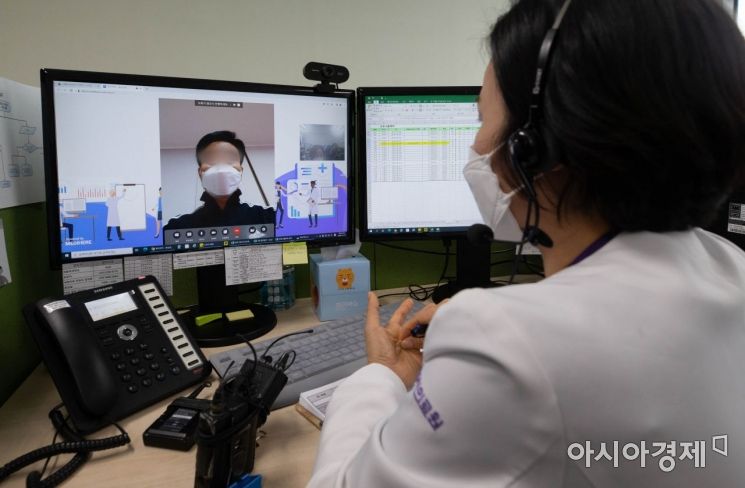 Medical staff are conducting non-face-to-face consultations with COVID-19 home treatment patients.
 [Photo by Asia Economy DB]
The Ministry of Health and Welfare analyzed the status of non-face-to-face medical consultations claimed to health insurance from February 24, 2020, when such consultations were temporarily permitted, to January 31 of this year. The analysis showed that a total of 36.61 million non-face-to-face consultations were conducted for 13.79 million people at 25,697 medical institutions. This figure includes 29.25 million cases of home treatment for COVID-19 patients related to COVID-19 illnesses. To understand the general status, the Ministry excluded these and analyzed 7.36 million cases.
Non-face-to-face consultations increase annually... Mainly used by the elderly, chronic disease patients, and mild cases
Among the 7.36 million cases excluding COVID-19 home treatment, 6 million cases (81.5%) were follow-up visits, and 1.36 million cases (18.5%) were first visits, indicating that non-face-to-face consultations were mainly for follow-up care. The number of consultations that resulted in prescriptions was 5.14 million (69.8%), while 2.22 million (30.2%) were consultations without prescriptions. The annual number of non-face-to-face consultations surged each year: 1.42 million cases (840,000 people) in 2020, 2.2 million cases (1.11 million people) in 2021, and 3.74 million cases (2.05 million people) in 2022.
There was no concentration of patients in tertiary hospitals, which the medical community initially feared at the start of non-face-to-face consultations. Medical institutions participating in non-face-to-face consultations accounted for 27.8% of all medical institutions, totaling 20,076 sites. Among these, clinics accounted for 93.6% (18,790 sites) of participating institutions and 86.2% (6.34 million cases) of total consultations.
Regarding the age of users, those aged 60 and above accounted for 2.88 million cases (39.2%), and those under 20 accounted for 1.11 million cases (15.1%), confirming that consultations were mainly for the elderly and pediatric/adolescent groups. In particular, the 60-69 age group accounted for the largest proportion at 17.3%. By disease, consultations for hypertension (15.8%), acute bronchitis (7.5%), and uncomplicated diabetes (4.9%) were common.
The government holds the position that institutionalizing non-face-to-face consultations is necessary based on these achievements. Since effectiveness and safety have been confirmed, non-face-to-face consultations can sufficiently contribute to public health improvement. In fact, an analysis of prescription adherence changes among hypertension and diabetes patients who used telephone prescriptions and consultations versus those who did not showed an increase in consistent medication intake after the temporary permission of non-face-to-face consultations. The Ministry of Health and Welfare explained, "We confirmed that non-face-to-face consultations can contribute to health improvement, such as enhancing prescription adherence among the elderly."
High user satisfaction... No serious medical accidents
Public satisfaction with non-face-to-face consultations was also high. According to a satisfaction survey conducted by the National Health Insurance Service in 2020 targeting 500 patients or family members who received telephone consultation prescriptions, 77.8% of respondents were satisfied with non-face-to-face consultations, and 87.8% expressed willingness to reuse the service. A survey conducted by the Korea Health Industry Development Institute in October last year also showed 62.3% satisfaction with non-face-to-face consultations and 87.9% intention to use such services in the future, indicating a generally high level of user satisfaction.
No serious medical accidents were confirmed during the temporary implementation of non-face-to-face consultations. Among 26,503 patient safety incidents reported to the Patient Safety Reporting and Learning System from 2020 to November last year, only five were related to non-face-to-face consultations. These were relatively minor issues such as omissions or mistakes during the prescription process.
Additionally, from 2020 to 2022, there was only one case related to consultations or claims concerning the temporary permission of non-face-to-face consultations at the Korea Medical Dispute Mediation and Arbitration Agency. Consumer complaints related to non-face-to-face consultations filed with the Korea Consumer Agency mostly involved refund refusals, and no cases of physical harm due to medical negligence in non-face-to-face consultations were confirmed.
Park Min-su, the 2nd Vice Minister of the Ministry of Health and Welfare, stated, "While conducting temporary non-face-to-face consultations, we were able to confirm their effectiveness and safety, and many of the concerns raised beforehand, such as concentration in large hospitals, have been largely dispelled. We will prepare supplementary measures to ensure that patients' medical choices and accessibility, as well as medical professionals' expertise, are respected during non-face-to-face consultations, so that both patients and medical professionals can safely and confidently use these services, and we will proceed with institutionalization."
© The Asia Business Daily(www.asiae.co.kr). All rights reserved.
![Clutching a Stolen Dior Bag, Saying "I Hate Being Poor but Real"... The Grotesque Con of a "Human Knockoff" [Slate]](https://cwcontent.asiae.co.kr/asiaresize/183/2026021902243444107_1771435474.jpg)















