Five Days After First Attempt Failure
Cost Reduction Through 3D Printing
The world's first 3D-printed rocket, 'Terran 1,' created by the US startup Relativity Space, will be launched on the 11th (local time) from Cape Canaveral, Florida.
This is a retry five days after a launch attempt on the 8th was postponed due to a fuel issue occurring 70 seconds before liftoff. The launch window for orbital insertion is from 1 to 4 p.m. local time (3 to 6 a.m. KST on the 12th).
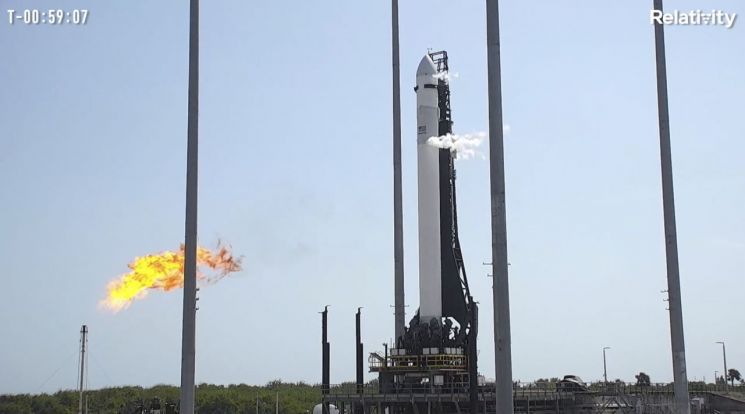
The Terran 1 rocket is a two-stage rocket with a height of 33.5 meters and a diameter of 2.3 meters. 85% of its mass, including the engine, is 3D-printed metal alloy. The ultimate goal is to manufacture up to 95% of the rocket using 3D printing.
Terran 1 notably reduces the number of parts used in the rocket to about 1/100th compared to conventional rockets by utilizing 3D printing, and shortens the production period to within 60 days.
'Terran 1' is expected to reach low Earth orbit (LEO) eight minutes after launch.
The estimated launch cost of Terran 1 is about $12 million (approximately 15.9 billion KRW) per launch. For 'Terran R,' scheduled to launch next year, it is expected that the proportion of 3D-printed parts will increase and the launch vehicle itself will incorporate reusable technology, further reducing launch costs.
© The Asia Business Daily(www.asiae.co.kr). All rights reserved.
![Clutching a Stolen Dior Bag, Saying "I Hate Being Poor but Real"... The Grotesque Con of a "Human Knockoff" [Slate]](https://cwcontent.asiae.co.kr/asiaresize/183/2026021902243444107_1771435474.jpg)
















