Low-density lipoprotein (LDL) cholesterol is commonly referred to as 'bad cholesterol.' This is because excessive cholesterol deposition in the vascular walls increases the risk of atherosclerosis and heart disease. Therefore, lowering LDL cholesterol is considered key in the treatment and complication prevention of patients with atherosclerotic cardiovascular disease. Traditionally, high-intensity statin therapy has been preferred regardless of LDL cholesterol levels. However, a domestic research team has presented findings that adjusting the intensity according to treatment goals can improve both therapeutic efficacy and safety, drawing attention from the academic community.
 Professors Myung Ki Hong, Sung Jin Hong, and Yong Jun Lee from the Department of Cardiology at Severance Hospital (from left).
 [Photo by Yonsei Medical Center]
The research team led by Professors Hong Myung-ki, Hong Sung-jin, and Lee Yong-jun from the Department of Cardiology at Severance Hospital reported on the 13th that 'statin intensity adjustment therapy' based on LDL cholesterol treatment goals in patients with atherosclerotic cardiovascular disease is as effective as the 'high-intensity statin maintenance strategy' while reducing related side effects. The study results were published in the latest issue of the world-renowned journal Journal of the American Medical Association (JAMA, IF=157.3).
Generally, two strategies are used when administering statins to lower LDL cholesterol. One is the 'statin intensity adjustment strategy,' which sets LDL cholesterol treatment goals and adjusts statin intensity accordingly. The other is the 'high-intensity statin maintenance strategy,' which uses high-intensity statins regardless of LDL cholesterol levels. The high-intensity statin maintenance strategy has the advantage of convenience as it does not require intensity adjustment. However, individual responses to statin drugs vary, and long-term use of high-intensity statins carries risks of side effects such as muscle pain, liver damage, and diabetes. Conversely, the intensity adjustment strategy allows for personalized treatment and is known to reduce side effects caused by high-intensity statins. Until now, there had been no clinical follow-up studies comparing these two statin treatment strategies.
The research team conducted the LODESTAR study, a randomized controlled trial from September 2016 to November 2019 involving 4,400 cardiovascular disease patients?including those with stable angina and acute coronary syndrome?across 12 hospitals in Korea. Patients were randomly assigned one-to-one to either the statin intensity adjustment strategy or the high-intensity statin maintenance strategy, targeting LDL cholesterol treatment goals of 50?70 mg/dL, and followed up for three years.
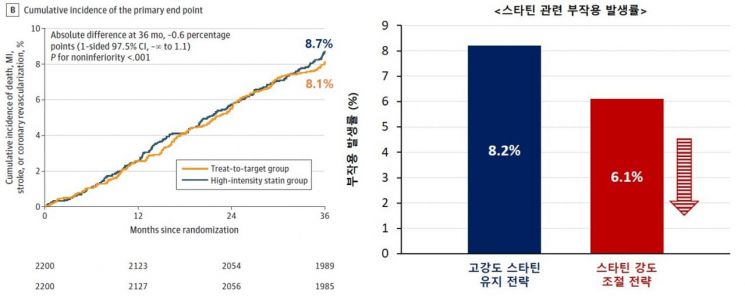 No significant difference was observed between the statin intensity adjustment strategy and the high-intensity statin strategy in the comparison of clinical outcomes over a 3-year clinical follow-up period (left). However, regarding the incidence of statin-related side effects, the high-intensity statin maintenance group showed 8.2%, while the statin intensity adjustment group showed 6.1%, confirming a significant reduction in side effects in the intensity adjustment group. [Data provided by Yonsei Medical Center]
As a result, the average LDL cholesterol level over three years was 69.1 mg/dL in the statin intensity adjustment group and 68.4 mg/dL in the high-intensity statin maintenance group, showing no significant difference between the two groups. In the statin intensity adjustment group, 54% of patients used high-intensity statins and 43% used moderate-intensity statins, meaning about half of the patients were able to reduce their use of high-intensity statins while still lowering LDL cholesterol levels.
When comparing clinical outcomes such as death, myocardial infarction, stroke, and cardiovascular revascularization, the statin intensity adjustment group had an incidence of 8.1%, while the high-intensity statin maintenance group had 8.7%, showing no significant difference. On the other hand, the incidence of statin-related side effects?including newly developed diabetes, elevated liver and muscle enzyme levels, and end-stage renal failure?was significantly lower in the statin intensity adjustment group at 6.1%, compared to 8.2% in the high-intensity statin maintenance group.
The research team interpreted that the statin intensity adjustment strategy is as effective as the high-intensity statin maintenance strategy while reducing the use of high-intensity statins and related side effects. Professor Hong Myung-ki stated, "In cholesterol-lowering treatment for atherosclerotic cardiovascular disease, we confirmed that statin intensity adjustment therapy based on treatment goals does not reduce efficacy compared to high-intensity statin maintenance therapy but results in fewer side effects." He added, "This confirms the clinical utility and safety of the statin adjustment strategy tailored to treatment goals, which is of great significance."
© The Asia Business Daily(www.asiae.co.kr). All rights reserved.
![Clutching a Stolen Dior Bag, Saying "I Hate Being Poor but Real"... The Grotesque Con of a "Human Knockoff" [Slate]](https://cwcontent.asiae.co.kr/asiaresize/183/2026021902243444107_1771435474.jpg)
















