‘The Sorrow of Mapo’ Due to Undesirable Facilities... Documented in a White Paper
Mapo-gu Decides to Publish a White Paper Detailing Facility Status and Damages, Launches Editorial Committee
Committee Composed of 13 Local Residents... Tasked with Collecting Historical Data and Resident Testimonies
Park Gang-su, Mayor of Mapo-gu: “Understanding the Past Properly Can Prevent Repeating the Same Suffering”
Residents of Mapo-gu have endured long years of pain and sorrow due to various undesirable facilities such as Nanji-do and Dangin-ri Thermal Power Plant. However, they now face the risk of having to bear yet another undesirable facility, an additional incineration plant.
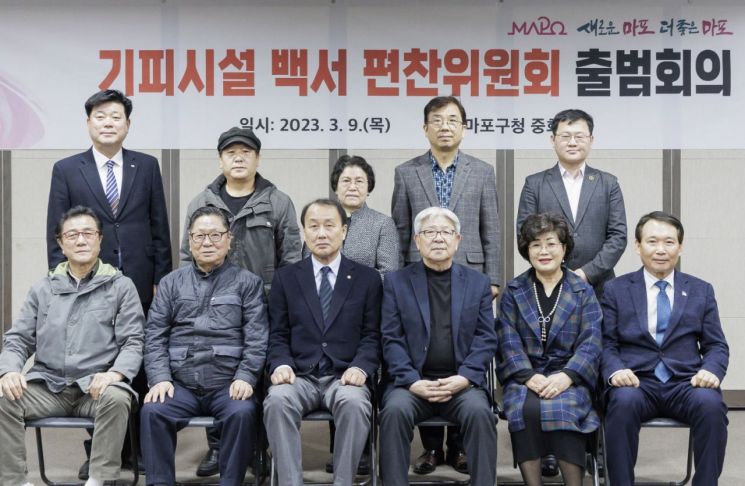
To avoid repeating the times of pain and sorrow, Mapo-gu decided to create a ‘White Paper on Undesirable Facilities’ to accurately understand the facilities and the damages caused by them, and to share these facts with residents. On the 9th, the ‘Mapo-gu Undesirable Facilities White Paper Editorial Committee’ was launched.
Mapo-gu (Mayor Park Gang-su) hosts six undesirable facilities: the Dangin-ri Thermal Power Plant, built in 1930 and moved underground in 2013; Nanji-do, which served as a landfill for 80 million truckloads of metropolitan waste from 1978 to 1993; the petroleum reserve base, secretly installed from 1978 and closed in 2000; the Mapo Resource Recovery Facility with a 750-ton capacity, built in 2005 and operating for 18 years; the Sangam Hydrogen Station completed in 2010; and the Sangam Hydrogen Fuel Cell Power Plant established in 2017.
Another unforgettable pain for Mapo is the demolition of Bamseom Island in 1968 for the development of Yeouido and the Han River, which caused about 440 residents to lose their homes overnight.
The Mapo-gu Undesirable Facilities White Paper (subtitle: The Sorrow of Mapo) will include the status, circumstances at the time, and policy decision processes related to these six undesirable facilities and the demolition of Bamseom Island.
In particular, besides documented materials, the white paper will contain various factual data such as testimonies from residents who lived near the undesirable facilities. This role is assigned to the Mapo-gu Undesirable Facilities White Paper Editorial Committee.
The editorial committee is a purely civilian organization composed of 13 local residents familiar with the area and with direct experience of the undesirable facilities.
Kim Seong-woo, Chairperson of the White Paper Editorial Committee, said, “I joined the committee because I sympathize with Mapo-gu’s purpose of publishing the white paper,” adding, “We will actively cooperate with the district office to create a white paper that can benefit our local residents.”
The district plans to publish the white paper by the end of this year and distribute copies to schools, related organizations, and other public institutions.
Park Gang-su, Mayor of Mapo-gu, stated, “It is true that there were flaws in policy decisions that overlooked residents’ suffering and damages each time six undesirable facilities were established in Mapo. Along with this awareness of responsible administration, residents must accurately understand the damages caused by these facilities to avoid repeating the same pain. I ask for the active support of the white paper editorial committee so that the white paper can serve as a guide for residents to properly understand the past and overcome the present.”
© The Asia Business Daily(www.asiae.co.kr). All rights reserved.
![Clutching a Stolen Dior Bag, Saying "I Hate Being Poor but Real"... The Grotesque Con of a "Human Knockoff" [Slate]](https://cwcontent.asiae.co.kr/asiaresize/183/2026021902243444107_1771435474.jpg)















