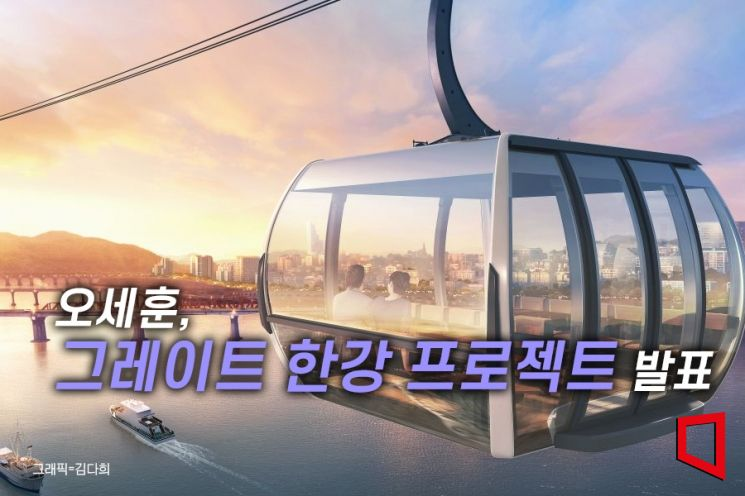
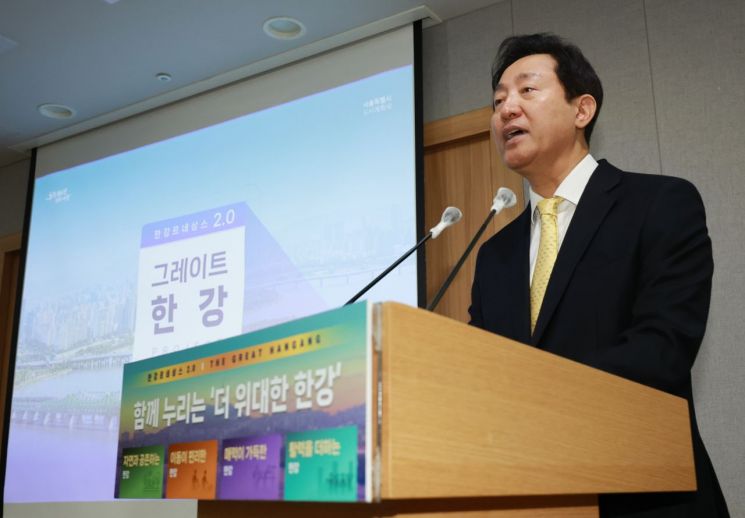
The Han River waterfront is about to undergo a dramatic transformation. On the 9th, Seoul Mayor Oh Se-hoon announced plans to promote the 'Great Han River Project,' the second phase of the Han River Renaissance 2.0. Areas such as the Yongsan International Business District will be designated as urban innovation zones with minimal regulations, developed alongside the Han River waterfront. The box-like apartments along the Han River will be redeveloped without floor restrictions, creating a dazzling skyline. Visitors will be able to watch movies while walking on floating walkways and travel from Ttukseom to Jamsil in just five minutes by gondola. A second Sejong Center for the Performing Arts will be established in Yeouido Park.
Below is a Q&A session.
Q: What is the reason for promoting the Great Han River Project?
A: (Seoul Mayor Oh Se-hoon) Seoul has rapidly industrialized, resulting in an absolute shortage of green spaces and cultural, artistic, and leisure facilities. Competitive cities are those rich in facilities where citizens can enjoy culture and arts, which is why we are promoting the Great Han River Project.
Fifteen years ago, when the Han River Renaissance was first promoted, there was criticism questioning the focus on the Han River when people were struggling to make a living. However, after experiencing COVID-19, everything was proven. Families came out to enjoy the Han River by pitching tents or spreading mats. If such spaces had not been available, imagine how much suffering 10 million citizens would have endured.
However, the Han River Renaissance was only a cultural revival in name and failed to complete cultural and artistic facilities along the Han River waterfront. Seoul citizens want more abundant cultural and artistic leisure facilities to enjoy their weekends.
Q: What is the biggest difference between Han River Renaissance 1.0 and 2.0?
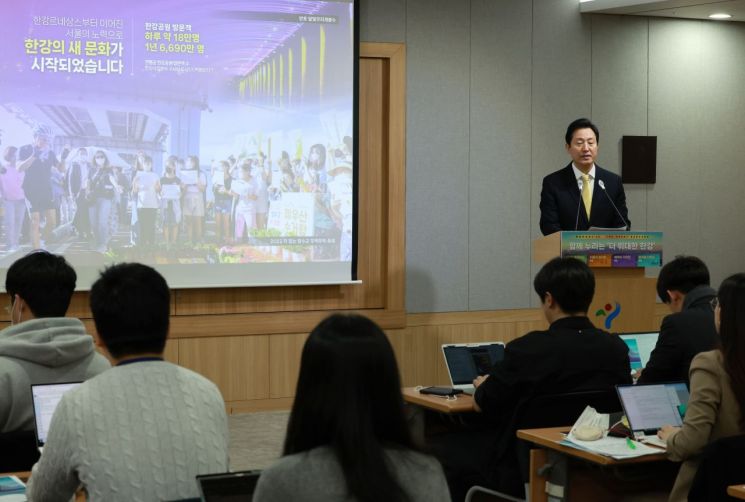
A: At that time, we only focused on the main stream of the Han River. But in Han River Renaissance 2.0, four major tributaries?Anyangcheon, Tancheon, Hongjecheon, and Jungnangcheon?will be transformed with the same concept as the Han River. Spaces for leisure and life will be evenly distributed across 25 autonomous districts.
Q: Large-scale construction projects incur enormous costs. What is the total cost, and can profitability be guaranteed?
A: Budget is always an issue for any project. Much of the projects we are currently promoting, such as the Seoul Ring, are likely to be private ventures. They will not require Seoul city’s budget. Like Sebitseom, we plan to structure them with as much private investment as possible.
When we researched the profitability of the London Eye in the UK for the Seoul Ring project, it was extremely profitable. The investment of 158 billion KRW was fully recovered in three years. We expect Seoul Ring to be similar. The number of tourists visiting Seoul will increase significantly. We anticipate fierce competition among private investors, which will be a pleasant challenge in selecting partners.
Q: The second Sejong Center for the Performing Arts will be located in Yeouido instead of Mullae-dong. How will the Mullae-dong site be utilized?
A: (Hong Seon-gi, Seoul City Future Space Planning Director) Initially, the second Sejong Center was planned for Mullae-dong. However, after Mayor Oh’s inauguration in September last year, it was pointed out that the Mullae-dong site is surrounded by large apartment complexes and the land area is limited. Therefore, it was deemed more appropriate to locate it in Yeouido, which is being developed as an international financial center. The Mullae-dong site is being prepared by Yeongdeungpo District Office for use as a cultural and arts center.
Q: Has the location and route of the gondola been decided?
A: (Yeo Jang-kwon, Director of Seoul City Balanced Development Headquarters) Currently, several locations along the Han River are being considered for the gondola. The route has not yet been finalized. Many proposals have been submitted for a route from Ttukseom toward Tancheon. We are reviewing the economic feasibility and private investment eligibility for that route. We estimate the route will be about 1.6 km from Ttukseom to Jamsil. Considering the speed of 4 to 5 meters per second, it is expected to transport around 2,000 people per day. Currently, transferring by public transportation from Jamsil Main Stadium to Ttukseom Amusement Park takes 30 minutes, but by gondola, it will take only 5 to 6 minutes.
Q: To promote Han River Renaissance 2.0 as a private investment project, profitability must be guaranteed. I understand Sebitseom has accumulated deficits for quite some time. Will there be companies willing to participate under these circumstances?
A: (Yoo Chang-soo, Seoul City Deputy Mayor for Administration) In private investment projects, profitability depends on who operates them. Sebitseom’s food and beverage operations are complex, but Seoul Ring will have a simple admission fee system. We believe there will be companies willing to participate.
Q: Will the 15-floor height restriction on main buildings along the Han River waterfront be lifted? Will a three-dimensional pedestrian bridge connecting Apgujeong and Seongsu-dong be installed?
A: (Jo Nam-jun, Director of Seoul City Urban Planning Bureau) As stated in the city master plan, the 35-floor height restriction has been lifted. The 15-floor height limit on main buildings along the Han River waterfront was previously a recommendation but has become widely recognized. Recently, through rapid integrated planning, we plan to review it flexibly according to regional characteristics.
The Apgujeong pedestrian bridge was proposed by residents pushing for redevelopment. It has not yet been decided how to accommodate it or whether to implement it through public contributions.
© The Asia Business Daily(www.asiae.co.kr). All rights reserved.
![Clutching a Stolen Dior Bag, Saying "I Hate Being Poor but Real"... The Grotesque Con of a "Human Knockoff" [Slate]](https://cwcontent.asiae.co.kr/asiaresize/183/2026021902243444107_1771435474.jpg)


















