Increased Activities Due to COVID-19 as the Cause
The National Fire Agency announced on the 9th the analysis results of ‘ambulance activity time,’ comparing the number of patient transports by 119 ambulance teams before and after the COVID-19 pandemic (over the past four years).
Last year, the number of patients transported by 119 ambulance teams was 1.99 million, and the average ‘ambulance activity time’?the time from receiving a 119 call to returning to the 119 safety center?was 69 minutes. Compared to 2019, before COVID-19, the number of transports increased by 7.3%, and the ‘ambulance activity time’ rose by 19 minutes (38%).
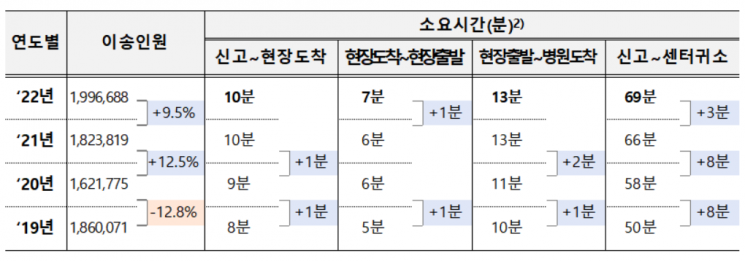
Looking at the graph of the time from 119 call receipt to hospital arrival over the past four years, 2019 showed a gradual steady trend, but in 2020, there was a sharp increase. In particular, in March 2022, when the Omicron variant pandemic caused the highest number of confirmed patient transports, the average ambulance activity time extended to 80 minutes. This indicates that transport times fluctuate depending on the spread of COVID-19 and the scale of confirmed patient transports.
Last year, the hospital transport times for the four major severe emergency patients?cardiac arrest, severe trauma, cardiovascular disease, and cerebrovascular disease?also increased significantly compared to 2019, before COVID-19: ▲cardiovascular disease (26 minutes), ▲cerebrovascular disease (24 minutes), ▲severe trauma (23 minutes), ▲cardiac arrest (16 minutes), reflecting that symptoms of severe patients such as respiratory distress are similar to those of COVID-19 patients, and that quarantine-focused treatment guidelines had a considerable impact.
Accordingly, the National Fire Agency is continuously monitoring delays in transporting severe emergency patients and is preparing countermeasures. First, they are standardizing severity classification guidelines between 119 ambulance teams and emergency medical institutions to reorganize the transport system by distributing patients according to severity to hospitals of appropriate levels. To this end, the National Fire Agency, Ministry of Health and Welfare, and medical community are jointly cooperating to introduce a ‘pre-hospital severity classification system’ where 119 paramedics classify patient severity on-site.
Additionally, in close consultation with the Ministry of Health and Welfare, they are establishing grounds to allow ambulance teams to prioritize transporting critically ill emergency patients to the nearest capable hospital, even when hospitals face difficulties accepting patients.
Furthermore, based on regional emergency medical resource information, each provincial fire headquarters plans to establish ‘regional emergency transport guidelines’ that consider local medical environments to promptly select and transport patients to appropriate medical institutions.
Nam Hwayeong, Acting Commissioner of the National Fire Agency, stated, “Although ambulance personnel have faced various difficulties in their activities since COVID-19, they are faithfully performing their duties with the determination to save precious lives,” and added, “We will continue to do our best to ensure the safety of ambulance personnel at disaster sites and to enhance the quality of 119 ambulance services.”
© The Asia Business Daily(www.asiae.co.kr). All rights reserved.
![Clutching a Stolen Dior Bag, Saying "I Hate Being Poor but Real"... The Grotesque Con of a "Human Knockoff" [Slate]](https://cwcontent.asiae.co.kr/asiaresize/183/2026021902243444107_1771435474.jpg)
















