The Lukewarm Japanese Government, Even Locals Say "Don't Know the Details"
The ripple effects surrounding the South Korean government's announced solution for compensating victims of forced labor during the Japanese colonial period, based on the 'third-party payment' method, continue to unfold. The victims and civic groups strongly oppose it, and the political sphere is also engaged in disputes over the appropriateness of the government's solution.
On the other hand, the Japanese government has been lukewarm, showing little enthusiasm for the South Korean government's announcement. This contrasts with President Yoon Suk-yeol's characterization of Japan as a "partner sharing common values" and his emphasis on improving Korea-Japan relations.
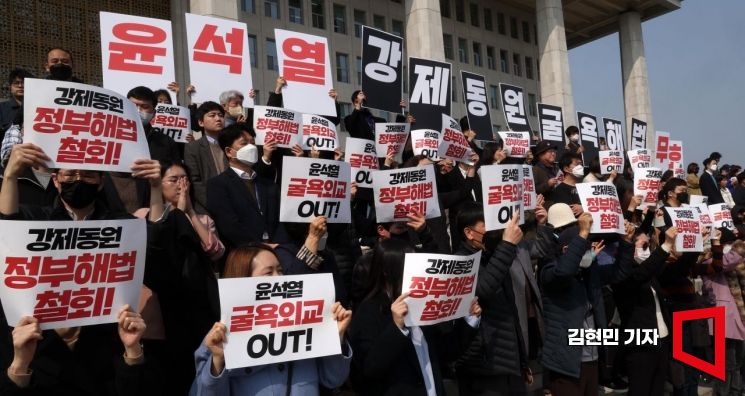 On the 7th, participants held up placards at an emergency press conference urging Japan to apologize and compensate, condemning the forced mobilization compensation solution, held on the stairs in front of the National Assembly Main Building in Yeouido, Seoul. Photo by Hyunmin Kim kimhyun81@
Japanese Prime Minister Fumio Kishida stated on the 6th regarding the government's compensation solution for forced labor victims, "Regarding historical awareness, we have comprehensively inherited the positions of successive cabinets and will continue to do so in the future."
Although he did not specify which historical awareness he referred to, it was interpreted as a commitment to uphold the 1998 "Kim Dae-jung?Obuchi" Joint Declaration, which contains reflection and apology for Japan's colonial rule. Prime Minister Kishida did not directly mention expressions of reflection and apology.
Japanese Foreign Minister Yoshimasa Hayashi also said, "The Japanese government has comprehensively inherited the positions of successive cabinets regarding historical awareness, including the 1998 declaration," and "We expect South Korea to steadily implement compensation measures for forced labor." This is interpreted in a similar context to Prime Minister Kishida's remarks. The phrase "South Korea... will steadily implement" is also interpreted by some as implying that Japan no longer bears responsibility to be involved in the compensation issue.
Compared to the significant controversy over the forced labor compensation solution within South Korea, it has been reported that Japanese public opinion has shown little reaction to the related news.
Yoshikata Beki, a senior researcher at the Seoul National University Language Proficiency Measurement Center and a Japanese resident in South Korea, conveyed the domestic atmosphere in an MBC radio interview on the 8th, saying, "'Forced labor' is frequently mentioned in the news and is a topic of discussion, but there is little interest in what it actually entails."
He said, "Among the various events during the war and colonial rule period, it is perceived as just one of those things, like 'that might have happened too.' Although there are individual differences, especially young people do not know well what happened during the colonial period."
Researcher Yoshikata pointed to Japan's history education and media coverage as the background for this indifference. He explained, "In Japan, history was not a compulsory subject in high school. Although the Japanese government changed modern history to a compulsory subject starting last year, there were still many students who had never properly studied history until then."
He also said, "During the Abe administration in 2014, there was a report by the Asahi Shimbun on comfort women, but due to strong backlash against the report, it was corrected and such incidents occurred. Since then, the media has become very restrained. There is a strong atmosphere that reports opposing national interests and representing the Korean position should be avoided."
Criticism of the Japanese government's response also appeared in local media. The Tokyo Shimbun, in an editorial on the 7th, stated, "Given the strong opposition from plaintiffs and Korean public opinion regarding the forced labor compensation lawsuits, it is difficult to realize without contributions from the Japanese side," emphasizing that "active cooperation from the Japanese government and defendant companies is essential for improving Korea-Japan relations."
The outlet also added, "The Japanese government should not forget a humble attitude facing the past and must more clearly express feelings of reflection and apology."
© The Asia Business Daily(www.asiae.co.kr). All rights reserved.
![Clutching a Stolen Dior Bag, Saying "I Hate Being Poor but Real"... The Grotesque Con of a "Human Knockoff" [Slate]](https://cwcontent.asiae.co.kr/asiaresize/183/2026021902243444107_1771435474.jpg)















