Seoul City Reveals Plans for Seoul Ring Creation and Promotion
To Be Established at Sky Park in Sangam-dong, Mapo-gu
Design Features a Fleshless Ring Shape Approximately 180m in Diameter
The Seoul Metropolitan Government will construct the world’s largest Seoul-style Ferris wheel, ‘Seoulling,’ at Haneul Park in Sangam-dong, Mapo-gu. The project will be carried out as a private investment initiative, with full-scale construction planned to begin in 2025.
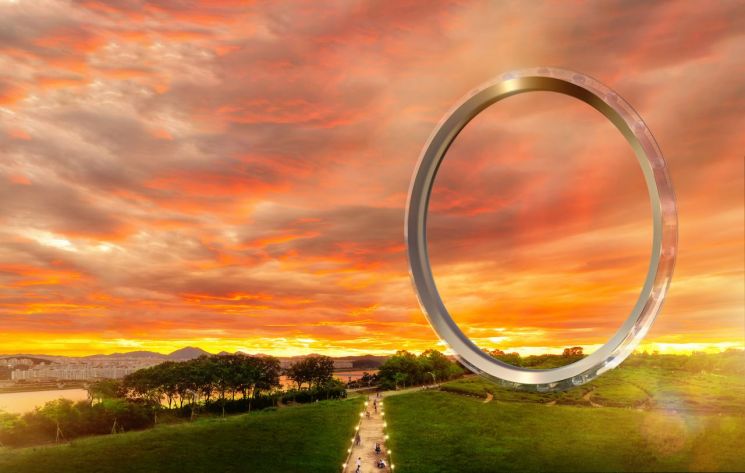
On the 8th, the city announced the details of the Seoulling construction and its specific implementation plans. Earlier, on the 3rd, Seoul Mayor Oh Se-hoon revealed at the Spring Meeting of the Diplomatic Corps in Korea that Seoulling, one of the key projects of the ‘Hangang Renaissance 2.0,’ would be built at Haneul Park in Sangam-dong.
Since October last year, Seoul has been deliberating on the location for the Ferris wheel. Following the main principle that ‘the view from the Hangang River and the scenery seen from the Ferris wheel should become representative landscapes of Seoul,’ various candidate sites were reviewed, including Haneul Park in Sangam-dong, Nodeul Island, Yeouido Park, the Water Supply Materials Center, and Jamsil.
Hong Seon-gi, Seoul’s Future Space Planning Officer, said regarding the site selection, “After considering accessibility, surrounding tourism infrastructure, views, landmark status, and balanced development, we conducted a final review focusing on Nodeul Island, which has well-established surrounding infrastructure, and Haneul Park, which has the best views and symbolism.” He added, “Among these, Haneul Park was finally selected for its symbolism as a gateway to Seoul and for promoting North-South harmony.” Nodeul Island, which was also considered, is the only site located within the Hangang River near Yongsan, but it was excluded after comprehensively considering the overlap with the ongoing Nodeul Art Island development project.
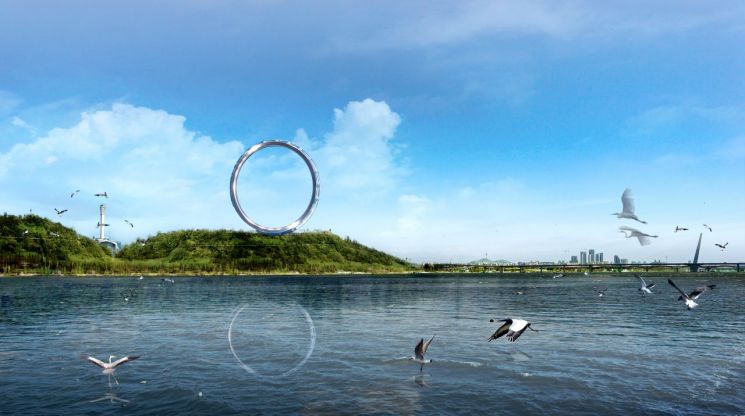
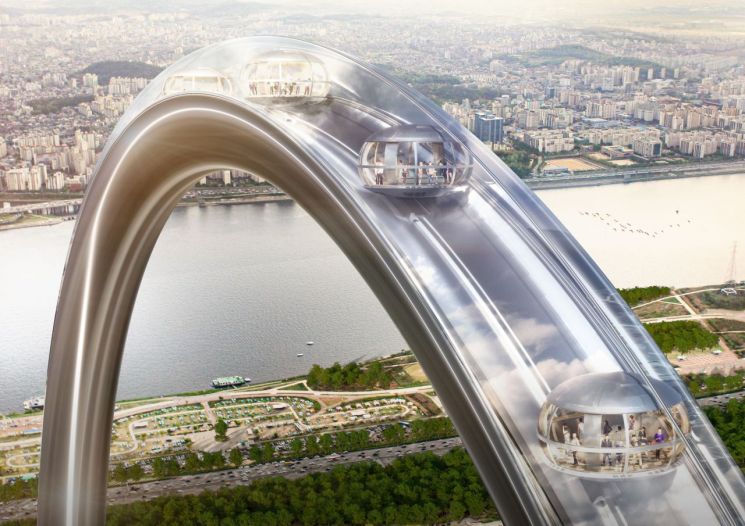
The Seoulling to be constructed at Haneul Park will depart from the traditional spoke design and adopt a spoke-less ring-shaped design approximately 180 meters in scale. The city stated that to ensure structural stability, domestic and international Ferris wheel design firms and major construction companies were consulted during the design review process to secure structural safety. Furthermore, the city plans to receive more advanced and creative design proposals from the private sector in the future to supplement and enhance the design.
Once completed, Seoulling will be the world’s second-largest Ferris wheel after Ain Dubai (diameter 257m), but it will be the largest in the world based on the spoke-less ring design. It will accommodate 1,474 passengers per hour, with a maximum daily capacity of 11,792 riders, and is expected to attract over 3.5 million tourists annually.
The city plans to develop Seoulling not only as a Ferris wheel but also as a complex cultural space that allows visitors to experience the historical significance of Nanji Island and offers various festivals and programs, serving as a hub for culture, tourism, and communication. Additionally, to address the current lack of public transportation connectivity, the city will gradually expand eco-friendly autonomous buses and is actively considering the installation of gondolas and inclined elevators.
The city plans to support the stable promotion of the private investment project by linking Haneul Park and the Sangam-dong area, where the Ferris wheel will be built, with public facilities such as the Mapo Petroleum Reserve Base and the Resource Recovery Facility. The goal is to proceed with construction in 2025 following administrative procedures under the ‘Private Investment in Social Overhead Capital Act’ upon submission of private business proposals.
Planning Officer Hong said, "Haneul Park is a meaningful space symbolizing Seoul’s gateway and a new gateway in the era of North-South unification, as well as a junction point geographically close to North Korea, embodying the hope for national harmony and unification. Furthermore, it aims to transform from a former landfill site into a symbol of circular economy and climate action, enhancing Seoul’s status and urban competitiveness, attracting 30 million tourists, and revitalizing the economy,” he added.
© The Asia Business Daily(www.asiae.co.kr). All rights reserved.
![Clutching a Stolen Dior Bag, Saying "I Hate Being Poor but Real"... The Grotesque Con of a "Human Knockoff" [Slate]](https://cwcontent.asiae.co.kr/asiaresize/183/2026021902243444107_1771435474.jpg)

















