Major indices on the U.S. New York Stock Exchange showed a decline early on the 7th (local time) as investors closely watched Federal Reserve (Fed) Chair Jerome Powell's congressional testimony. Powell's hawkish remarks suggesting that the terminal interest rate could be higher than previously expected caused the yield on the sensitive 2-year U.S. Treasury note to surge to its highest level since 2007.
As of 10:20 a.m. at the New York Stock Exchange (NYSE), the Dow Jones Industrial Average was up 122 points (0.37%) to around 33,309. The large-cap S&P 500 index rose 23 points (0.58%) to 4,024, while the tech-heavy Nasdaq index gained 65 points (0.56%) to 11,610.
Currently, all 11 sectors within the S&P 500 are showing declines. Real estate, materials, financials, and energy stocks are experiencing notable drops. Meta Platforms, which announced additional layoffs by sector, is trading up 1.57% compared to the previous close. WW International surged more than 34% following reports that it will acquire the subscription-based telehealth platform Sequence. Apple, which rose on a buy rating from Goldman Sachs the previous day, is down 0.7%. Rivian fell over 11% due to plans to issue $1.3 billion in bonds.
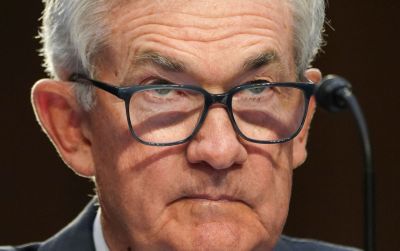
Investors are closely monitoring Powell's Senate testimony and Treasury yield movements today. Powell appeared before the Senate at 10 a.m. to deliver the semiannual monetary policy report. In his opening remarks, he stated, "Recent economic data have all come in stronger than expected," adding, "This suggests that the terminal rate may be higher than previously anticipated." He emphasized, "If the overall data require faster tightening, we are prepared to increase the pace of rate hikes," reinforcing a hawkish stance. This virtually guarantees an upward revision in the March dot plot for the interest rate path. Previously, the median year-end rate in the Fed's December dot plot was 5.1%.
Before Powell's opening remarks were released, the major New York stock indices showed mixed movements but then turned sharply lower. Since March last year, the Fed's tightening cycle has pushed U.S. interest rates to their highest levels since 2007, ranging between 4.5% and 4.75%.
In the New York bond market, Treasury yields surged sharply immediately after Powell's comments amid rising tightening concerns. The 2-year yield jumped to 4.979%, the highest since 2007, nearing the 5% mark. The benchmark 10-year yield briefly exceeded 4% before easing to around 3.98%.
However, the market is also showing caution, as Powell's remarks were largely in line with expectations, with investors awaiting the employment report later this week. Since Powell emphasized data in determining the pace of rate hikes, the upcoming February employment report and January Job Openings and Labor Turnover Survey (JOLT) are expected to play a more critical role. Major New York indices have gradually reduced their losses as Powell's Senate testimony continues. Alan Ruskin, a strategist at Deutsche Bank, noted, "Powell does not have significant new information that could firmly move the market before the next monetary policy meeting."
Therefore, the key question is whether the February employment report will follow a similar trend to January's, which exceeded expectations by nearly three times and heightened tightening concerns. February nonfarm payrolls are estimated to increase by 225,000, a slowdown from the previous month. The unemployment rate is expected to remain steady at 3.4%.
Powell will also appear before the House the following day. On the 8th, the Fed's Beige Book, which contains economic assessments, will be released. Next week, the February Consumer Price Index (CPI) and retail sales data are scheduled for release.
European stock markets showed declines. Germany's DAX index fell 0.43%. The UK's FTSE index dropped 0.05%, and France's CAC index declined 0.22%.
International oil prices fell across the board. April West Texas Intermediate (WTI) crude fell 0.55% to $80.02 per barrel, while May Brent crude dropped 0.66% to $85.63 per barrel compared to the previous close.
© The Asia Business Daily(www.asiae.co.kr). All rights reserved.
![Clutching a Stolen Dior Bag, Saying "I Hate Being Poor but Real"... The Grotesque Con of a "Human Knockoff" [Slate]](https://cwcontent.asiae.co.kr/asiaresize/183/2026021902243444107_1771435474.jpg)















