A-10 Attack Aircraft and MC-130J Special Operations Aircraft Participation
"Operational Execution Outside Base and Joint Operation Capability Assessment"
The South Korean and U.S. military authorities conducted a joint emergency runway training exercise in preparation for the destruction of air force bases. This exercise is analyzed as a response to North Korea's recent threat that it has deployed super-large multiple rocket launchers capable of striking South Korea's operational airfields.
On the 7th, the Air Force announced that it conducted a joint emergency runway takeoff and landing training exercise at the Namji emergency runway in Changnyeong County, Gyeongnam Province. About 10 aircraft from the South Korean and U.S. air forces participated in this exercise. The South Korean Air Force deployed C-130 and CN-235 transport aircraft and HH-47 helicopters, while the U.S. Air Force deployed A-10 attack aircraft, C-130J transport aircraft, and MC-130J special operations transport aircraft.
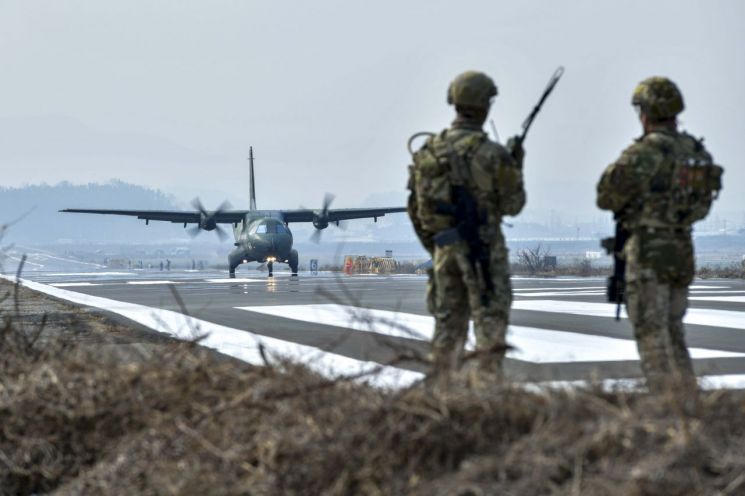 On Tuesday, March 7, the South Korean and U.S. Air Forces conducted the "ROK-U.S. Combined Emergency Runway Takeoff and Landing Exercise" at the Namji emergency runway located in Changnyeong-gun, Gyeongnam, to assess the sustained operational capability of wartime combined operations and to enhance emergency runway operation capabilities. A ROK Air Force CN-235 transport aircraft is landing on the emergency runway under the guidance and control of ROK Air Force air traffic controllers.
 [Photo by Air Force]
Choi Chun-song, commander (major general) of the Republic of Korea Air Force Air Mobility Reconnaissance Command, and Michael Martin, commander (air force brigadier general) of the U.S. Special Operations Command Korea, directly commanded the training on site and assessed the capability to conduct joint operations.
The training began with the joint air traffic controllers securing ground safety at the emergency runway. The controllers checked weather conditions, wind speed, and wind direction to determine whether landing was possible, then sent 'landing clearance' radio messages to the pilots waiting in the air. Subsequently, South Korean Air Force HH-47, C-130, CN-235, and U.S. Air Force A-10 and MC-130J aircraft approached and practiced takeoff and landing on the emergency runway.
Instead of fully landing, the aircraft alternated between a 'Low Approach' method, flying along the emergency runway at an altitude of 100 feet (about 30 meters), and fully landing on the runway and then taking off again. The U.S. Air Force MC-130J practiced landing on the emergency runway, quickly unloading supplies, and then taking off again, assessing the ability to sustain operations during wartime.
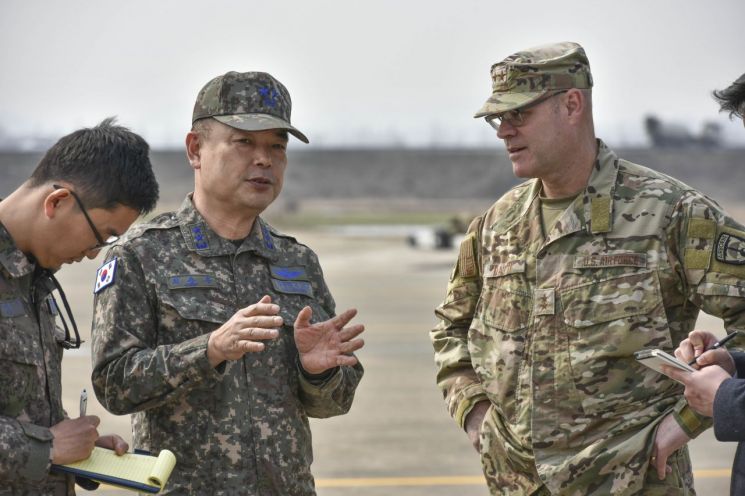 On March 7 (Tuesday), the South Korean and U.S. Air Forces conducted the "ROK-U.S. Combined Emergency Runway Takeoff and Landing Exercise" at the Namji emergency runway located in Changnyeong-gun, Gyeongnam Province, to assess the sustained operational capability of wartime combined operations and to enhance emergency runway operation capabilities. ROK Air Force Air Mobility Reconnaissance Command Commander Choi Chun-song (second from left, Major General) and U.S. Special Operations Command Korea Michael Martin (right, Air Force Major General) are discussing combined operation procedures.
 [Photo by Air Force]
Unlike regular air force bases, the emergency runway lacks navigation safety facilities such as Tactical Air Navigation (TACAN) equipment that provides necessary landing information. Pilots must rely solely on aircraft instruments and visual observation, making takeoff and landing on emergency runways much more challenging than at air force bases.
On the 20th of last month, North Korea fired two short-range ballistic missiles (SRBMs) and claimed that these missiles were 600mm super-large multiple rocket launchers, asserting that "with the explosive power of four rounds, it can paralyze the enemy's operational airfield functions and completely devastate them." Calculating the flight distance of the rocket artillery shells launched from the Sukchon area in South Pyongan Province, the strike range includes Cheongju in Chungbuk, Osan, and Gunsan in Jeonbuk. It is analyzed that the targets were set as simulated strike targets including the Cheongju F-35A base and the U.S. Air Force bases in Osan and Gunsan.
Lee Deok-hee, director of operations and training at the Air Mobility Reconnaissance Command who planned this training, said, "Emergency runway takeoff and landing training is essential to continue air operations even in locations other than air force bases," adding, "We will continue to strengthen wartime joint operation capabilities and emergency runway operation capabilities through realistic repetitive training."
© The Asia Business Daily(www.asiae.co.kr). All rights reserved.
![Clutching a Stolen Dior Bag, Saying "I Hate Being Poor but Real"... The Grotesque Con of a "Human Knockoff" [Slate]](https://cwcontent.asiae.co.kr/asiaresize/183/2026021902243444107_1771435474.jpg)
















