Funding from Korean Companies Instead of Japanese Firms... Criticism of 'Half-Measure' Forced Labor Compensation
The government has formalized a plan to compensate victims of forced labor during the Japanese occupation by using donations made by Korean companies as a form of ‘third-party payment.’ The plan excludes the participation of Japanese war crime companies in compensation and direct apologies, which were key issues.
Foreign Minister Park Jin held a press conference at the Ministry of Foreign Affairs building in Seoul on the 6th to announce this plan.
The core content is that the Forced Mobilization Victims Support Foundation under the Ministry of the Interior and Safety (hereinafter referred to as the Foundation) will pay the court-ordered compensation and delayed interest to the plaintiffs of three Supreme Court final rulings in 2018, and if the related ongoing lawsuits are confirmed in favor of the plaintiffs, it will also pay the compensation.
The funding will be raised through voluntary donations from about 16 domestic companies that benefited from the claims funds, including POSCO. These companies, which benefited from the 1965 Korea-Japan Claims Agreement, will pay the compensation on behalf of the victims through a ‘third-party payment’ method.
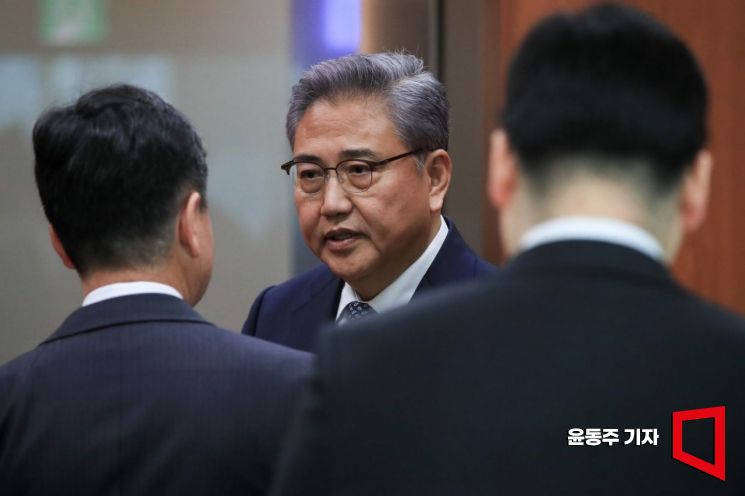 Foreign Minister Park Jin is talking with government officials after announcing the solution for compensation for forced labor victims during Japanese colonial rule on the 6th at the Ministry of Foreign Affairs in Jongno-gu, Seoul. Photo by Dongju Yoon doso7@
Minister Park Jin: “We must develop Korea-Japan relations in a future-oriented way”
There are 15 victims who received final compensation rulings from the Supreme Court. They belong to three groups: victims who worked at Nippon Steel, victims who worked at Hiroshima Mitsubishi Heavy Industries, and victims of the Nagoya Mitsubishi forced labor corps. The compensation they are to receive, including delayed interest, amounts to about 4 billion KRW.
Regarding the purpose of this announcement, Minister Park said, “Based on the close friendly cooperative relationship built between the two countries since the normalization of diplomatic relations in 1965, we have the will to develop Korea-Japan relations to a higher level in a future-oriented manner.”
He also stated, “We hope that Korea and Japan will jointly strive to progressively inherit the 21st Century New Korea-Japan Partnership Joint Declaration (the Kim Dae-jung?Obuchi Joint Declaration) announced in October 1998, overcome the unfortunate history of the past, and develop a future-oriented relationship based on reconciliation and friendly cooperation.”
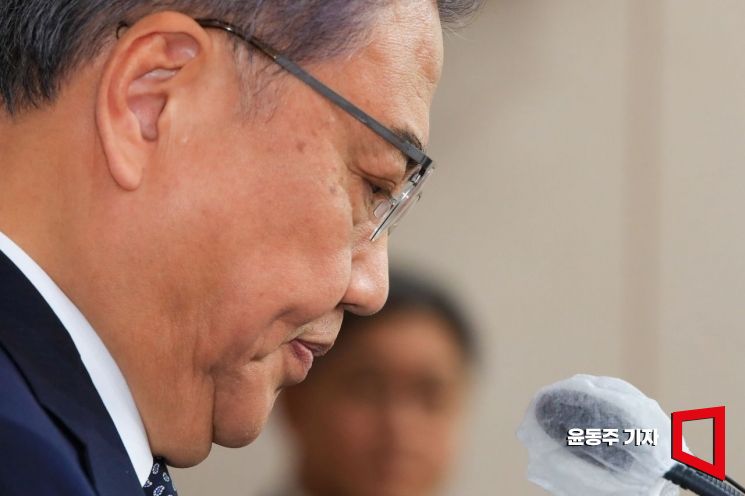 Foreign Minister Park Jin is announcing a solution for compensation for forced labor victims during Japanese colonial rule on the 6th at the Ministry of Foreign Affairs in Jongno-gu, Seoul. Photo by Dongju Yoon doso7@
Half-hearted criticism ignites... Minister Park: “It will be fulfilled depending on Japan’s response”
However, criticism that the government’s announcement is a hasty solution is strong. Although Korea and Japan held consultations at the director-general, vice minister, and minister levels, they failed to narrow differences, and the plan did not include the participation of war crime companies in compensation to the victims’ foundation, which Korea had consistently demanded.
In response to a question at the press conference about criticism that the compensation plan is ‘half-hearted,’ Minister Park said, “I do not agree with that. I think the glass is half full. Depending on Japan’s sincere response, the glass will be filled more.”
Minister Park said, “We expect Japan to offer a comprehensive apology and voluntary cooperation from companies in response to the government’s grand decision to find a breakthrough in the strained Korea-Japan relations,” adding, “I do not think receiving a new apology from Japan regarding past history is the best solution.” He also added that he understands that the two countries’ business sectors are considering ways to contribute voluntarily.
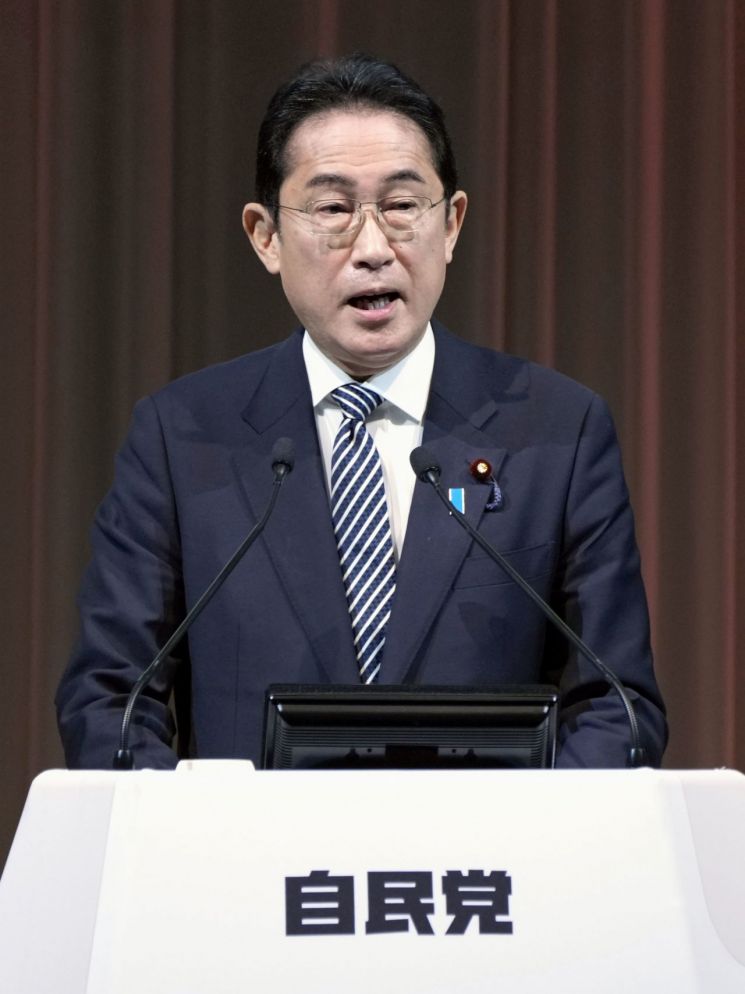
Japan’s historical awareness: “We have generally inherited the positions of successive cabinets”
Japan showed a positive response to the Korean government’s announcement of the forced labor solution plan. Japanese Prime Minister Kishida Fumio said regarding the forced labor compensation issue during the Japanese colonial period, “Coordination between the diplomatic authorities of the two countries is underway,” and “Regarding historical awareness, we have generally inherited the positions of successive cabinets and will continue to do so appropriately.”
At the Upper House Budget Committee in the morning, Prime Minister Kishida responded to a question from LDP Upper House member Sato Masahisa about Korea-Japan relations by saying this and added, “It is important to continue to appropriately express and communicate the government’s position.” This is interpreted as expressing the intention to inherit the 1998 ‘Kim Dae-jung?Obuchi Joint Declaration,’ which contains sincere reflection on colonial rule and an apology from the heart.
Regarding the lifting of semiconductor material export restrictions to Korea and the re-designation of Korea as a preferential export management country, he said, “I understand that we requested Korea to take appropriate measures, including the suspension of the World Trade Organization (WTO) dispute resolution process initiated by Korea.”
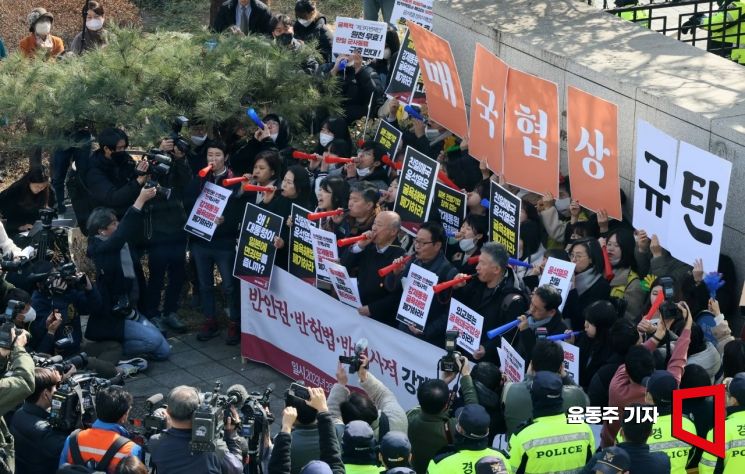 Members of the Korea-Japan Historical Justice and Peace Action held a press conference on the 6th in front of the Ministry of Foreign Affairs building in Jongno-gu, Seoul, criticizing the government's solution for compensation for forced labor victims. The government announced a forced labor solution centered on a 'third-party compensation' plan, in which the 'Foundation for Supporting Victims of Forced Mobilization under Japanese Rule' (Support Foundation) uses funds contributed by 16 domestic companies, including POSCO, that benefited from the Korea-Japan Claims Agreement, to compensate the victims on their behalf. Photo by Yoon Dong-joo doso7@
Victims’ groups: “Serious historical regression... granting impunity to a war crime country”
However, victims’ groups immediately reacted negatively to the results. The Korea-Japan History Justice and Peace Action held a rally in front of the Ministry of Foreign Affairs in the morning titled “Condemning the enforcement of the humiliating forced mobilization solution that is anti-human rights, anti-constitutional, and anti-historical.” An emergency candlelight vigil is also scheduled in Seoul Plaza in the afternoon. The Forced Mobilization Citizens’ Association and Gwangju Jeonnam History Justice and Peace Action also held a press conference in front of the May 18 Democratic Square in the afternoon on the same day. They are expected to strongly condemn the government’s solution plan. Grandmother Yang Geum-deok, a forced mobilization victim, will also attend.
The victim support organization Justice and Memory Solidarity issued a statement saying, “It grants impunity to a war crime country and war crime companies,” and criticized, “It has committed a serious historical regression that once again hinders future generations based on a tragic historical awareness.” Regarding the Japanese government’s apology at the level of inheriting the ‘Kim Dae-jung?Obuchi Declaration,’ it said, “It is far from acknowledging specific responsibility for Japan’s inhumane illegal acts or apologizing for forced mobilization,” and added, “This government compensation plan is a blunder worse than the 2015 Korea-Japan comfort women agreement, as it fully accepts the claims of the Japanese right-wing and government.”
© The Asia Business Daily(www.asiae.co.kr). All rights reserved.
![Clutching a Stolen Dior Bag, Saying "I Hate Being Poor but Real"... The Grotesque Con of a "Human Knockoff" [Slate]](https://cwcontent.asiae.co.kr/asiaresize/183/2026021902243444107_1771435474.jpg)


















