Korea Federation of SMEs Holds Press Briefing
Announces Policy Tasks for Year 2 of Yoon Administration
Emphasizes Voluntary Win-Win Cooperation Between Large Corporations and SMEs
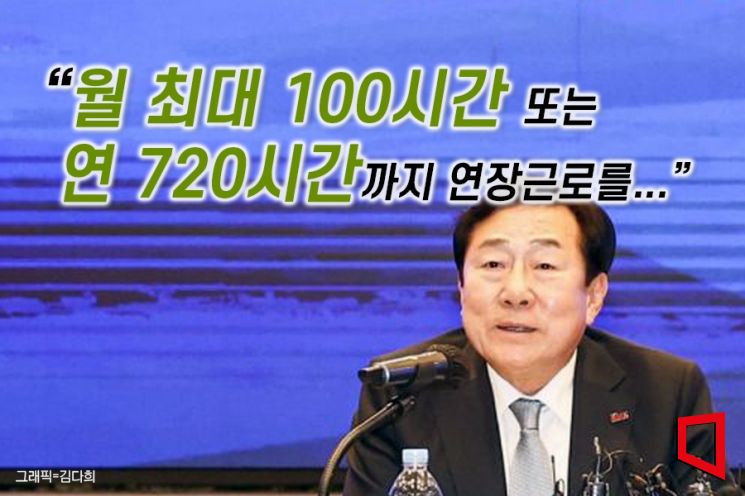
Kim Ki-moon, Chairman of the Korea Federation of SMEs, argued that "when the workload surges, the system should be improved to allow extended working hours of up to 100 hours per month or 720 hours per year."
On the day, Chairman Kim held a press conference at the Federation of SMEs in Yeouido, Seoul, and announced the "Second Year Policy Tasks for SMEs under the Yoon Seok-yeol Administration." He presented six key areas that the government should pursue to restore the dynamism of small and medium-sized enterprises.
The six areas are △ promoting employment-friendly labor reforms △ establishing a culture of coexistence between large and small-medium enterprises △ promoting SME growth and investment △ advancing SME financial policies △ revitalizing SME exports △ and transforming cooperatives into growth platforms for SMEs.
In particular, regarding labor reform, he proposed flexibilization of the 52-hour workweek system, permanent application of an additional 8-hour extended work system, and abolition of the foreign worker quota system.
Earlier that day, the government announced plans to reform the 52-hour workweek system by expanding extended working hours from a 'weekly' basis to a 'monthly' or longer basis. Chairman Kim welcomed the government's announcement but stated, "From the perspective of small and micro enterprises, additional improvements are needed to allow extended working hours of up to 100 hours per month or 720 hours per year, similar to Japan, when the workload surges."
He said, "It is really frustrating why workers who want to work cannot do so and have to take on second jobs," adding, "Both companies and workers hope for an environment where they can work more."
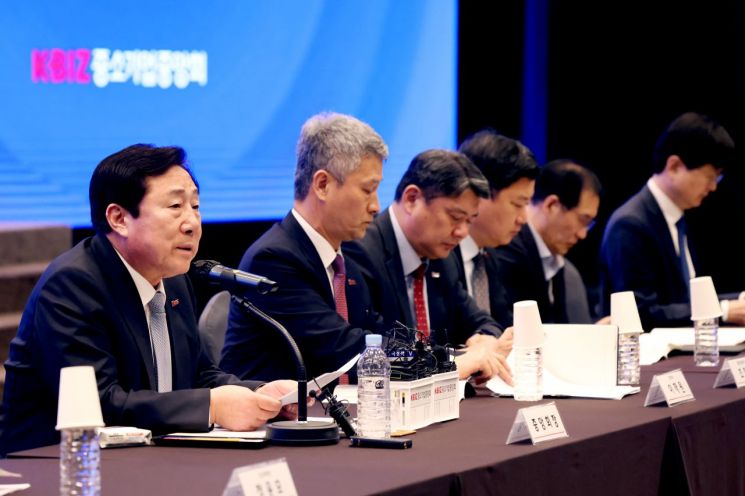
He mentioned the necessity of coexistence between large and small-medium enterprises and again cited Japan as an example. Chairman Kim said, "Japanese department stores protect traditional markets by distinguishing the products they sell from those in the traditional markets," and "when a traditional market festival is held, the department stores even advertise it."
He continued, "It would be good if economic activities were conducted with the mindset that large enterprises do well when SMEs do well, and SMEs do well when large enterprises do well."
Regarding the delivery price linkage system, which will be fully implemented from the second half of this year, Chairman Kim also urged large enterprises to voluntarily practice coexistence. He described the clause that exempts the need to include delivery price linkage matters in agreements if the consignor and consignee agree not to link as "a sign of harmony."
He said, "Although it is called a harmful clause unfavorable to SMEs, we included it in the law as a gesture of harmony," and added, "I hope many large enterprises will voluntarily take the lead in coexistence."
Meanwhile, the Federation of SMEs announced the results of a survey conducted from May 17 to 28 targeting 500 SMEs.
In this survey, SME owners identified the most urgent issues facing the Korean economy as a rigid labor market (34.0%), worsening low birthrate and aging population (20.8%), and excessive regulations (19.4%).
The pressing difficulties faced by SMEs (multiple responses allowed) included rising raw material prices (47.0%), worsening labor shortages (46.4%), and increasing labor costs (39.8%).
© The Asia Business Daily(www.asiae.co.kr). All rights reserved.
![Clutching a Stolen Dior Bag, Saying "I Hate Being Poor but Real"... The Grotesque Con of a "Human Knockoff" [Slate]](https://cwcontent.asiae.co.kr/asiaresize/183/2026021902243444107_1771435474.jpg)

















