Core inflation still maintains 4% range
Expectations of inflation also rising this year
With consumer prices slowing down in February, attention is focused on the direction of the Bank of Korea's monetary policy, which kept the base interest rate unchanged last month. If, as the Bank of Korea expected, consumer prices fall to the 4% range last month and the inflation slowdown becomes more evident this month, it could provide grounds to maintain the current rate-hold stance. However, uncertainties surrounding monetary policy are expected to continue due to various domestic and international factors such as the U.S. Federal Reserve's (Fed) monetary policy, China's reopening effects, and public utility rates.
On the 6th, the Bank of Korea held a 'Price Situation Review Meeting' and stated, "The consumer price inflation rate in February decreased compared to the previous month due to falling prices of petroleum products and livestock products, which generally aligns with the expectations at the Monetary Policy Board meeting last month." Lee Hwan-seok, Deputy Governor, said, "The core inflation rate (excluding food and energy) continued to show a slowdown in the rise of rent and dining-out prices but only slightly decreased compared to the previous month," adding, "The consumer price inflation rate in March is likely to drop significantly due to the base effect from last year's sharp rise in international oil prices."
The Bank of Korea expects consumer prices to continue rising above the annual target level (2%) but to maintain a slowing trend. For now, the Bank of Korea feels somewhat relieved as consumer prices fell to the 4% range for the first time in 10 months. If the inflation slowdown becomes clear, it would provide the Bank with grounds to continue holding the base interest rate steady. Following last month's Monetary Policy Board meeting, Governor Lee Chang-yong forecasted at a press conference, "In March, the base effect from last year's sharp rise in international oil prices will significantly lower the consumer price inflation rate to the 4% range, and by the end of the year, it will show a level in the low 3% range."
However, uncertainties surrounding inflation remain, leaving monetary policy in a fog. It is still too early to be reassured about inflation. In particular, core inflation excluding food and energy remains stubbornly above 4%, and inflation expectations rose again in February to 4%, driven by recent increases in electricity and city gas rates, which have a strong impact on consumers this year. Lee Jung-ik, head of the Bank of Korea's Price Trends Team, explained, "Core inflation has strong persistence and tends to change more slowly than the consumer price index," adding, "Even if consumer prices fall, the pace of core inflation slowdown may be slower."
Uncertainty surrounding the U.S. Federal Reserve's base interest rate decisions is also a major variable in monetary policy. Ahead of the Fed's Federal Open Market Committee (FOMC) regular meeting scheduled for March 21-22, forecasts on the size of the rate hike are divided. While a 0.25 percentage point increase is more favored than a 0.50 percentage point hike, expectations that the U.S. will maintain tighter monetary policy at a higher level for longer are increasing, adding pressure. The current interest rate gap between Korea and the U.S., which has widened to 1.25 percentage points, could potentially expand to as much as 2 percentage points in the future.
Concerns also arise as China set its economic growth target lower than market expectations this year, increasing economic uncertainty. On the 5th, Chinese Premier Li Keqiang announced China's economic growth target for this year as "around 5%" reflecting export slowdown and weakening consumption. Kim Jung-sik, Emeritus Professor of Economics at Yonsei University, said, "From Korea's perspective, which expects effects from China's reopening, the lower-than-expected growth forecast for China is not a positive signal," adding, "The slowdown in inflation and growing concerns over export sluggishness support the case for maintaining the interest rate, but uncertainties about U.S. monetary policy and the scale of public utility rate hikes in the second half of the year also increase. The Bank of Korea, which must consider both the economy and inflation simultaneously, will continue to face challenges in its monetary policy decisions."
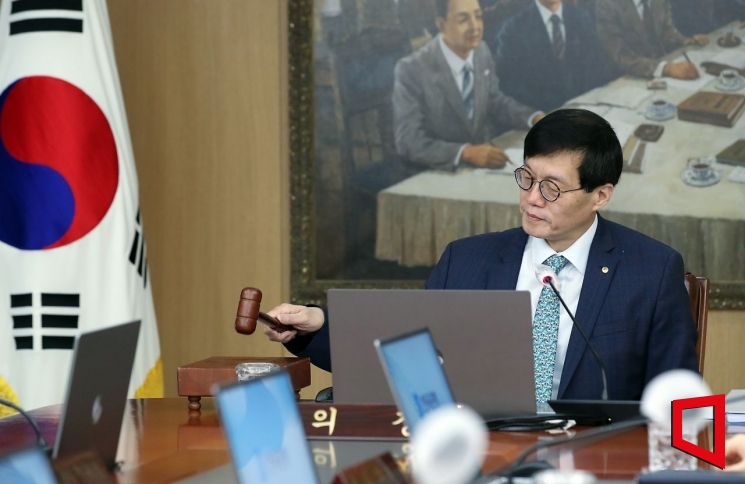 Lee Chang-yong, Governor of the Bank of Korea, is striking the gavel at the regular Monetary Policy Committee meeting held at the Bank of Korea in Jung-gu, Seoul on the 23rd. Photo by Joint Press Corps
© The Asia Business Daily(www.asiae.co.kr). All rights reserved.
![Clutching a Stolen Dior Bag, Saying "I Hate Being Poor but Real"... The Grotesque Con of a "Human Knockoff" [Slate]](https://cwcontent.asiae.co.kr/asiaresize/183/2026021902243444107_1771435474.jpg)















