80% of Business Activities and Competitiveness 'Will Be Helpful'
The Korea Chamber of Commerce and Industry conducted a survey on the 'Government Labor Market Reform Corporate Opinions' targeting 502 companies on the 6th, and the results showed that companies expect that if the flexibilization of working hours and the reform of the wage system, which are being promoted as the first step of labor reform, are implemented, it will have a positive impact on corporate management and employment.
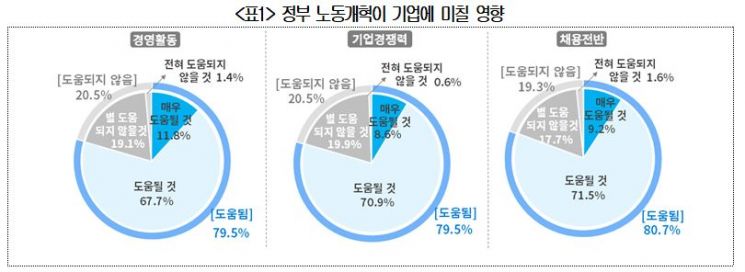
79.5% of the responding companies answered that if labor reform centered on the flexibilization of working hours and the reform of the wage system is completed, it will help corporate management activities and enhance corporate competitiveness. In addition, 80.7% of companies believed it would also help the hiring market, including new recruitment and employment stability.
Among the working hours reform plans announced by the government, the most needed improvement by companies was 'Expansion of the extended working hours operation cycle (1 week → month, quarter, half-year, year)' (45.0%), followed by 'Extension of the settlement period for the selective working hours system (1 month → 3 months)' (32.9%). Next were 'Change of the consent subject for the introduction of flexible working hours system (from all employee representatives → representatives of the relevant occupation/job group)' (16.9%), 'Introduction of working hours savings account system' (15.1%), 'Establishment of working hours recording and management practices' (14.9%), and 'Exemption of working hours application for high-income and professional workers' (10.8%).
However, the business community pointed out that health protection measures such as the 11-hour continuous rest system and the 64-hour weekly limit, which are being promoted together with the expansion of the extended working hours operation cycle, should be made more flexible to enhance the effectiveness of the system reform.
An official from the Korea Chamber of Commerce and Industry said, "We agree on reforming the extended working hours operation unit to expand the autonomy of working hours, but enforcing the 11-hour continuous rest time system for health protection rather diminishes the effect of the reform." He emphasized, "Even if the continuous rest time system is introduced, if labor and management agree, there should be an exemption clause allowing other health protection measures suitable for the company's situation instead of the continuous rest time system."
Key Tasks of Labor Reform... Rational Labor-Management Relations, Labor Market Flexibility, and Safe Industrial Sites
As the most urgent labor reform task that the government should pursue, 53.0% of companies chose 'Establishment of rational labor-management relations.' This was followed by 'Enhancement of labor market flexibility' (41.0%), 'Establishment of safe industrial sites' (37.1%), and 'Resolution of the dual structure of the labor market' (15.1%).
Specifically, as a key task for establishing rational labor-management relations, 'Establishment of laws and principles against illegal and unfair acts' (49.4%) was chosen the most, followed by 'Allowing replacement work during strikes' (31.5%), 'Enhancing union accounting transparency' (29.5%), and 'Complete prohibition of workplace occupation' (24.3%).
Next, regarding the enhancement of labor market flexibility, the current government’s initiatives of 'Flexibilization of working hours' (63.9%) and 'Reform of the wage system' (44.2%) were identified as key tasks. This was followed by 'Relaxation of regulations on fixed-term and dispatched workers' (18.3%) and 'Easing rigidity in dismissal of low performers' (12.0%).
Regarding the establishment of safe industrial sites, 'Strengthening workers' safety awareness and compliance obligations' (47.0%) and 'Improvement of safety management laws and systems focused on punishment' (43.8%) were cited as key tasks. This was followed by 'Establishment of safety systems centered on small and vulnerable workplaces' (31.1%) and 'Strengthening employers' safety awareness and compliance obligations' (27.1%).
For resolving the dual structure problem of the labor market, 'Implementation of equal pay for equal work' (45.4%) was chosen as the core task, followed by 'Resolution of wage arrears and compliance with labor laws' (28.5%), 'Resolution of unfair transactions between prime contractors and subcontractors' (27.3%), and 'Elimination of social insurance blind spots' (22.7%).
Yoo Il-ho, head of the Employment and Labor Policy Team at the Korea Chamber of Commerce and Industry, said, "The core of labor reform is the advancement of labor-management relations, but if legislation such as the Yellow Envelope Act undermines labor-management competitiveness and increases uncertainty and confusion in industrial sites, it could result in losing quality jobs overseas." He emphasized, "Labor-management laws should be improved to meet global standards, such as allowing replacement work during strikes and completely prohibiting workplace occupation."
© The Asia Business Daily(www.asiae.co.kr). All rights reserved.
![Clutching a Stolen Dior Bag, Saying "I Hate Being Poor but Real"... The Grotesque Con of a "Human Knockoff" [Slate]](https://cwcontent.asiae.co.kr/asiaresize/183/2026021902243444107_1771435474.jpg)















