The Bank of Korea Expects Potential Growth Rate to Fall Below 2010 Levels
Need to Increase Economic Participation of Women and Foreigners
The annual increase in the number of employed persons, which averaged 340,000 in the 2010s, is expected to shrink significantly to about 100,000 per year over the next five years due to factors such as the slowdown in labor supply growth caused by changes in population structure.
On the 5th, Park Yang-su, Director of Economic Research at the Bank of Korea, and Kim Do-wan, Head of the Macroeconomic Research Office, posted an article titled "What is the Trend of Employment Numbers in Our Country?" on their blog, estimating that the increase in the number of employed persons will further shrink to around 100,000 this year, and over the next five years (2023?2027), the annual increase will fall to between 70,000 and 120,000.
Last year, the number of employed persons surged by 820,000 compared to the previous year due to the domestic reopening (resumption of economic activities), but the growth gradually slowed, dropping to 410,000 in January this year. The increase this year is expected to be around 100,000.
According to the report, the projected increase in the number of employed persons over the next five years is 70,000 when estimated based on data including the COVID-19 period, which had high short-term volatility, and 120,000 when based on data excluding the COVID-19 period. In particular, the increase in employment, which has been slowing since mid-last year, is expected to converge to around 100,000 in the near future.
Director Park explained, "Even if the year-on-year increase in the number of employed persons soon falls to around 100,000, it should be understood that this is more likely due to the slowdown in the labor supply growth trend caused by changes in population structure rather than a lack of job creation."
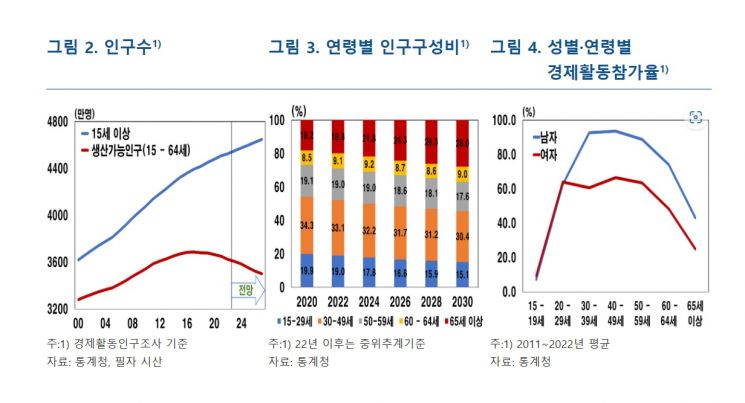
This significant decrease in the increase of employed persons is partly due to changes in population structure. In Korea, the growth of the population aged 15 and over is slowing due to the intensification of low birth rates. The working-age population (ages 15?64) has been declining since 2018 as the baby boom generation reaches retirement age.
Moreover, even among those aged 15 and over, the willingness to participate in economic activities, i.e., the economic activity participation rate, affects employment trends. This participation rate varies among youth, middle-aged, and elderly groups, and also differs between men and women due to childcare and household responsibilities. Recently, improvements in the health status of the elderly and insufficient retirement preparation have contributed to a continuous increase in the economic activity participation rate among the elderly. The rise in women's education levels, expansion of self-realization desires, and reduction of the gender wage gap have collectively led to a significant increase in women's economic activity participation rates.
The reduction in the increase of employed persons is linked to a decline in potential growth rate, as potential growth is determined by labor supply, capital, and total factor productivity. According to the Bank of Korea, Korea's potential growth rate during 2023?2027 will be lower than in the late 2010s.
Kim explained, "If we want to raise the potential growth rate by about 0.2 percentage points during this period, it is estimated that employment promotion measures such as increasing women's economic activity participation and expanding the utilization of foreign labor will need to increase the number of employed persons by 80,000 to 100,000 annually above the baseline level." He emphasized, "Considering the critical importance of employment trends in formulating and operating economic policies, research in this area should be conducted from multiple perspectives as soon as possible."
© The Asia Business Daily(www.asiae.co.kr). All rights reserved.

















