The bill on fiscal rules aimed at strengthening national fiscal soundness ultimately failed to pass the February National Assembly session. While both ruling and opposition parties agree that the legalization of fiscal rules is a safeguard to restore national fiscal soundness, concerns have been raised mainly by the opposition that it could hinder additional spending for welfare budgets and livelihood stabilization. Amid the delay in legalizing fiscal rules, concerns are growing that the national debt will exceed 1,100 trillion won by the end of this year.
According to the Ministry of Economy and Finance and the National Assembly on the 5th, the National Assembly's Planning and Finance Committee is scheduled to hold a public hearing soon on the amendment to the National Finance Act related to fiscal rules. The amendment was discussed last month at the Economic and Fiscal Subcommittee of the Planning and Finance Committee, but its passage was delayed as opposition lawmakers requested a public hearing. Although the date of the public hearing has not been decided, it is known that it is likely to be held as early as this month. However, since opinions between the ruling and opposition parties are divided, the prevailing view is that it will take considerable time before it passes the National Assembly.
 Deputy Prime Minister and Minister of Economy and Finance Choo Kyung-ho is delivering a congratulatory speech at the Fiscal Rules Conference held at the Korea Deposit Insurance Corporation in Jung-gu, Seoul on the 18th. Photo by Hyunmin Kim kimhyun81@
Fiscal rules set limits on national finances, focusing on managing the deficit of the management fiscal balance within 3% of the gross domestic product (GDP). If the national debt-to-GDP ratio exceeds 60%, the deficit ratio of the management fiscal balance is managed within 2%. Due to the exponential increase in national debt caused by the expansionary fiscal policy of the previous Moon Jae-in administration, concerns are growing that the national debt will surpass 1,100 trillion won by the end of this year. The national debt rose from 660 trillion won in 2017 to 1,068 trillion won in 2022.
In the political sphere, there is speculation that the legalization of fiscal rules may be delayed for a long time due to overlapping issues such as the prosecution's investigation of Lee Jae-myung, leader of the Democratic Party of Korea. A faction of the opposition is also urging the formulation of a supplementary budget for livelihoods amounting to 30 trillion won, including 7.2 trillion won for energy public utility support, which is another obstacle. If fiscal rules are delayed, it could negatively affect South Korea's external creditworthiness. According to the International Monetary Fund (IMF) survey on countries that have introduced fiscal rules, as of 2021, a total of 105 countries have adopted fiscal rules. Among the 38 OECD countries, South Korea and T?rkiye are the only ones that have never introduced fiscal rules.
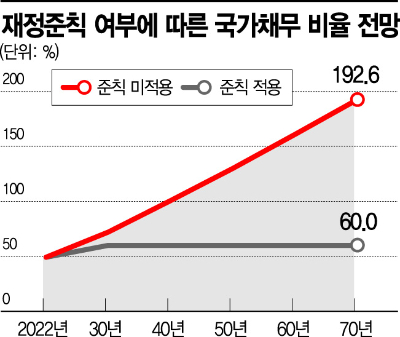
If external creditworthiness declines, government bond yields are likely to rise, increasing the government's interest burden. The IMF classifies South Korea as one of the countries with a rapid increase in debt and analyzes that the legalization of fiscal rules is necessary. The interest on government bonds is expected to increase from 17.8 trillion won in 2020 to 24.8 trillion won this year. As the possibility of finalizing the legalization of fiscal rules within this month becomes slim, the prevailing view is that the Ministry of Economy and Finance will not be able to include this matter in the budget formulation guidelines to be announced at the end of March. According to the Ministry of Economy and Finance, annual consultations with international credit rating agencies that determine the national credit rating?Fitch and Moody's?are scheduled for the first half of the year, and consultations with Standard & Poor's (S&P) are planned within the year.
© The Asia Business Daily(www.asiae.co.kr). All rights reserved.
![Clutching a Stolen Dior Bag, Saying "I Hate Being Poor but Real"... The Grotesque Con of a "Human Knockoff" [Slate]](https://cwcontent.asiae.co.kr/asiaresize/183/2026021902243444107_1771435474.jpg)

















