Yomiuri "Japanese Business Community Also Considering Korea-Japan Projects"
Kyodo "Reviewing Solutions for Forced Labor, Export Controls, and Shuttle Diplomacy Issues"
The Japanese government has begun coordinating in a direction where Prime Minister Fumio Kishida would express the succession of past statements reflecting historical reflection if the South Korean government comes up with a solution to the lawsuit issue concerning forced labor (compulsory labor) during the Japanese colonial period, Yomiuri Shimbun reported on the 4th.
Yomiuri, citing multiple officials from both governments, reported that the South Korean government aims to soon announce a solution in which the Foundation for Victims of Forced Mobilization under Japanese Colonial Rule (hereinafter the Foundation), affiliated with the South Korean government, pays an amount equivalent to compensation to the plaintiffs instead of the Japanese defendant companies whose obligation to compensate was confirmed by the 2018 Supreme Court ruling.
The South Korean government demanded a "sincere response" from Japan to resolve the compensation issue for forced labor, but the Japanese government has maintained the view that the issue was resolved by the 1965 Korea-Japan Claims Agreement.
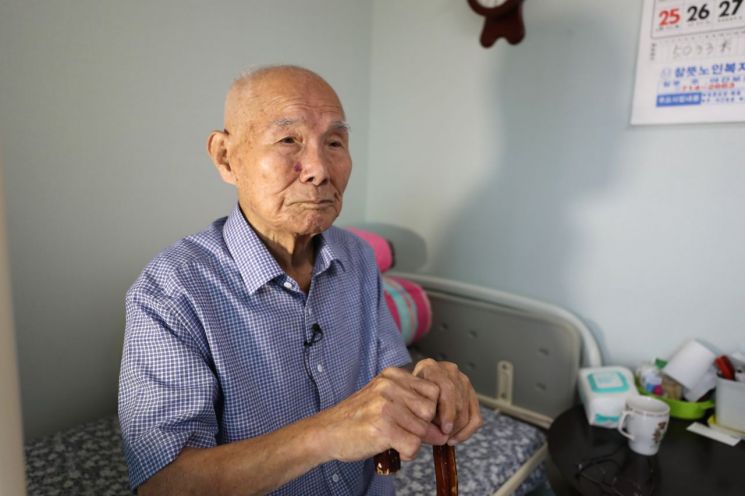 On September 2nd last year, Mr. Lee Chun-sik, a victim of forced labor under Japanese rule, was waiting for the visit of Foreign Minister Park Jin at his home in Usan-dong, Gwangsan-gu, Gwangju. On that day, Minister Park visited Gwangju to meet victims of forced labor under Japanese rule and promised to find a diplomatic solution.
 [Image source=Yonhap News]
Yomiuri reported that Prime Minister Kishida’s expression of "succession of the positions contained in past statements or joint declarations" rather than a new statement is judged not to undermine the existing view that the forced labor issue has been resolved.
Yomiuri also reported that the document valued by both the South Korean and Japanese governments is the "Joint Declaration on a New Korea-Japan Partnership for the 21st Century" announced by President Kim Dae-jung and Japanese Prime Minister Keizo Obuchi in 1998.
At that time, Prime Minister Obuchi expressed "deep remorse and heartfelt apology" for the past colonial rule. President Kim emphasized a future-oriented relationship overcoming the unfortunate history.
The "50th Anniversary Statement" (Murayama Statement) announced in 1995 by then Japanese Prime Minister Tomiichi Murayama also contained "deep remorse" and "heartfelt apology" for colonial rule.
In the Japanese business community, projects contributing to a future-oriented Korea-Japan relationship are also being considered. Within Keidanren (Japan Business Federation), a plan to request financial cooperation from member companies to establish Korea-Japan cooperative projects is emerging.
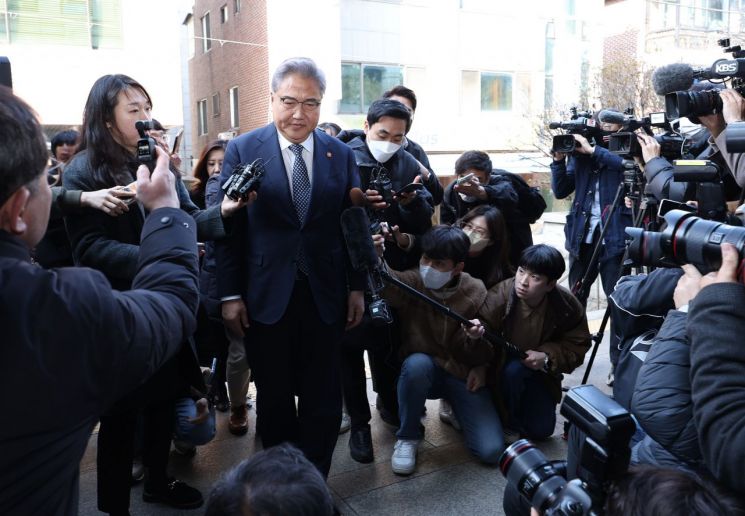 Foreign Minister Park Jin is heading to the meeting venue at the Seoul Bar Association building in Seocho-gu, Seoul, on the afternoon of the 28th of last month to meet with the families of forced labor victims. [Image source=Yonhap News]
Yomiuri reported that the cooperative projects are expected to include scholarships for Korean international students, separate from the forced labor compensation issue. Attention is focused on whether Mitsubishi Heavy Industries and Nippon Steel, defendants in the forced labor compensation lawsuit, will participate in these cooperative projects.
Kyodo News reported on the same day that the South Korean and Japanese governments are considering a package solution to bilateral issues including the forced labor compensation issue, Japan’s export restrictions on South Korea, and the resumption of shuttle diplomacy with mutual visits by the two countries’ leaders.
According to this plan, if the South Korean government officially announces a solution in which the Foundation pays an amount equivalent to compensation, the Japanese government will allow donations from willing Japanese companies to the Foundation and express the succession of past statements and joint declarations, showing an "apology sentiment" toward forced laborers.
Subsequently, the Japanese government will lift the semiconductor material export restrictions imposed on South Korea in 2019 and reinstate South Korea on the "white list," the list of countries receiving preferential treatment in export controls.
The Japanese government has explained that the semiconductor material export restrictions and removal from the white list (in 2019) are unrelated to the forced labor issue, so these measures are expected to be lifted and announced after some time.
Resuming shuttle diplomacy with mutual visits by the Korea-Japan leaders once a year is also being considered. Kyodo News said, "(The Korea-Japan) intergovernmental consultations are in the final stages" and "have reached the stage of political decision."
© The Asia Business Daily(www.asiae.co.kr). All rights reserved.
![Clutching a Stolen Dior Bag, Saying "I Hate Being Poor but Real"... The Grotesque Con of a "Human Knockoff" [Slate]](https://cwcontent.asiae.co.kr/asiaresize/183/2026021902243444107_1771435474.jpg)
















