Compared Himself to Maximus - Yoon as Commodus in the Past
Appeals to Young People Unfamiliar with Four-Character Idioms
Criticism of Being Frivolous and Mixed Political Communication Reviews
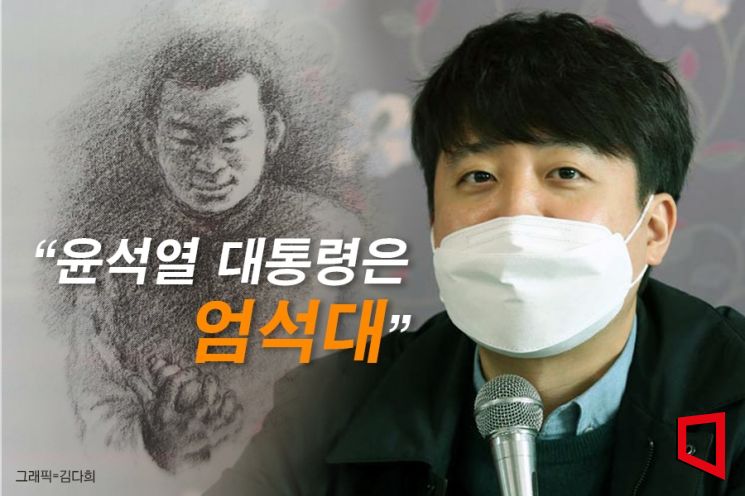
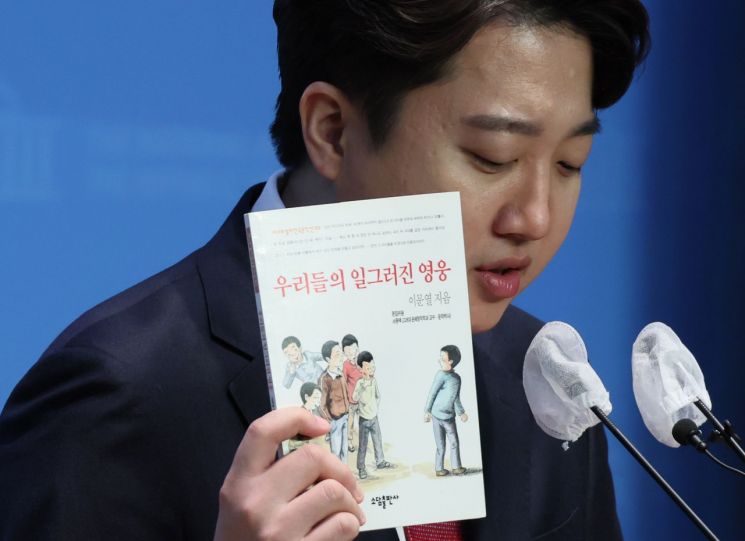
On the 3rd, former People Power Party leader Lee Jun-seok sparked controversy by comparing President Yoon Seok-yeol to Eom Seok-dae, a character from author Lee Mun-yeol's novel Our Twisted Hero, urging people to vote for the candidates he supports in the ruling party's leadership election.
Eom Seok-dae is a character who maintains his power as class president by bullying a transfer student, Han Byung-tae, who resists him, but falls from power when the homeroom teacher changes. Lee likened President Yoon to Eom Seok-dae, the resisting transfer student Han Byung-tae to the candidates he supports?Cheon Ah-yong (Cheon Ha-ram, Heo Eun-ah, Kim Yong-tae, Lee Gi-in)?and the group that betrayed Eom Seok-dae upon his downfall to the 'Yoon Core Group' (Yoon Seok-yeol’s key associates).
"I am Maximus, Yoon is Commodus"
This is not the first time former leader Lee has used metaphors comparing politicians to fictional characters from novels or movies, or famous people. He is well known for explaining complex political issues through popular culture analogies. A representative example is from last August during the 'injunction political crisis,' when he appeared on MBN and used the analogy of Maximus and Emperor Commodus.
"The gladiator gains popularity among the public, and to suppress that popularity, the emperor himself has no choice but to fight the gladiator. But since the emperor lacks confidence, he stabs his side with a knife before the match begins."
Maximus is the protagonist of the movie Gladiator, whose main story is avenging his family lost to Emperor Commodus. Lee compared himself to Maximus and President Yoon to the 'unfilial emperor' Commodus, implying that his removal from party leadership was due to the emperor who 'starts the fight by stabbing his own side.' Although the injunction situation is complex, anyone who has seen the movie can quickly understand the situation without deep thought.
Another unique analogy emerged during this leadership election phase. Last month, on BBS's Jeon Young-shin's Morning Journal, he said, "If I run the election alone, I can just decide and move, but this time I have to promote four candidates evenly," adding, "If I were to make an analogy, in the old classic movie Ben-Hur, the protagonist receives four horses from the chieftain and trains them together to compete in the chariot race." This clearly indicated that he is leading this election.
He also caused a stir by explaining his relationship with candidate Cheon Ha-ram through the relationship between travel YouTubers GwakTube and PaniBottle. On YTN Radio, he said, "Among travel YouTubers, a friend named 'PaniBottle' initially took 'GwakTube' around and introduced him to YouTube, but now GwakTube is more popular," hinting at his political support for candidate Cheon.
"Is that analogy accurate?" Criticized but... "Political communication skill"
There are many criticisms questioning whether Lee’s analogies truly capture the essence. Hong Joon-pyo, the party’s standing advisor and mayor of Daegu, posted on his social media that day, "Are we really comparing our party’s president to the thug Eom Seok-dae? Then what should we call those who betrayed Park Geun-hye during her impeachment?" He also criticized Lee’s 'Maximus' remark, saying, "Maximus never did the despicable act of betraying his comrades to save himself. Maximus is not petty."
However, experts analyze that Lee’s analogies are a form of sophisticated political communication. Professor Park Sang-byeong of Inha University said, "The characteristic of political communication is to create words or stories that help the audience understand the situation most appropriately and retain the memory for a long time," adding, "Lee’s style is popular and he has the skill to deliver the most suitable message to the public or party members by invoking symbolism without necessarily stating it directly."
It is explained that this is why he compares politicians to characters from movies or popular media. Professor Park said, "In the past, four-character idioms were commonly used, but nowadays younger generations do not like them much," and "Compared to idioms, analogies to movie characters or singers help listeners remember longer and understand the essence of the event more clearly."
Lee, who prefers fresh analogies, is also closely related to his frequent use of online memes. Memes are words that trend online and are highly volatile but attract attention because they are provocative. This is why his posts using memes such as 'human greed is endless and repeats the same mistakes' and 'I am not interested in money' during last year’s injunction crisis received great sympathy.
However, the excessive use of memes to mock or belittle opponents sometimes backfires. Just before the presidential unity talks, Lee sarcastically told candidate Ahn Cheol-soo to "just keep laughing (ㄹㅇㅋㅋ)," which drew a rebuttal from the People’s Party demanding "change the party name with the power of ridicule." Recently, he also faced backlash for a poster applying the internet meme 'HongjjikXX' to candidate Cheon.
© The Asia Business Daily(www.asiae.co.kr). All rights reserved.
![Clutching a Stolen Dior Bag, Saying "I Hate Being Poor but Real"... The Grotesque Con of a "Human Knockoff" [Slate]](https://cwcontent.asiae.co.kr/asiaresize/183/2026021902243444107_1771435474.jpg)


















