"Unable to Lift Heads Due to Guilt"... Executives' Self-Blame Report
Plenary Meeting Fails to Propose 'Solution'... Food Shortage Resolution Uncertain
Ministry of Unification: "Repeated Relief Without Measures... Plan Disrupted"
North Korean officials collectively wrote a letter of reflection admitting their failure to properly implement agricultural policies. This is interpreted as an 'action' in response to Chairman Kim Jong-un's directive at this year's plenary meeting, where agricultural production targets were the main agenda, and as an attempt to quell public dissatisfaction.
The Workers' Party's official newspaper, Rodong Sinmun, published on the 3rd a front-page article titled "After Receiving Reports on the Expanded Plenary Meeting," which revealed that party and cabinet officials confessed to the shortcomings in agricultural measures and pledged to increase food production. Previously, North Korea held a party plenary meeting for four days from the 26th of last month to the 1st of this month, and at the year-end meeting, 'grain' was set as the first achievement goal for this year.
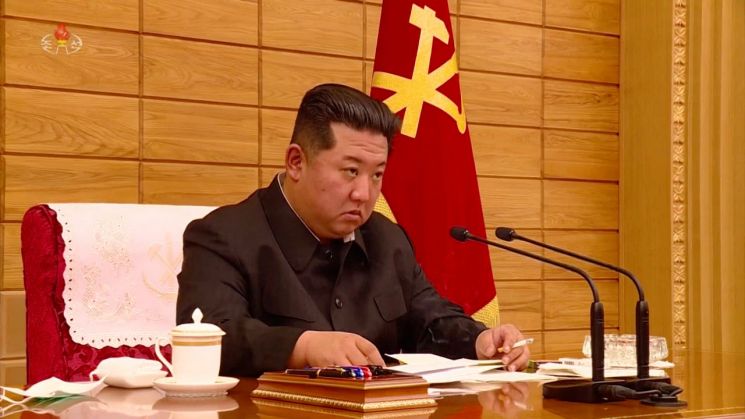
According to the report, Ju Chol-gyu, Deputy Premier of the Cabinet and Chairman of the Agricultural Committee, self-criticized, saying, "The fundamental reason we failed in farming is that agricultural guidance officials, under the pretext of securing farming materials and abnormal weather disasters, did not responsibly carry out farming operations and command." Ju Chol-gyu rose to Deputy Premier after serving as director of the Ministry of Agriculture and chairman of the Rural Management Committee responsible for rural issues in Hwanghae Province.
Additionally, Ri Chol-man, a department head of the Party Central Committee, pledged, "We will strengthen party leadership and policy guidance to fulfill our duty as the owners responsible for the nation's rice granaries," and Jang Hyun-chol, director of the South Pyongan Agricultural Science Research Institute, said, "I felt great self-reproach participating in the plenary meeting," adding, "When thinking of his (Kim Jong-un's) immense dedication and painstaking efforts regarding grain production issues (omission) I cannot raise my head due to guilt."
Chairman Kim emphasized at this plenary meeting that the agricultural production target for this year must be "achieved at all costs." Measures to increase agricultural output included ▲ vigorous promotion of irrigation projects ▲ distribution of 'new and efficient' agricultural machinery ▲ reclamation of tidal flats and expansion of arable land, but these were essentially repetitions of previously presented content. Ultimately, it is difficult to say that any meaningful conclusions were drawn to increase agricultural production.
The Ministry of Unification also evaluated the results of North Korea's Workers' Party plenary meeting as "repeating existing slogans without visible measures." A ministry official stated, "North Korea reviewed the progress of the new era rural revolution program's first year, but the lack of specific evaluations suggests there are no achievements worth showcasing," adding, "Emphasizing discipline from the beginning of the year can be interpreted as indicating disruptions in the execution of the authorities' plans."
© The Asia Business Daily(www.asiae.co.kr). All rights reserved.
![Clutching a Stolen Dior Bag, Saying "I Hate Being Poor but Real"... The Grotesque Con of a "Human Knockoff" [Slate]](https://cwcontent.asiae.co.kr/asiaresize/183/2026021902243444107_1771435474.jpg)















