China Market Share: Vivo Ranks 1st, Apple 2nd
Samsung Struggles Amid China's Patriotic Consumption Impact
Apple has been brought to its knees in the Chinese smartphone market due to a wave of patriotic consumption. Despite efforts to focus on the Chinese market amid US-China tensions, Apple lost its top market share position to a Chinese smartphone manufacturer. Samsung Electronics also remained stuck at a market share in the 0% range. While Apple and Samsung compete for first and second place in the global smartphone market, they are struggling to gain traction in the Chinese market.
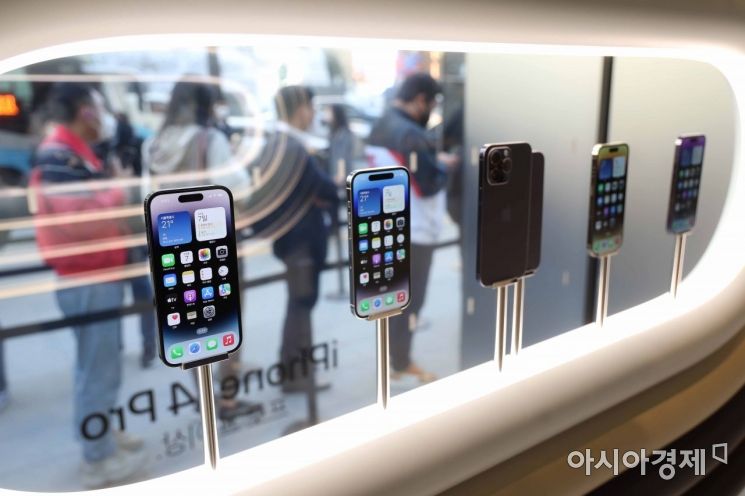 On the 7th, when Apple's new iPhone 14 series was officially released in Korea, citizens lined up at the Apple Store in Myeongdong, Jung-gu, Seoul to purchase the product. Photo by Moon Honam munonam@
Have Chinese People's 'iPhone' Love Cooled?
On the 4th, market research firm Counterpoint Research reported that after the launch of the iPhone 14 series, Apple, which had consistently held the number one sales position in the Chinese market, dropped to second place in sales volume starting January. Its market share fell from 22% at the end of last year to 19% in January this year. Disruptions in the operation of Apple's core iPhone production base, the Zhengzhou factory, appear to have prevented sales from recovering to previous levels from the end of last year through February this year. The top spot was taken by Chinese smartphone maker Vivo, which holds a market share in the 20% range. Vivo increased sales by launching new products at the end of the year and running promotions during the Lunar New Year period.
Sales volume in the Chinese smartphone market in January reached 29.59 million units, a 41% increase compared to December last year. Changes in the Chinese government's COVID-19 prevention policies revived consumer sentiment, which had been subdued. Sales increased compared to the previous month starting from the Lunar New Year. However, during this period, Apple’s sales volume dropped by 22%. Despite Apple’s unprecedented aggressive move to discount the iPhone 14 series by nearly 150,000 KRW, sales recovery seems difficult. Vivo’s sales volume increased by 53% compared to the previous month with the release of its popular model, the 'S16.'
A Difficult Market for Apple Following Samsung
Samsung Electronics is also struggling to regain market share in China. Samsung’s market share in China, which was close to 20% in 2013, plummeted to the 0% range by 2019 due to major incidents such as the THAAD dispute and the Galaxy Note 7 explosion. Currently, its market share stands at 0.6%. Tae-moon Roh, President of Samsung Electronics MX Division, said at the 'Galaxy Unpacked 2023' event held last year, "Our market share in China increased slightly in 2022 compared to 2021," adding, "We expect it to continue rising steadily based on our efforts and strategies."
The reason why leading global companies struggle in the Chinese market is due to Chinese people's patriotic consumption (Guochao). This term combines "China" and "trend," referring to a patriotic consumer movement encouraging the use of domestic products instead of foreign ones. Young people in their 20s and 30s born after 1990 are at the center of this movement. The technological capabilities of Chinese companies support this patriotic consumption. Companies are expanding their product spectrum from cost-effective to premium. Xiaomi and Huawei launched high-end smartphones priced between 1.8 million and 2.2 million KRW at the end of last year.
Kang Min-su, a researcher at Counterpoint Research, said, "There were expectations that the Pro series, which had limited supply due to the Zhengzhou incident, would flood the market and achieve good sales for a considerable period at the beginning of the year, but such trends have not yet been observed." He believes, "Without an overall recovery in the Chinese market, it will be difficult for iPhone sales to increase throughout this year."
© The Asia Business Daily(www.asiae.co.kr). All rights reserved.
![Clutching a Stolen Dior Bag, Saying "I Hate Being Poor but Real"... The Grotesque Con of a "Human Knockoff" [Slate]](https://cwcontent.asiae.co.kr/asiaresize/183/2026021902243444107_1771435474.jpg)















