Government: "Deterioration of Coverage Rate, Increase in Parallel Treatment Benefit Expenditure"
Medical Community Repeatedly Regrets: "Violation of Healthcare Workers' and Patients' Basic Rights"
Civil Society: "Alleviate Citizens' Economic Burden... Expand Further"
As part of health insurance reform measures, the strengthening of non-reimbursable service management has been included, and debates continue over the constitutional ruling on the medical law provisions mandating the reporting of non-reimbursable services. While the government expresses concerns about the leakage of health insurance finances due to increased health insurance benefit expenditures alongside non-reimbursable parallel treatments, the medical community continues to oppose, arguing that the current reporting system demands excessive information and may infringe on doctors' professional freedom.

What is the Non-Reimbursable Reporting System?
According to the government and medical community on the 3rd, the 'Measures to Enhance the Sustainability of Health Insurance' finalized and announced by the Health Insurance Policy Deliberation Committee on the 28th of last month included strengthening appropriate management of non-reimbursable services as one of the core contents. This is due to the generous coverage of indemnity insurance and the balloon effect where parallel treatments of reimbursable and non-reimbursable services lead to price increases in non-reimbursable services, resulting in increased benefit expenditures. In fact, the health insurance coverage rate for last year, disclosed by the National Health Insurance Service last month, was 64.5%, a decrease of 0.8 percentage points from the previous year. Conversely, the burden rate of non-reimbursable services increased by 0.4 percentage points to 15.6% during the same period.
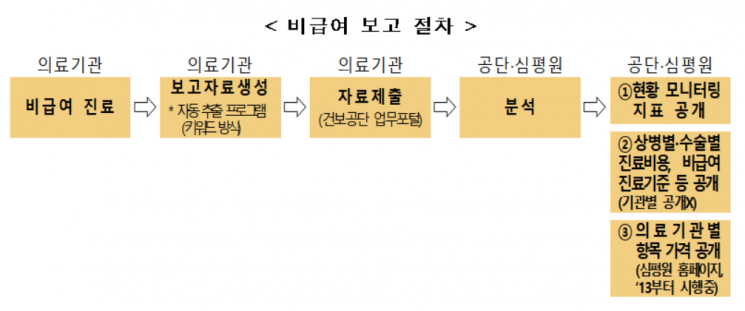
It is also pointed out as a problem that there is a lack of basic status understanding such as usage volume besides the main non-reimbursable prices by medical institution, and a lack of mechanisms to evaluate the quality of non-reimbursable services such as safety and effectiveness, resulting in insufficient information provided to patients. As a solution, the government proposed improving indemnity insurance, strengthening disclosure of non-reimbursable item information to consumers, and enhancing monitoring of parallel reimbursable and non-reimbursable treatments. In particular, the plan includes implementing a 'Non-Reimbursable Treatment Details Reporting System.' All medical institutions must periodically report non-reimbursable items, standards, amounts, and treatment details to the Ministry of Health and Welfare.
Accordingly, the 672 non-reimbursable treatment costs currently disclosed by the Health Insurance Review and Assessment Service will be reported starting this year, and in 2024, major non-reimbursable services estimated to account for about 90% of the total non-reimbursable scale, including these, will be subject to reporting. The non-reimbursable services included cover a total of 1,212 items, including 100 drugs, 436 therapeutic non-reimbursable services, nutritional injections, vaccinations, dental orthodontics, and herbal medicine. The Ministry of Health and Welfare expects that by grasping the detailed treatment scale and target diseases by non-reimbursable item, it will support the establishment of evidence-based non-reimbursable management policies and make it easier for patients to obtain various information such as non-reimbursable treatment costs. A ministry official explained, "The aim is to understand the status of non-reimbursable services and strengthen the public's right to know and the choice of medical institutions."
Constitutional Court's 5-4 'Constitutional' Ruling... Medical Community Regrets, Civic Groups Say "It Should Be Expanded"
The medical community, which has continuously opposed the reporting of non-reimbursable services, filed a constitutional complaint against the relevant provisions of the Medical Service Act and its enforcement rules, but recently, the Constitutional Court ruled the provisions constitutional. The court found that essential matters regarding the reporting obligation of non-reimbursable treatment costs, including items, standards, amounts, and treatment details, are directly stipulated by law, and that the public interest purpose of guaranteeing the public's right to know and medical choice through non-reimbursable reporting is greater. However, the justices' opinions were narrowly decided by a 5 to 4 vote.
The medical community expressed regret over the court's decision and, separate from the constitutional ruling, has begun efforts to minimize damages caused by the non-reimbursable reporting obligation. The Korean Medical Association stated in a press release, "If the purpose of the reporting and disclosure system for non-reimbursable treatment costs is to guarantee the public's right to know and medical choice, the target should be limited to items and amounts." They criticized, "There is suspicion as to why extremely private basic information such as patient gender and birth year, as well as sensitive medical information such as disease, treatment details, and medications, are necessary, and this can only be seen as an intention to control non-reimbursable services and accumulate patients' medical information." They added, "Although it superficially takes the form of guaranteeing the public's right to know and medical choice, in substance, it poses a high risk of infringing on the fundamental rights of patients and medical professionals, and we deeply regret this constitutional ruling."
Contrary to the medical community, civic society groups strongly argue that the non-reimbursable reporting obligation should be further expanded. The Citizens' Coalition for Economic Justice (CCEJ) welcomed the Constitutional Court's ruling in a commentary, stating, "Non-reimbursable services are treatment items for which medical institutions independently set prices and frequencies, and they are a key factor causing over-treatment and excessive medical expenses for patients." They urged the government to enhance the effectiveness of the system by mandating reporting of all non-reimbursable items, expanding the reporting period and frequency, and compulsory disclosure of the list of medical institutions that fail to report data.
The National Health Insurance Labor Union also stated, "Non-reimbursable treatments occur widely due to the absence of standardized treatment costs, uncertain safety, and their use as a means of profit generation, but there is no system to properly manage and supervise them. The non-reimbursable reporting system will be a starting point to solve these problems." They added, "Standardized non-reimbursable treatments will reduce behaviors that arbitrarily set prices to increase profits, alleviate the economic burden on the public, and suppress excessive increases in non-reimbursable treatments, thereby contributing to public health promotion through expanded coverage."
© The Asia Business Daily(www.asiae.co.kr). All rights reserved.
![Clutching a Stolen Dior Bag, Saying "I Hate Being Poor but Real"... The Grotesque Con of a "Human Knockoff" [Slate]](https://cwcontent.asiae.co.kr/asiaresize/183/2026021902243444107_1771435474.jpg)

















