At least 43 people have died in a head-on train collision in central Greece, sparking a rapid spread of public anger.
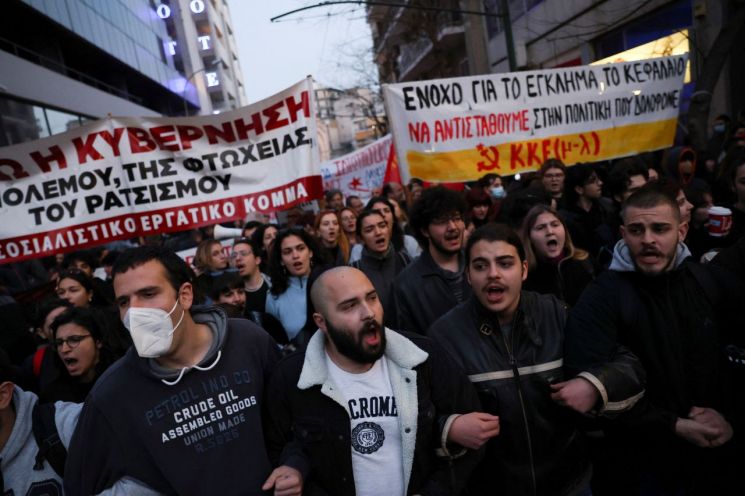
According to major foreign media, on the evening of the incident, protesters clashed with police in front of the Hellenic Train headquarters in Athens, the capital of Greece. The protesters expressed their anger by throwing stones at the building of the company responsible for the maintenance and management of Greek railways, while the police attempted to disperse them by firing tear gas. Protests were also reported in Thessaloniki, Greece's second-largest city, and in Larisa, a city near the accident site.
Earlier, just before midnight on the 28th of last month, a passenger train carrying 350 people traveling from Athens to Thessaloniki collided head-on with a freight train traveling from Thessaloniki to Larisa. So far, 43 people have died in the accident, with the majority of the victims confirmed to be university students in their 20s who were returning home after enjoying the golden holiday, which has fueled public outrage. The Greek government has deployed firefighting and police personnel, as well as heavy equipment such as cranes, to continue search operations at the accident site.
In response, Kostas Karamanlis, the Greek Minister of Transport, resigned immediately after the accident. Minister Karamanlis stated, "I will take responsibility for failing to improve the railway system, which is not suitable for the 21st century, for a long time."
The Greek police arrested the stationmaster of Larisa on charges of negligent homicide for sending the passenger train onto the wrong track in connection with the accident. However, the railway union protested, saying that the tragedy occurred because the safety system did not function properly and accused the authorities of using the Larisa stationmaster as a scapegoat to cover up the problem. They also announced a strike on the 2nd, stating, "Pain has turned into anger," and condemned the government's complacent response as having led to the tragic outcome.
Meanwhile, as part of structural reforms pursued after receiving bailout support from the European Union (EU) in 2017, the Greek government sold Hellenic Train to an Italian company. Initially, the Greek government expected that foreign capital would lead to investment in railway infrastructure, but the reality was quite the opposite.
© The Asia Business Daily(www.asiae.co.kr). All rights reserved.
![Clutching a Stolen Dior Bag, Saying "I Hate Being Poor but Real"... The Grotesque Con of a "Human Knockoff" [Slate]](https://cwcontent.asiae.co.kr/asiaresize/183/2026021902243444107_1771435474.jpg)















