
Last year, the National Pension Service (NPS) fund's investment return rate recorded a negative (-) 8.22%, showing poor performance. However, when compared to major overseas pension funds, it was analyzed to have achieved a relatively decent result.
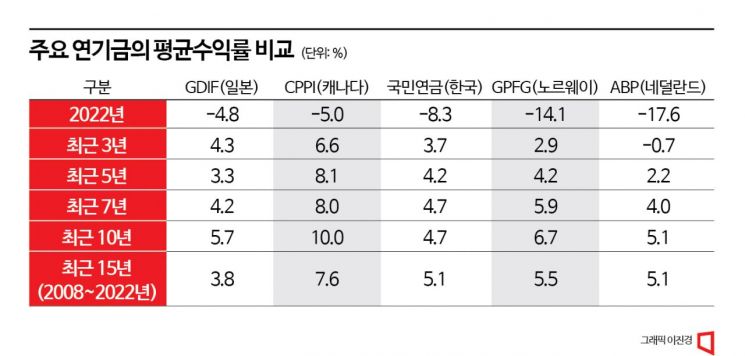
According to the NPS Fund Management Headquarters, the average return rates of major overseas pension funds last year were Japan (-4.8%), Canada (-5.0%), Korea (-8.22%), Norway (-14.1%), and the Netherlands (-17.6%), respectively.
The NPS stated, "The investment returns of major overseas pension funds also declined significantly due to the global stock market plunge, and among them, the performance of the NPS appeared relatively favorable." Looking at the average returns over the past three years, Canada (6.6%), Japan (4.3%), Korea (3.7%), Norway (2.9%), and the Netherlands (-0.7%) ranked in that order.
As of the end of last year, the NPS fund's accumulated assets were tentatively estimated at 890.5 trillion KRW, falling below 900 trillion KRW. However, the return rate (tentative) disclosed by the NPS fund mostly reflects unrealized losses rather than realized losses. If the investment environment improves, these unrealized losses can also recover. In February, the financial sector return rate of the NPS fund recorded around 5% (tentative), and the total accumulated assets recovered to the 930 trillion KRW level.
The poor return rate last year was largely due to the global financial market freezing caused by monetary tightening and the Russia-Ukraine war. The expansion of alternative investments and foreign exchange gains from the strong US dollar helped reduce the loss margin.
Last year's asset-specific return rates (based on amount-weighted returns) were tentatively estimated as domestic stocks -22.76%, overseas stocks -12.34%, domestic bonds -5.56%, overseas bonds -4.91%, and alternative investments 8.94%.
In detail, domestic and overseas stocks saw a decline in the valuation of managed assets due to persistent market instability caused by the Federal Reserve's aggressive tightening stance amid worsening inflation and the prolonged Russia-Ukraine war. Domestic and overseas bonds had lower returns as interest rates sharply rose (bond valuation declined) amid inflationary pressures and ongoing monetary tightening concerns. Alternative investment assets showed higher returns compared to traditional assets due to the rise in valuation of real estate and infrastructure assets, realized gains, and the increase in the KRW-USD exchange rate.
Chairman Kim Tae-hyun said, "Last year, an unusual situation occurred where both stock and bond markets performed poorly due to increased external uncertainties," adding, "This year, as the financial market shows signs of recovery, the NPS fund's returns are expected to improve."
© The Asia Business Daily(www.asiae.co.kr). All rights reserved.
![Clutching a Stolen Dior Bag, Saying "I Hate Being Poor but Real"... The Grotesque Con of a "Human Knockoff" [Slate]](https://cwcontent.asiae.co.kr/asiaresize/183/2026021902243444107_1771435474.jpg)
















