Ministry of Science and ICT Announces Legislative Notice for Space Aviation Agency Establishment Act on 2nd
Plans for National Assembly Approval and Agency Opening Within the Year
Annual Salary Guaranteed at NASA Level of 200-300 Million KRW
Autonomy in Organization, Personnel, and Budget Ensured
The Ministry of Science and ICT has unveiled the outline of a Korean version of NASA (the U.S. National Aeronautics and Space Administration) under the Yoon Suk-yeol administration. The plan is to establish a specialized and flexible organization by creating a Space Aviation Agency through a special law, which will oversee space aviation policy and industry development as well as handle research and development (R&D). The agency will be granted autonomy over organization, personnel, and budget, serving as a model for public institution innovation, while guaranteeing NASA-level salaries and autonomy. However, issues such as the division of duties with existing national research institutions, differentiation from other public organizations, and the creation of living conditions in Sacheon, Gyeongnam, where the agency will be located, remain challenges.

On the 2nd, the Ministry of Science and ICT announced the legislative notice of the draft special law titled "Special Act on the Establishment and Operation of the Space Aviation Agency." This bill proposes the establishment of the Space Aviation Agency as a central administrative agency under the Ministry of Science and ICT, unifying space aviation-related technology development, industry promotion and support, talent cultivation, and space hazard preparedness, which had previously been carried out individually by various ministries such as the Ministry of Science and ICT and the Ministry of Trade, Industry and Energy. To this end, the Space Development Promotion Act, Aerospace Industry Promotion Act, and Astronomy Act under the jurisdiction of the Ministry of Science and ICT and the Ministry of Trade, Industry and Energy will be transferred to the jurisdiction of the head of the Space Aviation Agency. The bill also includes elevating the chairperson of the National Space Committee from the Prime Minister to the President and adding the head of the Space Aviation Agency as a member who will serve as the working committee chairperson.
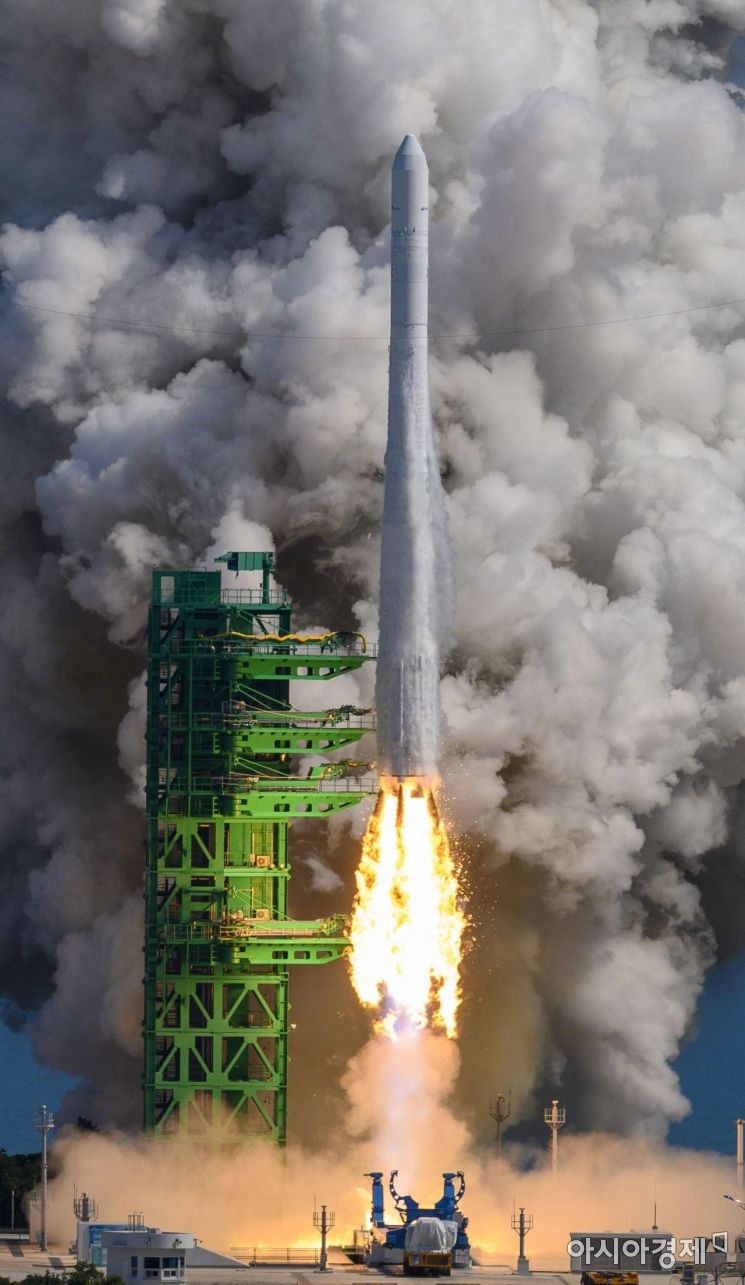 The Korean launch vehicle Nuriho (KSLV-II), designed and manufactured entirely with domestic technology, is soaring into space with flames erupting from the launch pad at Naro Space Center in Goheung-gun, Jeollanam-do on the 21st. Unlike the first launch, which carried only a satellite mock-up with no actual functionality, the second Nuriho launch this time included a performance verification satellite and four CubeSats.
 Goheung - Photo by Joint Press Corps
Specifically, the head of the agency will be a political appointee at the vice-minister level, and the deputy head, a general service official at the assistant minister level, will oversee practical affairs. A separate headquarters led by term-appointed officials will be established to focus on R&D and industry revitalization. Unlike existing civil service organizations, the agency will be granted significant autonomy in organization, personnel, and budget management. Normally, reorganizing an organization at the division or section level within government ministries requires amendments to Prime Ministerial or ministerial ordinances, taking more than three months. The Space Aviation Agency can establish or dissolve units within a week through internal directives. To recruit talented private experts, it can hire term-appointed officials beyond the existing limit of 20% of total positions.
Various special measures will be granted to attract top domestic and international experts. Notably, to guarantee salaries comparable to NASA, exceeding 200 to 300 million KRW annually, the agency will remove salary caps within budget limits. Technology fees will also be paid as performance bonuses. While existing ministries have hiring authority only up to grade 3, the agency head can hire personnel up to grades 1 and 2. Instead of competitive recruitment, a scouting method will be introduced, and exceptions will be made for external experts regarding stock blind trusts, as well as allowing foreigners and dual nationals. Employment contracts will specify job content and grounds for dismissal, enabling flexible personnel redeployment. Restrictions on employment and job duties for term-appointed officials will be reviewed by the agency head instead of the Public Officials Ethics Committee, expanding autonomy.
Financial stability and autonomy will also be greatly enhanced. Currently, ministries must obtain approval from the Minister of Economy and Finance to reallocate budgets, but the Space Aviation Agency will be allowed to reallocate its budget independently, subject to prior consultation. A Space Aviation Fund will be established to enable long-term investment of budgets above a certain scale, with a two-year grace period after establishment.
The Ministry of Science and ICT plans to collect public opinions during the legislative notice period until the 17th and submit the bill to the National Assembly in the first half of the year along with the government organization law amendment from the Ministry of the Interior and Safety. Once the bill passes, the agency is scheduled to open within this year in Sacheon, Gyeongnam.
Minister Lee Jong-ho of the Ministry of Science and ICT stated, "We will introduce an innovative civil service system that attracts the best talent and allows them to demonstrate expertise proactively," adding, "We will establish this agency as the central institution to realize the space economy roadmap, opening Korea’s space era and enabling it to leap to become one of the world’s top seven space powers by 2045."
© The Asia Business Daily(www.asiae.co.kr). All rights reserved.
![Clutching a Stolen Dior Bag, Saying "I Hate Being Poor but Real"... The Grotesque Con of a "Human Knockoff" [Slate]](https://cwcontent.asiae.co.kr/asiaresize/183/2026021902243444107_1771435474.jpg)
















