[Asia Economy Sejong=Reporter Dongwoo Lee] Last month, the trade deficit exceeded $5 billion, continuing for 12 consecutive months. This was due to a 20% increase in the average import value of the three major energy sources?crude oil, gas, and coal?compared to the same period last year, while exports of our key product, semiconductors, decreased by more than 40% compared to the same period last year. Analysts also point out that the slow reopening of China, our largest trading partner, is acting as a negative factor in the export slump.
According to the Ministry of Trade, Industry and Energy on the 1st, last month's export value (provisional customs clearance basis) was $50.1 billion, down 7.5% from the same period last year, while imports increased by 3.6% to $55.4 billion. The number of working days during this period was 22, two days more than the same period last year (20 days). Considering the number of working days, the average daily export value was $2.28 billion, down 15.9%. With exports decreasing and imports increasing, last month’s trade balance recorded a deficit of $5.3 billion. The trade balance has been in deficit for 12 consecutive months from March last year to this month, marking the first time since January 1995 to May 1997.
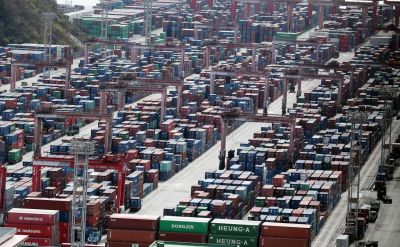
Energy Imports Up 19.7%, Semiconductor Exports Plunge 42.5%
The main reason behind the year-long trade deficit is the prolonged surge in international energy prices caused by the Russia-Ukraine war. Due to the domestic industrial structure with a high manufacturing ratio, energy consumption is large. Winter heating costs also contributed to increased imports. Last month, imports of crude oil, gas, and coal amounted to $15.3 billion, accounting for 27.6% of total imports. By item, crude oil imports ($7.25 billion) decreased by 0.1% compared to the same period last year, but gas ($6.18 billion) increased by 73.2%, and coal ($1.87 billion) by 4.4%. The import value of the three major energy sources averaged $9.7 billion per month over the past 10 years (2013?2022), so last month’s imports increased by more than $5.5 billion compared to the average of $9.7 billion. The Ministry of Trade, Industry and Energy analyzed, "Due to the impact of falling oil prices, crude oil imports slightly decreased compared to the previous year, but gas imports increased compared to the same month last year to ensure stable energy supply during the winter season."
The decline in semiconductor exports, Korea’s key product, is also cited as a major factor worsening the trade balance. Last month, semiconductor exports amounted to $5.96 billion, down 42.5% from the same period last year. Semiconductor exports have shrunk for seven consecutive months since August last year (-7.8%) through last month. The 40% level drop in semiconductor exports marks the second consecutive month following January this year (44.5%). In particular, the price weakness of memory semiconductor products such as DRAM and NAND, which have a large export share within semiconductors, dealt a direct blow to export declines. The fixed price of DRAM fell from an average of $3.41 between January and April last year to $1.81 between January and February this year. The fixed price of NAND also dropped from $4.81 between January and May last year to $4.14 last month. The high base effect from last February, which achieved the highest semiconductor export performance for February ever ($10.37 billion, 23.8%), also contributed to the decline in semiconductor exports last month. Experts expect the downward trend in major semiconductor product prices to continue for the time being, but foresee a possible rebound after the second half of the year supported by reduced investments by major companies and new server CPUs.
Trade Deficit with China Continues for 9 Months... ASEAN Also in Slump
The prolonged trade deficit with China, the largest trading partner, for nine consecutive months is another negative factor. Although China is accelerating its reopening (resumption of economic activities), the recovery speed is slower than expected, and this has not translated into visible export effects. Last month, exports to China were $9.88 billion, down 24.2% from the same period last year. The decline in semiconductor unit prices, the largest export item, had a significant impact. Semiconductor exports to China fell to 46.2% in January this year and continued to decline by 39% through the 25th of last month. The worsening export conditions in the ASEAN region are also problematic. Due to global demand weakness, Vietnam, Korea’s largest trading partner within ASEAN, saw a decrease in global exports and imports, leading to a reduction in Korea’s exports of intermediate goods to ASEAN. Export items to the ASEAN region include semiconductors (-35.7%), petrochemicals (-36.7%), displays (-37.3%), and steel (-13.0%).
With the increase in energy imports and the decrease in semiconductor exports overlapping as negative factors, the annual trade deficit this year reached $17.956 billion. This marks 12 consecutive months of trade deficits from March last year to last month. This figure accounts for 38.0% of last year’s total trade deficit (-$47.2 billion) in just about 60 days since the beginning of this year. As concerns over the prolonged trade deficit grow, the government plans to respond with full force by swiftly implementing the 'Whole-of-Government Export Expansion Strategy' confirmed at the 4th Export Strategy Meeting. Minister of Trade, Industry and Energy Lee Chang-yang said, "We will strengthen inter-ministerial cooperation and promote measures to enhance export competitiveness by sector so that the government and companies can work as one team to achieve this year’s export target of $685 billion."
© The Asia Business Daily(www.asiae.co.kr). All rights reserved.
![Clutching a Stolen Dior Bag, Saying "I Hate Being Poor but Real"... The Grotesque Con of a "Human Knockoff" [Slate]](https://cwcontent.asiae.co.kr/asiaresize/183/2026021902243444107_1771435474.jpg)















