The Bank of Korea Expects Inflation Impact from Base Rate Adjustment to Intensify After 4 to 6 Quarters
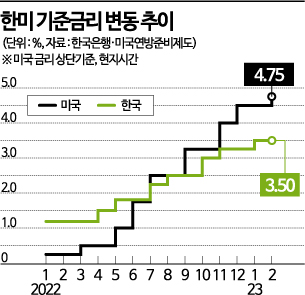
Considering the time lag in the inflation transmission of the base interest rate adjustment, the effect of the 3.0 percentage point increase in the base interest rate from August 2021 to January this year on slowing inflation is expected to expand further this year. The Bank of Korea estimated that the consumer price index (CPI) inflation rate deceleration effect due to the base rate hikes will increase from -0.4 percentage points last year to -1.3 percentage points this year.
On the 28th, Hong Kyung-sik, Director of the Monetary Policy Department at the Bank of Korea, posted an article titled "Main Background of the February Base Rate Decision" on the Bank of Korea blog, stating that the inflation deceleration effect from the base rate hikes, which have been transmitted with a time lag, will expand further this year.
Director Hong said, "It is necessary to consider the time lag in the transmission of base rate hikes," adding, "When the central bank adjusts the policy rate, it first affects market interest rates and deposit and loan rates in the financial market, leading to adjustments in consumption and investment, during which inflation is adjusted."
Although the inflation transmission lag varies by country and economic conditions, according to the Bank of Korea’s econometric models, the inflation impact of base rate adjustments is estimated to begin in earnest after 4 to 6 quarters.
Changes in the trends of real consumption and the private consumption deflator also confirm the transmission lag. Director Hong explained, "From August 2021, when the base rate hikes began, through the first half of last year, there was a strong increase in real consumption alongside a high rise in the private consumption deflator, but in the second half of last year, both variables showed a simultaneous slowdown." This suggests that the previous base rate hikes have gradually eased demand-side inflationary pressures through consumption adjustments with a time lag.
Director Hong stated, "The Bank of Korea raised the base rate by a total of 3.0 percentage points from August 2021 to January 2023 in response to rising inflation. Comparing the inflation rate increases and policy rate hikes in Korea and major countries after COVID-19, the Bank of Korea’s policy response can be evaluated as being at the average level of major countries."
Regarding future base rate decisions, given the high uncertainty in domestic and international policy conditions, it is necessary to closely monitor the final rate level of the U.S. Federal Reserve (Fed), the speed of China’s economic recovery, and their impacts. Director Hong said, "Initially, the market expected the Fed’s terminal rate to be in the low 5% range, but in February, U.S. employment and inflation indicators exceeded market expectations, leading to upward revisions of the terminal rate outlook and increasing claims that the tightening stance may last longer than expected. Depending on future employment and inflation trends, market expectations may change again, so it is important to closely watch these indicators and the results of the Federal Open Market Committee (FOMC) meeting scheduled for March 21?22."
Additionally, the resumption of economic activities in China is expected to positively impact the domestic economy through increased exports to China and the influx of Chinese tourists, which had been subdued, but the extent remains uncertain. It is also necessary to be mindful that increased production activities in China could stimulate global energy prices.
Domestically, there is significant uncertainty regarding the pace of inflation deceleration. Director Hong said, "Currently, the consumer price inflation rate is expected to gradually decline after March and reach the low 3% range by the end of the year, but uncertainty remains high." He added, "While expected inflation had been gradually decreasing, it has risen again this year, with the proportion of responses citing 'public utility charges' as a factor in expectation formation recently exceeding 80%."
Director Hong added, "Although public utility rate increases are inevitable for the overall national economy, it is necessary to continuously monitor the second-round effects on core items and others." He also noted, "Since it is still difficult to gauge the direction of the real estate market and its impact on growth and financial stability, it is important to carefully observe the housing market and related financial market conditions."
© The Asia Business Daily(www.asiae.co.kr). All rights reserved.
![Clutching a Stolen Dior Bag, Saying "I Hate Being Poor but Real"... The Grotesque Con of a "Human Knockoff" [Slate]](https://cwcontent.asiae.co.kr/asiaresize/183/2026021902243444107_1771435474.jpg)















