Korean Travel Boom to Japan After No Japan Movement
"Cheap Airfare, Weak Yen, and Decline of No Japan" Analysis
"Low Per Capita Spending Raises Questions on Economic Impact"
The Japanese media are also paying attention to the phenomenon of a travel boom to Japan in South Korea, where the 'No Japan' movement had been strong.
Local media analyzed that the sharp decline in anti-Japanese sentiment since early 2019, the decrease in travel costs due to the weak yen, and the high safety of travel seem to have driven Koreans to visit Japan.
Newsweek Japan edition highlighted the Korean travel boom to Japan in an article titled "Surge in Koreans visiting Japan... Changing attitude of 'No matter how cheap, I won't go to Japan'... What is the reason?" on the 24th.
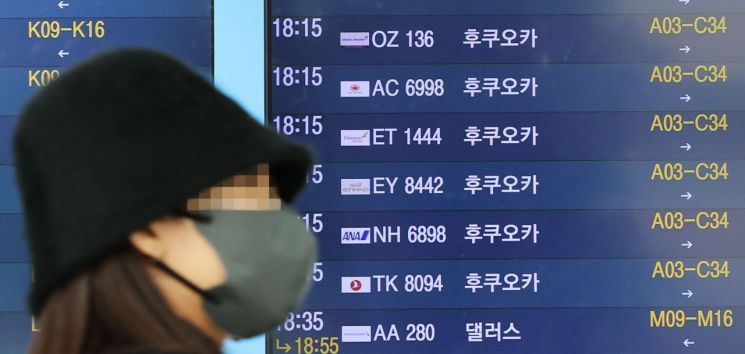 Travel demand, which had been suppressed due to the COVID-19 pandemic, has rebounded, and the number of Korean tourists visiting Japan has significantly increased due to the weak yen. Regarding this, a Japanese media outlet predicted that the Japanese tourism industry would not gain much benefit.
 [Photo by Yonhap News]
According to the Japan National Tourism Organization (JNTO), among the 1,497,300 foreign visitors to Japan in January this year, 565,200 were Koreans, accounting for 38% of the total. This number is more than two to three times higher than the second-ranked Taiwan (259,300) and third-ranked Hong Kong (159,000).
The media introduced that in a survey conducted by the Korean public opinion research firm Embrain in December 2020, when the impact of the 'No Japan' movement was still ongoing, 70.1% of Koreans responded that they participated in the boycott of Japanese products.
Additionally, 49.9% said "Japan is a hostile country," and 55.7% of Koreans answered, "No matter how cheap, I will not go to Japan." However, the media explained that the current atmosphere is different from that time.
The media reported that in a survey conducted in December last year, the response rate of participation in the 'No Japan' movement dropped to 60.0%, the answer that "Japan is a hostile country" decreased to 36.1%, and the response of "I will not go to Japan" sharply declined to 26.8%.
Newsweek cited cheap airfares and the weak yen as reasons for the explosive demand for tourism to Japan. The media diagnosed, "While international airfares of low-cost carriers (LCCs) have soared to the level of major airlines before the COVID-19 pandemic, Japan routes, which are relatively close and have frequent flights, remain relatively cheaper compared to other countries (with smaller increases)."
Newsweek also explained that the weakening of the 'No Japan' movement sparked the tourism boom to Japan. "As negative sentiment toward Japan has weakened, the number of Koreans visiting Japan is increasing due to advantages in cost and safety," it analyzed.
However, the media predicted that even with the increase in Koreans visiting Japan, the Japanese tourism industry would not gain significant benefits. The reason is that Koreans spend less compared to nationals of other countries.
Newsweek pointed out, "Foreign travelers arriving at Tokyo Narita Airport usually take dedicated trains such as the 'Narita Express' or 'Keisei Skyliner' to the city center, and at Osaka Kansai Airport, they use 'Limited Express Haruka' or 'Rapi:t,' but most Koreans take cheaper regular trains," adding, "Among foreign visitors to Japan in 2018, when Korea-Japan travel reached 10 million people, Koreans were the ones who spent the least."
© The Asia Business Daily(www.asiae.co.kr). All rights reserved.
![Clutching a Stolen Dior Bag, Saying "I Hate Being Poor but Real"... The Grotesque Con of a "Human Knockoff" [Slate]](https://cwcontent.asiae.co.kr/asiaresize/183/2026021902243444107_1771435474.jpg)















