104th Anniversary of Samiljeol, Missing Taegukgi
Flagpoles Disappear and Methods Are "Well..."
Places Selling Taegukgi Also Greatly Decrease
March 1, 2023, marks the 104th anniversary of Samiljeol (Independence Movement Day). The Taegeukgi, which used to be seen in every household on national holidays, is gradually disappearing. Compared to the past, the social atmosphere encouraging the display of the Taegeukgi has weakened, and flagpoles for the Taegeukgi are becoming harder to find. As a result, the number of people who do not know the necessity or proper method of displaying the Taegeukgi is increasing, leading to calls for related education and promotion.
Displaying the Taegeukgi is 'voluntary,' not 'mandatory'
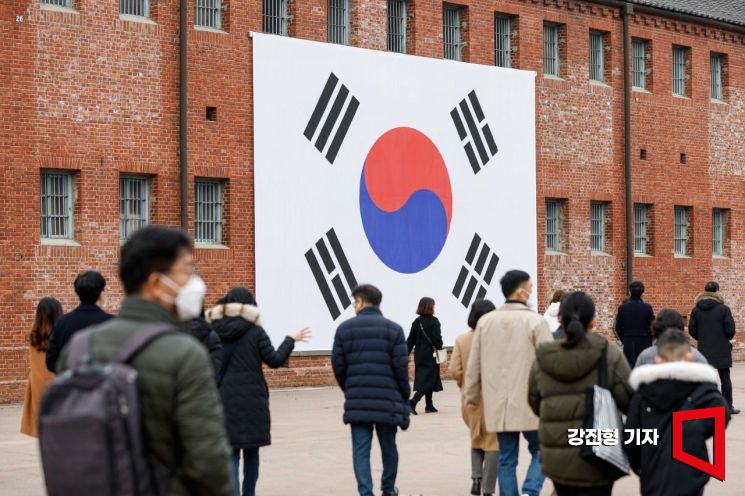 On the 28th, ahead of the 104th anniversary of the March 1st Movement, citizens visiting the Seodaemun Prison History Hall in Seoul are looking at the large Taegeukgi flag hanging on the exterior wall of the history hall. Photo by Jinhyung Kang aymsdream@
According to the National Flag Act of the Republic of Korea, the officially designated days for flying the national flag are seven in total: the five major national holidays (March 1st Movement Day, Constitution Day, Liberation Day, National Foundation Day, and Hangul Day) and government-designated days (Memorial Day and Armed Forces Day). However, since it is not mandatory but 'voluntary,' the practice of displaying the Taegeukgi at home is gradually decreasing.
In recently built apartments, flagpoles for the Taegeukgi are not installed separately, citing reasons such as spoiling the aesthetics. The culture of actively encouraging the display of the Taegeukgi in schools or local governments is also disappearing. Consequently, few modern people know how to properly display the Taegeukgi or understand its design correctly.
Last year, Incruit conducted a survey to commemorate March 1st, investigating modern people's 'understanding and interest in the Taegeukgi.' The percentage of respondents who answered the correct method of displaying the Taegeukgi on March 1st was 75%, while only 25.1% knew the Taegeukgi design properly. A 26-year-old respondent, Mr. A, said, "When I was in elementary and middle school, teachers taught us how to draw and hang the Taegeukgi on national holidays," adding, "But these days, such education seems to be lacking."
The correct way to display the Taegeukgi on March 1st is to keep the flagpole and the flag surface close without leaving a gap. The time to display the flag at each household on national holidays is from 7 a.m. to 6 p.m. However, according to Article 8 of the National Flag Act of the Republic of Korea, it can be displayed 24 hours a day, every day. The Taegeukgi should be hung at the center or left side of the main gate when viewed from outside, and in the case of apartments or multi-family housing, it should be placed on the balcony of each unit.
"Most buyers are foreign tourists"
As the culture of displaying the Taegeukgi gradually disappears, finding places to buy the Taegeukgi in Seoul has also become difficult. The main customers who still buy the Taegeukgi are foreign tourists and street vendors who resell them during rallies and protests.
Mr. Kim, in his 40s, who runs a franchise stationery store in Apgujeong-dong, Gangnam-gu, told Yonhap News, "We used to sell the Taegeukgi, but it has been quite a while since we removed them from our inventory." Mr. Choi, also in his 40s, who operates a wholesale stationery store in Changsin-dong, Jongno-gu, said, "Only handheld flag-type Taegeukgi are barely selling," adding with a wry smile, "We barely make 100 won profit per flag sold."
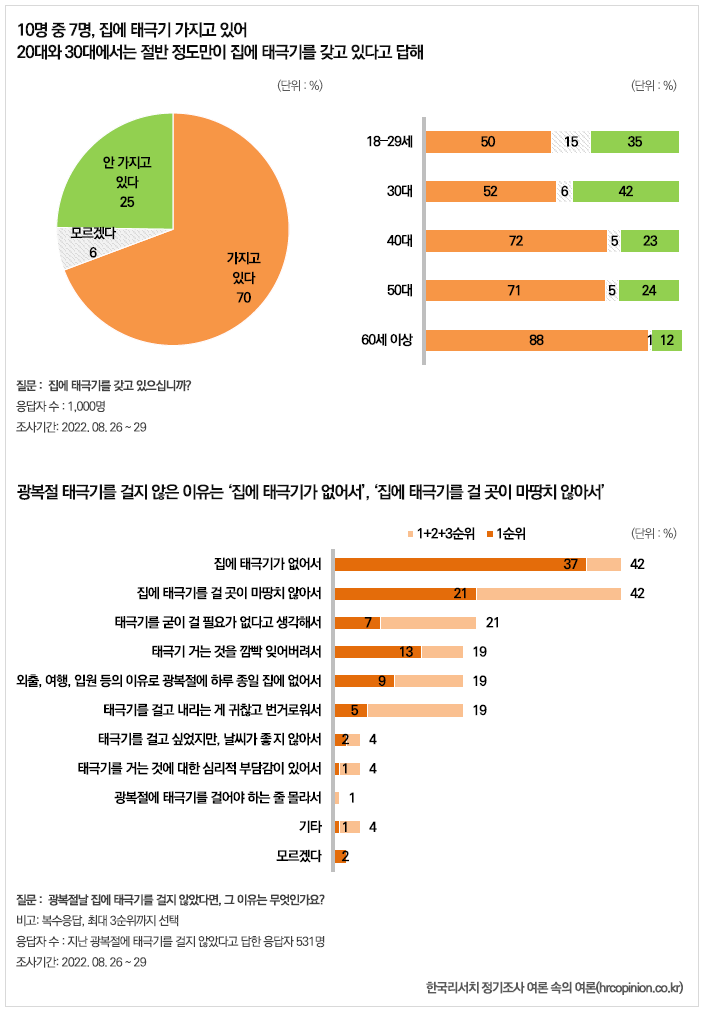
As the culture of displaying the Taegeukgi fades, voices are rising that people should display the national flag on more major national holidays and commemorative days. In response, Korea Research's 'Opinion within Opinion' suggests that Taegeukgi should first be distributed to households without one. According to the 'Perception of National Holidays, Major Commemorative Days, and Taegeukgi Display' survey conducted by 'Opinion within Opinion' in September last year, 25% of respondents answered that they do not have a Taegeukgi at home. Especially among those aged 18-29 (35%) and those in their 30s (42%), the response rate of not owning a Taegeukgi was high, showing that younger age groups have less interest in the Taegeukgi.
Beyond simply distributing the Taegeukgi, enhancing national pride is also one method. The survey revealed a correlation between national pride and flag display. The group that selected 'high national pride' evaluated flag display more positively than other groups, and the response rate for hanging the Taegeukgi on Liberation Day and major national holidays was also higher. This indicates that national pride can be a 'motivation' for voluntarily displaying the Taegeukgi.
Meanwhile, the Taegeukgi can be purchased at local government civil service offices (city, county, district offices, and town, township, and neighborhood community centers) and online post offices. Contaminated or damaged Taegeukgi can be placed in national flag collection boxes at civil service offices and community centers.
© The Asia Business Daily(www.asiae.co.kr). All rights reserved.
![Clutching a Stolen Dior Bag, Saying "I Hate Being Poor but Real"... The Grotesque Con of a "Human Knockoff" [Slate]](https://cwcontent.asiae.co.kr/asiaresize/183/2026021902243444107_1771435474.jpg)

















