$34.2 Billion Property Damage from Earthquake
105,000 Buildings Collapsed
Allegations of Turkish Government's Excessive Exemptions
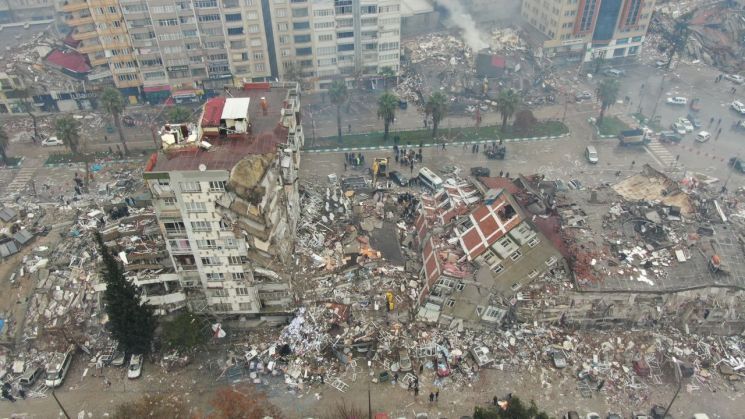
Turkey, where a strong earthquake caused 50,000 deaths, is estimated to need up to $68 billion (about 89 trillion won) to recover from the damage and rebuild the country. This amount is equivalent to one-fifth of Ukraine's reconstruction cost ($349 billion) after the war.
On the 27th (local time), the World Bank (WB) estimated that the earthquake damage in Turkey would reach $34.2 billion (about 45 trillion won). This amount corresponds to 4% of Turkey's Gross Domestic Product (GDP), and the total damage is expected to increase further when indirect damage cases are included.
Since the consecutive earthquakes of magnitude 7.8 and 7.5 struck on the 6th, 105,000 buildings have collapsed within Turkey and Syria. It is estimated that 1.25 million people have been displaced onto the streets due to the collapse of buildings caused by the earthquake. Public infrastructure such as housing, schools, and hospitals was also severely damaged by the strong tremors.
As Turkey fell into chaos, President Recep Tayyip Erdo?an promised to rebuild the southern region within a year. However, earthquake experts believe it will take at least several years to fully recover from the damage. Since the fundamental cause of the numerous casualties was 'poor construction,' rebuilding the city based on scientific data will require a certain amount of time.
Experts told major foreign media, "The top priority is not just building new buildings, but devising new plans," and pointed out that "the city should be planned not only by reconstructing demolished buildings but also by constructing in ways that avoid fault lines."
As 'poor construction' was identified as a cause that increased the scale of damage, the issue of the political sector's excessive issuance of 'exemptions' has emerged as a major social issue in Turkey. After the 1999 earthquake that killed about 17,000 people, Turkey significantly strengthened seismic regulations for buildings, but suspicions have arisen that poor construction became widespread because the government excessively issued exemptions from seismic regulation laws for certain construction companies.
Ajay Chiba, an economist who was the World Bank's Turkey director during the 1999 earthquake, pointed out in an interview with CNN, "The Turkish government excessively issued exemptions for certain construction companies, and construction companies were funding politicians and parties, so they knew they would receive exemptions." Instead of strictly enforcing seismic regulations, the Turkish government periodically issued 'construction pardons,' exempting unauthorized real estate and buildings that did not meet safety standards from fines. The BBC reported that 672,000 buildings in the Izmir region of Turkey, where a large earthquake occurred in 2020, received construction pardons.
The WB stated, "Although the earthquake's intensity was abnormally strong, the indifferent attitude of Turkish authorities toward construction and safety contributed significantly to the extent of the damage."
© The Asia Business Daily(www.asiae.co.kr). All rights reserved.
![Clutching a Stolen Dior Bag, Saying "I Hate Being Poor but Real"... The Grotesque Con of a "Human Knockoff" [Slate]](https://cwcontent.asiae.co.kr/asiaresize/183/2026021902243444107_1771435474.jpg)















