Democratic Party's Proposal to Change Legislative Schedule Rejected
Negotiations Between Ruling and Opposition Parties Expected to Continue Until First Plenary Session of March Extraordinary Assembly
The vote on the Grain Management Act, which mandates the government to compulsorily purchase surplus production when rice prices plummet, was postponed in the plenary session. Speaker Kim Jin-pyo mentioned the possibility of President Yoon Seok-yeol exercising his veto power on the Grain Management Act and requested further agreement between the ruling and opposition parties. If no consensus is reached, a revised bill from the Democratic Party regarding the Grain Management Act is expected to be voted on at the first plenary session in March.
On the 27th, Speaker Kim postponed the plenary session schedule for the Grain Management Act by not putting to vote the Democratic Party’s request for a “motion to change the agenda.” He said, "I have been consulting with the representatives of the negotiating groups about adding agenda items," and added, "I hope the vote on the motion to change the agenda submitted today will be delayed so that the ruling and opposition parties can continue to reach an agreement on the Grain Management Act." Kim also urged, "The Democratic Party, as the responsible majority party in the National Assembly, should make efforts for a consensual resolution, and the People Power Party should actively engage in negotiations to produce an agreement."
This means that the vote on the Grain Management Act will be postponed to encourage further negotiations between the ruling and opposition parties.
As protests continued over the decision to delay the vote on the Grain Management Act amendment, Speaker Kim expressed his concerns about holding a plenary vote amid the government’s open declaration, including President Yoon’s, of the intention to exercise veto power against the Democratic Party’s amendment. He said, "Ideally, it would be right to handle the agenda submitted to the plenary session, but since the government has openly declared its intention to exercise veto power, it is most important as the Speaker that the legislative authority of the National Assembly is respected." He continued, "I highly appreciate that the Democratic Party accepted the Speaker’s mediation proposal, which has not been publicized, and the People Power Party has said that if given one more chance, they will come up with a negotiated agreement. Let’s take one more chance and engage in negotiations."
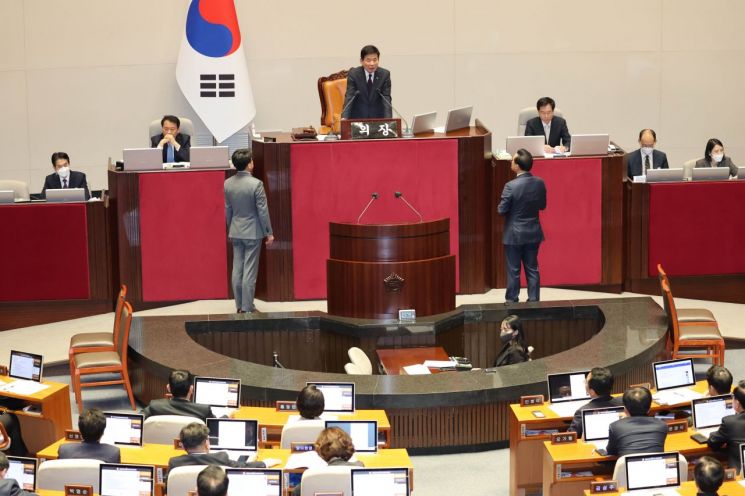
Originally, the Democratic Party chose a direct referral method after the Grain Management Act, which passed the relevant standing committee in October last year, was blocked in the Legislation and Judiciary Committee. Subsequently, through consultations with the Speaker, the Democratic Party prepared a revised bill that strengthened the surplus production requirement for compulsory purchase from 3% to 5%, expanded the rice price decline threshold from 5% to 8%, and included provisions allowing exemption from compulsory purchase if the rice cultivation area increases. Due to the lack of further dialogue with the People Power Party, the Democratic Party intended to pass the bill at the plenary session that day. However, the plan was halted as Speaker Kim did not agree to the change in the agenda.
Speaker Kim also stated that if the ruling and opposition parties fail to reach an agreement on the Grain Management Act amendment by the first plenary session in March, the Democratic Party’s revised bill will be submitted for a vote in the plenary session. Therefore, if no consensus is reached, the door remains open for the Democratic Party’s submitted revision to be processed at the March plenary session.
Meanwhile, at the plenary session that day, the Government Organization Act, which upgrades the Ministry of Patriots and Veterans Affairs to the Ministry of Patriots and Veterans and establishes a new Office for Overseas Koreans, also passed. The plenary session approved the elevation of the Ministry of Patriots and Veterans Affairs to a full ministry responsible for affairs related to national merit recipients and their families, compensation and protection of discharged soldiers, and promotion of patriotism. Additionally, the Office for Overseas Koreans was newly established under the Ministry of Foreign Affairs to handle affairs related to overseas Koreans. Initially, President Yoon had pledged to abolish the Ministry of Gender Equality and Family as part of his presidential campaign promises. However, since no agreement was reached between the ruling and opposition parties on the fate of the Ministry of Gender Equality and Family, it remains unchanged.
© The Asia Business Daily(www.asiae.co.kr). All rights reserved.
![Clutching a Stolen Dior Bag, Saying "I Hate Being Poor but Real"... The Grotesque Con of a "Human Knockoff" [Slate]](https://cwcontent.asiae.co.kr/asiaresize/183/2026021902243444107_1771435474.jpg)















