Korea Electric Power Corporation (KEPCO), which recorded a deficit of over 30 trillion won last year, is expected to see its monthly deficit increase by several hundred billion won starting next month. This is due to the expiration of the electricity wholesale price (SMP) cap system at the end of this month, which allowed KEPCO to purchase electricity from power producers at about 90 won/kWh (kilowatt-hour) cheaper than the market price over the past three months. Although the government plans to review whether to reinstate the SMP cap system, the private power generation industry is opposing it, calling it a "trick to pass KEPCO's tens of trillions of won in deficits onto others," making the likelihood of reinstatement uncertain.
According to the energy industry on the 28th, KEPCO will end the SMP cap system, which has been in effect from December last year until the end of this month. The SMP cap system limits the wholesale price that KEPCO uses as a basis when purchasing electricity. When the system is in place, KEPCO can reduce its purchasing costs by the capped amount, but private power producers see their profits decrease by the same amount.
The cap system can be implemented if the average SMP over the previous three months exceeds 1.5 times the average of the past 10 years. When the system was implemented in December last year, the Ministry of Trade, Industry and Energy set the SMP cap at around 160 won per kWh. Considering that the actual SMP was in the 250 won per kWh range last month, KEPCO effectively saved about 90 won per kWh in costs. The electricity purchasing cost savings for KEPCO amount to an average of 700 billion won per month.
The problem is that with the SMP cap system ending at the end of this month, the deficit will increase sharply next month. At the end of last year, the Office for Government Policy Coordination partially revised and approved the amendment to the "Notice on the Ceiling of Electricity Transaction Prices" through the Regulatory Reform Committee, specifying that the cap system cannot be implemented for more than three months and that the related provisions will sunset after one year. In other words, the SMP cap system was a temporary measure to reduce KEPCO's electricity purchasing cost burden, and if it is not reinstated, a deficit cost amounting to several hundred billion won per month will occur.
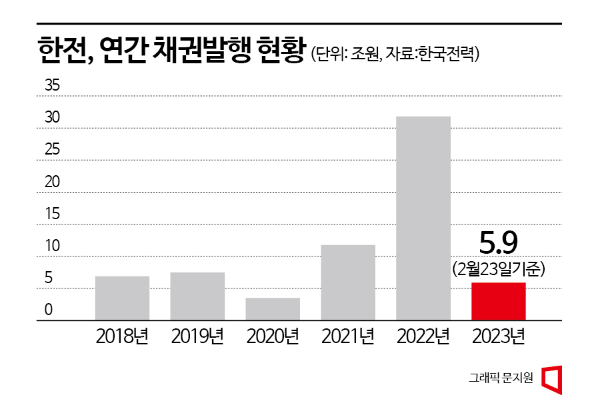
KEPCO recorded its worst-ever performance last year with a total deficit of 32.6 trillion won, and this year, the monthly deficit continues to increase by about 3 trillion won each month. The amount of corporate bonds (long-term bonds) issued by KEPCO for electricity purchases totaled 5.9 trillion won as of the 23rd of this month, a 34.1% increase compared to 4.4 trillion won during the same period last year. The total amount of corporate bonds issued last year was 31.8 trillion won, and if the SMP cap system is not reinstated, the expected deficit will increase further.
The recent rise in KEPCO bond issuance interest rates is also a long-term burden. According to the Korea Financial Investment Association, as of the day before, the issuance interest rate for KEPCO 3-year bonds re-entered the 4% range at 4.123%, just one month after falling to the 3% range. The cumulative amount of KEPCO corporate bonds issued reached 72.7 trillion won, an increase of 2.1 trillion won in just two months compared to 70.6 trillion won at the end of last year. The rate of increase is faster than the rate at which the bonds are being repaid.
The possibility of an electricity rate hike in the second quarter of this year is also uncertain. Due to the recent heating cost shock, the government feels burdened by raising public utility rates, strengthening expectations that a slowdown is inevitable. Minister Lee Chang-yang of the Ministry of Trade, Industry and Energy has stated that an electricity rate increase is necessary in the second quarter considering KEPCO's financial situation, but the Presidential Office is discussing the possibility of freezing rates to consider the burden on low-income households.
Opposition to the reinstatement of the SMP cap system, mainly from private power producers who sell electricity, also makes the situation difficult for KEPCO. Prior to the implementation of the cap system last year, associations related to renewable energy and district energy opposed it, arguing that the SMP destroys the industrial ecosystem and does not meet the legitimate compensation requirements for restrictions on property rights. They argue that the government should not force sacrifices from power producers without fundamentally normalizing electricity rates.
© The Asia Business Daily(www.asiae.co.kr). All rights reserved.
![Clutching a Stolen Dior Bag, Saying "I Hate Being Poor but Real"... The Grotesque Con of a "Human Knockoff" [Slate]](https://cwcontent.asiae.co.kr/asiaresize/183/2026021902243444107_1771435474.jpg)















