Through Revision of Model Standards
Sequential Ratio Adjustment Expected
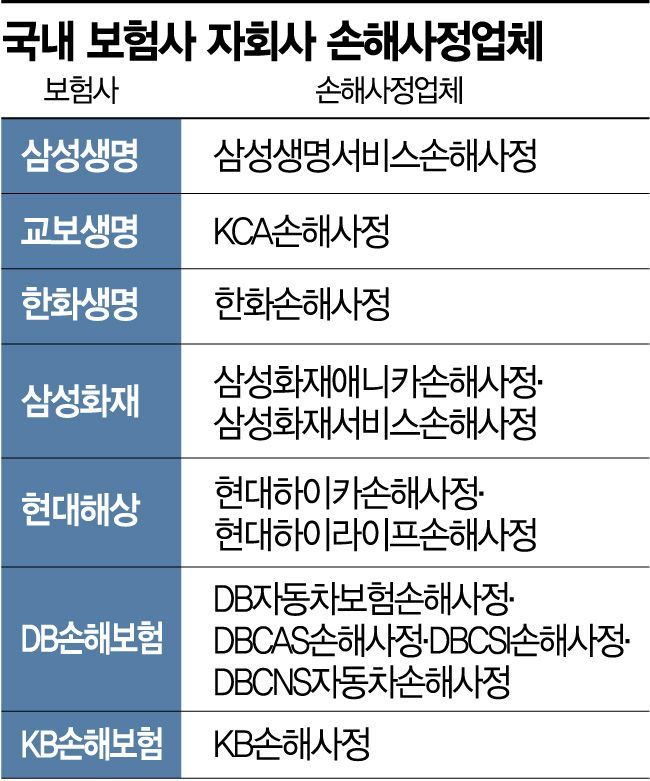
Starting as early as the second quarter of this year, restrictions will be imposed on insurance companies' practice of funneling 'claims adjustment work' to their subsidiaries.
According to the financial sector on the 28th, the General Insurance Association recently informed each insurance company that it plans to implement a revised version of the "Model Regulations on Outsourcing Claims Adjustment Work and Appointment of Claims Adjusters," which limits the proportion of work that large insurers can assign to their subsidiary claims adjustment corporations to 50%, following consultations with the Financial Services Commission and the Financial Supervisory Service.
A senior official from the Financial Supervisory Service stated, "There is a consensus that outsourcing 100% of claims adjustment work to subsidiaries may appear unfair from the public's perspective," adding, "We are exploring ways to gradually reduce the proportion of work outsourced to subsidiaries in stages with the industry, and the financial authorities hope to implement the model regulations as soon as possible."
The revision changes the provisions related to "outsourcing of claims adjustment work by insurance companies." Going forward, the scope of outsourcing claims adjustment work to subsidiary claims adjustment entities will be recommended to be limited to "around 50% of the number of claims adjustment cases outsourced in the previous year."
If this ratio is exceeded, the "selection criteria" and "selection results" must be reported to the board of directors and disclosed publicly once a year.
Although the Financial Services Commission and the Financial Supervisory Service announced improvements to the claims adjustment system including these measures in 2021, delays in related legislative amendments in the National Assembly have led the insurance industry to initiate self-purification efforts.
Claims adjusters investigate and analyze incidents when insurance claims occur and determine the scope of compensation by calculating the amount of loss.
Claims adjustment is operated in forms such as "employed or outsourced adjusters," where insurers either directly employ or outsource to external claims adjustment corporations (subsidiaries or non-subsidiaries), and "independent adjusters," who are appointed directly by policyholders or insured parties separately from insurers.
The current claims adjustment system prohibits self-adjustment, but insurance companies have been criticized for effectively conducting "self claims adjustment" by establishing subsidiary claims adjustment corporations based on exceptions in the Enforcement Decree of the Insurance Business Act and entrusting most of the claims adjustment work to these subsidiaries.
Most major domestic insurers, including Samsung Life Insurance, Kyobo Life Insurance, Hanwha Life Insurance, Samsung Fire & Marine Insurance, Hyundai Marine & Fire Insurance, DB Insurance, and KB Insurance, have subsidiary claims adjustment corporations. The proportion of claims adjustment work these companies entrust to their subsidiaries ranges from 64.7% to 99.5% (based on 2021 commission payments). By company, the figures are Kyobo Life Insurance (99.5%), Hanwha Life Insurance (97.0%), Samsung Life Insurance (89.8%), DB Insurance (82.7%), Samsung Fire & Marine Insurance (71.2%), Hyundai Marine & Fire Insurance (66.8%), and KB Insurance (64.7%).
As a result, there have been ongoing calls for reform. Hwang Unha, a member of the National Assembly's Political Affairs Committee from the Democratic Party of Korea, previously pointed out, "It is practically impossible to prevent insurance companies from inducing their subsidiary claims adjustment corporations to reduce insurance payouts and using this as a performance indicator." Moreover, complaints related to claims adjustment in the insurance sector have somewhat increased recently. Although claims adjustment complaints account for about 3% of all insurance-related complaints, the number of such complaints rose approximately 2.4 times from 117 cases in 2017 to 278 cases in 2022.
There is also anticipation that the enforcement of the 50% rule will revitalize the outsourced claims adjustment corporation industry. Until now, the industry has been stagnant as work concentrated on subsidiary claims adjustment corporations, leading to a trend of claims adjustment corporations disappearing.
© The Asia Business Daily(www.asiae.co.kr). All rights reserved.
![Clutching a Stolen Dior Bag, Saying "I Hate Being Poor but Real"... The Grotesque Con of a "Human Knockoff" [Slate]](https://cwcontent.asiae.co.kr/asiaresize/183/2026021902243444107_1771435474.jpg)















