Survey of Judgments Shows 78% of Crimes Committed via SNS
"Ran Away" Posts Prompt Immediate Contact from Adults
Crisis Youth Neglected by Society Mainly Encounter Sex Trade
Government Shifts Responsibility to SNS and Chat App Companies
"Please send me a DM (short for Direct Message)." When a middle school student born in 2008 posted a plea for help on the social networking service (SNS) Twitter, more than 15 comments appeared at once. Some asked, "Are you available on weekends?" People rushed to buy the middle school student's sexuality. A homeless youth, Ms. A (18), said, "It is safe to say that no one contacts with pure intentions through SNS," adding, "Every day, messages proposing prostitution, prostitution mediation, and transactional meetings come to the SNS accounts of runaway youths."
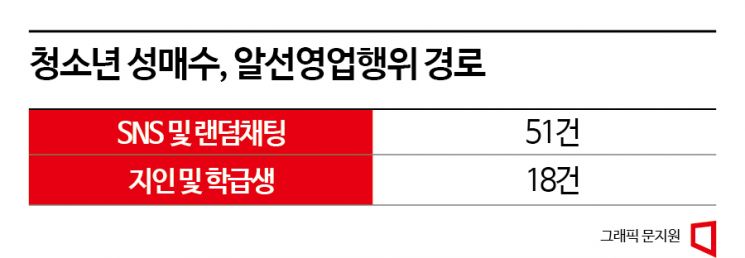
On the 28th, Asia Economy conducted a full survey of 69 court rulings from last year involving charges of prostitution, mediation business, coercion, and statutory rape of minors under the Act on the Protection of Children and Juveniles Against Sexual Abuse (Child and Youth Sexual Protection Act). The results showed that there were a total of 51 cases of youth prostitution conducted through SNS such as Twitter and random chat applications. This means that most youth prostitution occurs online.
Even now, youth prostitution can be easily encountered on SNS. When a post is made saying that a female middle or high school student has run away from home, people immediately contact her. They exploit the difficult situation to buy the youth's sexuality or to keep them at their place. Sexual relations with youths, as well as merely providing lodging and meals at their residence, constitute illegal acts violating the Act on the Protection and Support of Missing Children. Some students openly specify prostitution prices. They sell not only similar sexual acts and sexual intercourse but also the underwear they wore, attaching price tags.
 On social networking services (SNS) including Twitter, posts buying and selling the sexuality of teenagers are openly posted. / Source=Twitter
The same applies to random chat applications. When accessing the random chat application 'OO,' countless posts appeared with presumed prostitution prices such as "9 for once, 15 for twice, 7 in a car." Currently, random chat applications only allow adults to register, but prostitution brokers buy and sell youths' sexuality on their behalf. In November 2020, offender Mr. B was tried in Daegu for mediating prostitution of two 12-year-old youths through a chat application. Mr. B mediated prostitution 12 times to unnamed buyers.
Ongoing Child and Youth Prostitution... Mainly Encountered by Youths in Difficult Situations
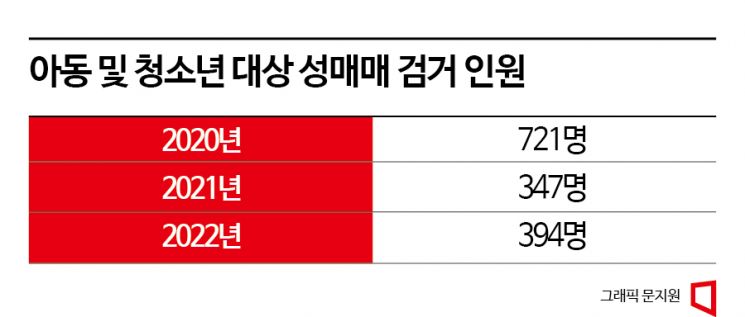
Child and youth prostitution occurs steadily every year. According to the National Police Agency, 721 people were caught buying the sexuality of children and youths in 2020, 347 in 2021, and 394 last year. Considering 'online grooming,' which exploits youths' sexuality through online conversations, and the dark web, the scale of youth prostitution is expected to be even larger.
Generally, youths in unstable situations encounter such prostitution. They are effectively neglected by society and pushed to the brink. According to the Ministry of Gender Equality and Family, as of 2019, 47.6% of at-risk youths experienced transactional meetings with adults. Furthermore, among at-risk youths who experienced transactional meetings, 77.3% said they tried it for the first time after running away from home. Legislative Researcher Heo Min-sook pointed out, "Adults are exploiting youths' difficult situations," adding, "Society has an obligation to protect children and youths from harmful environments, but it is neglecting this duty."
The state still shifts responsibility to SNS or random chat application providers. When these providers have servers overseas, there are no clear regulations regarding search and seizure, making investigations impossible. Of course, if the headquarters are in the United States, investigations are possible through criminal justice cooperation treaties, but the process involves going through law enforcement officers, prosecutors, the Ministry of Justice, the Ministry of Foreign Affairs, the U.S. Department of State, the U.S. Department of Justice, prosecutors, and overseas corporations in sequence, then reversing the order. Unless victims collect and submit evidence directly, investigative agencies cannot proactively respond.
There are calls for the state to play a role it can, such as strongly punishing criminals who buy the sexuality of children and youths. Jo Jin-kyung, director of the Teenage Women's Human Rights Center, said, "As technology advances, sexual crimes against children and youths are becoming more sophisticated and malicious," adding, "The state must actively step forward and send a message that it will protect children and youths."
© The Asia Business Daily(www.asiae.co.kr). All rights reserved.
![Clutching a Stolen Dior Bag, Saying "I Hate Being Poor but Real"... The Grotesque Con of a "Human Knockoff" [Slate]](https://cwcontent.asiae.co.kr/asiaresize/183/2026021902243444107_1771435474.jpg)

















