Comprehensive Judgment on Spaces Beyond Facility Use and Learning Purposes
Second Instance 'Guilty' Verdict Overturned and Remanded for Not Guilty
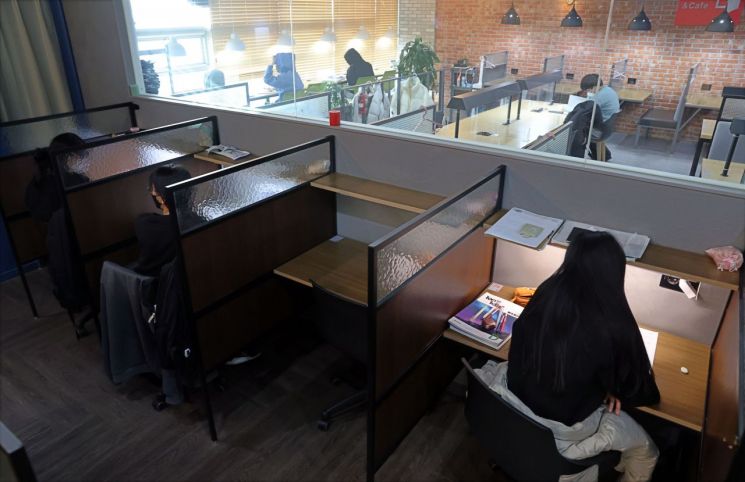 Interior view of a study cafe in Suwon-si, Gyeonggi-do. (Not directly related to the article content) [Image source=Yonhap News]
The Supreme Court has ruled that study cafes cannot be regarded as 'reading rooms' subject to the same regulations as academies under the Act on the Establishment, Operation, and Tuition of Private Institutes (the Academy Act). Through this ruling, the Supreme Court specifically outlined the criteria distinguishing reading rooms regulated as academies under the Academy Act from those that are not.
Study cafes include not only individual study spaces similar to reading rooms but also 'PC zones' where computers can be used, 'study rooms,' and 'eating areas.' Additionally, the purpose of the facility's use is not limited to 'study,' and most customers used hourly rates for less than 30 days, which served as grounds for the judgment that these are not reading rooms under the Academy Act.
According to the legal community on the 26th, The Supreme Court's 2nd Division (Presiding Justice Min Yu-sook) overturned the lower court's ruling that fined study cafe operator Mr. A 1 million KRW for violating the Academy Act earlier this month and remanded the case to the Suwon District Court.
The court stated, "The lower court upheld the first trial's judgment, which found the defendant guilty on the grounds that the facility (study cafe) was provided as a study place to an unspecified number of people for more than 30 days, thus qualifying as a 'reading room,' a type of academy under Article 2, Clause 1 of the Academy Act. However, the lower court's judgment is difficult to accept."
The court pointed out, "Considering comprehensively the regulatory framework and legislative history of the Academy Act, provisions in other laws distinguishing 'academies' and 'reading rooms,' the dictionary meaning of academies, and the legislative purpose of the Academy Act, whether a 'reading room' provided as a study place for more than 30 days qualifies as an academy subject to registration under the Academy Act depends on whether its function or purpose is comparable to a facility that teaches knowledge, skills, or arts. It must be strictly interpreted by comprehensively considering whether the facility's use is limited to study or if the manager prohibits use for non-study purposes, whether the structure and equipment of the facility are primarily designed to create a study environment, the presence and area of spaces or facilities used for non-study purposes, the content of services provided, the payment methods and purposes of users, and other usage realities."
Then, after listing various characteristics of the study cafe operated by Mr. A, the court concluded, "It is difficult to consider the facility in question as a 'facility provided as a study place for more than 30 days' as defined in Article 2, Clause 1 of the Academy Act." It added, "Nevertheless, the lower court found the defendant guilty for the reasons stated above, which constitutes a misinterpretation of the legal principles concerning 'academies' as defined in Article 2, Clause 1 of the Academy Act, affecting the judgment," explaining the reason for overturning and remanding the case.
Mr. A, who operates an unmanned study cafe in Jangan-gu, Suwon City, was prosecuted for operating a 'reading room' subject to registration under the Academy Act without registering with the competent authority (the Superintendent of Education). The prosecution charged Mr. A with operating an unregistered reading room by installing 95 seats in an internal area of 75 pyeong (approximately 248 square meters) around March 2020 and charging users a monthly subscription fee of 120,000 KRW.
Mr. A registered his business under the trade name 'OOO Study Cafe,' business type as 'service,' and category as 'study cafe.'
Through flyers and internet advertisements, Mr. A promoted the target users as 'civil service exam candidates, job seekers, university and high school students, and general public for hourly space rental,' and advertised study room rentals as 'small group space rental, FC planner space rental, consultation room rental,' describing the facility as a 'comfortable place to study, operating 24 hours unmanned.'
Inside the study cafe, desks with partitions blocking sight and fixed chairs of a general type were provided, but no special amenities were offered at each seat.
Customers could select and pay for their desired seat among available seats at an unmanned payment kiosk at the entrance and then use the facility. The usage fee was set hourly for single-use tickets (e.g., 3,000 KRW for 2 hours), and the 4-week subscription was priced at 120,000 KRW.
Meanwhile, the study cafe had separate 'study room zones' and 'PC zones' accommodating six people each, and the lounge was equipped with vending machines offering boiled eggs and coffee.
Article 2 (Definitions) Clause 1 of the Academy Act defines an academy as "a facility that provides knowledge, skills, or arts instruction to ten or more learners or an unspecified number of learners according to a course of instruction lasting 30 days or more, or a facility provided as a study place for 30 days or more,"
while Enforcement Decree Article 2 (Definitions) Paragraph 1 Clause 4 defines a 'reading room' as "a facility provided as a study place, which is an academy facility, and regulates reading rooms that are provided only as study places without instructional activities as academies under the Academy Act."
Article 6 (Registration for Establishment and Operation of Academies) Paragraph 1 of the same Act stipulates that "a person who intends to establish or operate an academy must register with the Superintendent of Education by submitting an application form containing the personal details of the founder, course of instruction, list of instructors, tuition fees, facilities, and equipment in accordance with the Presidential Decree after equipping the facilities and equipment prescribed in Article 8."
If this registration obligation is not fulfilled, Article 22 (Penalties) Paragraph 1 Clause 1 of the same Act provides for punishment by imprisonment for up to one year or a fine of up to 10 million KRW.
The first trial court found Mr. A guilty of violating the Academy Act for operating a study cafe that qualifies as a reading room subject to registration under the Academy Act without registering and sentenced him to a fine of 1 million KRW.
The court considered ▲the installation structure of partitions, the area within the partitioned desks, and the fact that one person designates one seat, concluding that it seems impossible to have conversations or conduct work with others at the designated seats within the facility as in a typical cafe, ▲the defendant consistently claimed that the facility provides a new space where users can freely spend leisure time, but no equipment other than partitioned desks and chairs was visible, ▲the PCs, beverages, and food provided appeared to be for the convenience of customers using the seats rather than for sale, ▲the study rooms in the cafe are spaces provided incidentally to users who pay for seats in the facility (considering the overall facility size and unmanned payment system, it is difficult to see study room rental as the main purpose of using the cafe), ▲some users were provided fixed seats, and subscription payments were possible, and concluded, "Considering these circumstances comprehensively, it is reasonable to find that the defendant provided the facility as a study place to an unspecified number of people for more than 30 days."
When a public official from the competent authority visited Mr. A's study cafe on March 24, 2020, 24 students were using the cafe, and seats numbered 1, 8, 24, 33, and 51 were classified as fixed seats, unavailable to the general public, which served as evidence.
Meanwhile, during the trial, Mr. A claimed that the study cafe he operates was not a reading room and requested a constitutional review of Article 22 Paragraph 1 Clause 1, Article 6, Article 2, Article 2-2 defining types of academies, and related provisions of the Enforcement Decree of the Academy Act.
Mr. A's side argued, "In this case, a reading room means a facility provided as a study place for 30 days or more to ten or more or an unspecified number of learners, and there is no limitation on the scope of study or study place, making the concept of reading rooms abstract and broad, violating the principle of clarity under the principle of legality. It is unconstitutional as it criminally punishes new startups, infringing on the right to pursue happiness."
The court dismissed the request for constitutional review regarding Article 2-2 of the Academy Act and some Enforcement Decree provisions, stating that even if the Constitutional Court ruled them unconstitutional, it would not affect Mr. A's punishment.
Regarding the remaining provisions, the court recognized the 'premise of the trial' that the ruling of unconstitutionality by the Constitutional Court could change the order of Mr. A's criminal trial but rejected the constitutional review request on the grounds that "the provisions are not so unclear as to prevent predicting the substance of the punishable act."
The second trial court also found no problem with the first trial's judgment, rejecting all of Mr. A's claims of factual error, legal misinterpretation, and excessive sentencing, and dismissed his appeal.
However, the Supreme Court's judgment differed.
The court first acknowledged, "Regarding the individual seat spaces in the facility, desks and chairs with partitions are arranged per seat, and users can exclusively use the designated seat for a certain period after paying the fee, which is somewhat similar to a reading room."
However, the court also noted ▲the facility includes not only individual seat spaces but also 'PC zones' where computers can be used, 'study rooms' for small group meetings, and spaces where users can purchase and consume snacks such as coffee and boiled eggs, ▲the purpose of use is not limited to 'study,' and there is no evidence that the defendant prohibited activities other than study in the facility, so customers likely used the study rooms for personal work or leisure, ▲the facility's promotional flyers emphasize a 'comfortable and pleasant atmosphere' and state that space rental is available on an hourly basis to high school students, university students, job seekers, and the general public, and that study rooms are rented for small group meetings, with some women reportedly using the study rooms for such purposes, ▲the usage fees are composed of differential 'hourly rates' from 2 hours to 24 hours and a '4-week subscription' based on 28 days, with the subscription period being less than 30 days, ▲when the enforcement officer visited, 6 out of 95 seats were classified as fixed seats, and most users appeared to use the hourly rate, a one-time usage method, concluding that "it is difficult to consider the facility as a 'facility provided as a study place for 30 days or more' as defined in Article 2, Clause 1 of the Academy Act."
© The Asia Business Daily(www.asiae.co.kr). All rights reserved.
![Clutching a Stolen Dior Bag, Saying "I Hate Being Poor but Real"... The Grotesque Con of a "Human Knockoff" [Slate]](https://cwcontent.asiae.co.kr/asiaresize/183/2026021902243444107_1771435474.jpg)















