Bile produced in the liver plays a role in aiding the absorption of fats. Bile travels from the liver through the 'bile duct (biliary tract)' to the duodenum, and cancer that develops in this bile duct is called cholangiocarcinoma. Although it is not a well-known cancer among the general public, it is one of the cancers with an extremely poor prognosis. According to the national cancer registration statistics as of 2020, the number of patients with 'gallbladder and other biliary tract' cancers, including cholangiocarcinoma, was 7,452, making it the ninth most common cancer type in South Korea. Although the 5-year survival rate has been gradually increasing, it was only 29.0% for the period from 2016 to 2020.
If diagnosed early, the treatment effectiveness for cholangiocarcinoma can be improved. However, current technologies have low accuracy. The standard test used in clinical practice for early diagnosis, the blood CA19-9 test, has a diagnostic rate of only 70%. Due to this, diagnosis is often delayed, and only about 30% of patients are eligible for surgery at the time of diagnosis. The standard definitive diagnostic method for cholangiocarcinoma is an invasive procedure involving endoscopic retrograde cholangiopancreatography (ERCP) to directly obtain tissue samples, but its diagnostic rate is low, requiring repeated tests, which is inconvenient. To overcome this, the medical community has recently been actively developing 'liquid biopsy' technology. Liquid biopsy is a non-invasive technique that detects tumor markers in body fluids to diagnose cancer, gaining attention especially in cancer fields where early diagnosis by tissue biopsy is difficult.
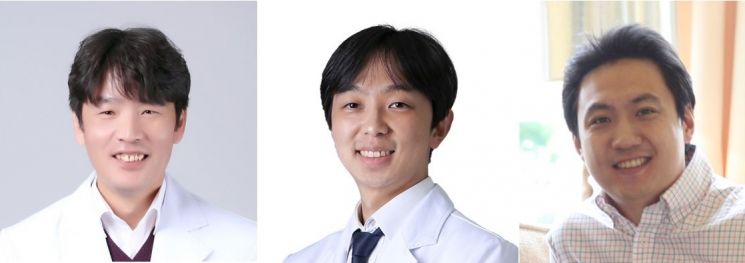 Professors Seungmin Bang and Junghyun Cho from the Department of Gastroenterology at Severance Hospital, and Professor Hyungsun Lim from Harvard Medical School. (from left)
Cholangiocarcinoma is also considered a cancer field with a high need for liquid biopsy research. However, due to the lack of specific markers, development has been challenging until recently, when a Korean research team, in collaboration with Harvard Medical School in the United States, developed a liquid biopsy technology that has attracted attention. The research team from the Department of Gastroenterology at Severance Hospital, led by Professors Seungmin Bang and Junghyun Cho, together with Professor Hyungsun Lim’s team at Massachusetts General Hospital, Harvard Medical School, succeeded in developing a liquid biopsy diagnostic technology that uses extracellular vesicles to enable early diagnosis of cholangiocarcinoma.
The research team first compared extracellular vesicles extracted from normal cells and cholangiocarcinoma cells to identify tumor markers occurring in cholangiocarcinoma. Extracellular vesicles derived from cancer contain proteins, nucleic acids, and lipid substances that represent cancer cells, making them a recently highlighted biomaterial for cancer diagnosis through liquid biopsy. During this process, the team confirmed that the expression of MUC1, EpCAM, and EGFR proteins was high in extracellular vesicles derived from cholangiocarcinoma and that these proteins were also frequently found in actual patient tissues.
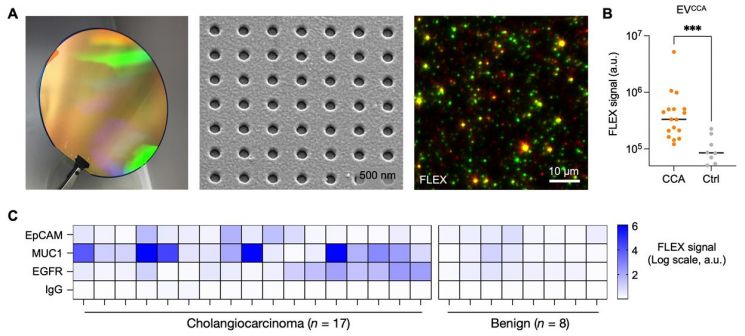 A: 'FLEX' sensor chip technology developed by a research team at Harvard Medical School significantly improves the detection and analysis accuracy of extracellular vesicles.
 B: It was confirmed that the expression of three target proteins in bile extracellular vesicles of cholangiocarcinoma patients was statistically significantly higher compared to benign patients.
C: When comparing bile extracellular vesicles from 17 cholangiocarcinoma patients and 8 benign tumor patients, the three target proteins were more strongly expressed in cholangiocarcinoma patients.
[Data provided by Severance Hospital]
Next, to analyze the proteins expressed in extracellular vesicles, the research team utilized the 'FLEX' sensor chip technology developed by the Harvard Medical School team. This technology significantly amplifies the optical signals of cancer cell-derived extracellular vesicles in body fluids containing a mixture of normal and cancer cell-derived extracellular vesicles, thereby improving analytical precision. The researchers extracted extracellular vesicles from patients' bile and used the FLEX sensor chip technology to analyze the expression of the three target proteins. They found that the target proteins were measured at higher levels in the bile of cholangiocarcinoma patients compared to patients with benign diseases.
The accuracy of the liquid biopsy diagnostic technology developed in this way surpassed existing diagnostic methods. In diagnostic tests conducted on the same 25 patients, the liquid biopsy diagnostic accuracy developed by the research team recorded 93%, far exceeding that of blood tests (69%) and endoscopic retrograde cholangiopancreatography tissue biopsy (71%). Professor Junghyun Cho stated, "Through this study, we were able to discover diagnostic markers for cholangiocarcinoma and develop a liquid biopsy diagnostic technology with higher diagnostic accuracy than existing methods in collaboration with Harvard Medical School. We are continuing liquid biopsy research using bile and blood from more cholangiocarcinoma patients to verify the accuracy of the test and improve patient convenience." The results of this study were published in the international academic journal 'Advanced Science (IF 17.521).'
© The Asia Business Daily(www.asiae.co.kr). All rights reserved.
![Clutching a Stolen Dior Bag, Saying "I Hate Being Poor but Real"... The Grotesque Con of a "Human Knockoff" [Slate]](https://cwcontent.asiae.co.kr/asiaresize/183/2026021902243444107_1771435474.jpg)
















