Gwangju Mayor Kang Ki-jung Announces 'Public Institution Structural Reform Plan'
Focus on Enhancing Management Efficiency and Strengthening Accountability to Citizens
[Asia Economy Honam Reporting Headquarters Reporter Yoon Jamin] The Gwangju Tourism Foundation and Kim Dae-jung Convention Center will be integrated and reborn as the ‘Gwangju Tourism Corporation.’ Additionally, the Gwangju Institute of Science and Technology Promotion will be integrated into ‘Gwangju Technopark.’
On the 23rd, Gwangju Mayor Kang Gi-jung announced the ‘8th Term Gwangju Metropolitan City Public Institution Structural Innovation Plan’ with these details at the city hall briefing room.
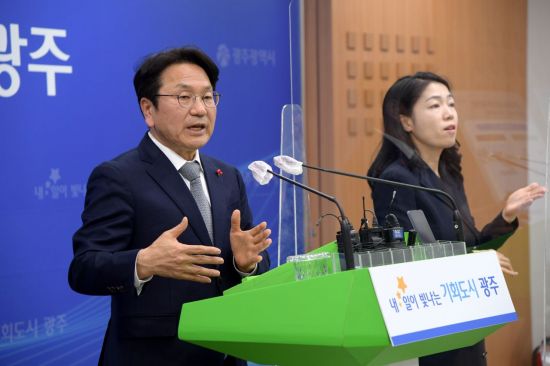
This public institution structural innovation focuses on enhancing management efficiency and strengthening accountability to citizens.
It was promoted based on three fundamental principles: adjustment of similar and overlapping functions and reorganization of private competitive projects, integration and strengthening of function-centered organizations, and employment guarantees following integration.
According to the structural innovation principles, eight public institutions will be integrated into four institutions, and three institutions will have their functions expanded. As a result, the number of Gwangju public institutions will be reduced from the existing 24 to 20.
The integrated institutions are ▲Gwangju Tourism Corporation (Tourism Foundation + Kim Dae-jung Center) ▲Gwangju Technopark (Gwangju Technopark + Institute of Science and Technology Promotion) ▲Gwangju Social Welfare Service Center (Social Service Center + Welfare Research Institute) ▲Gwangju Win-Win Job Economy Foundation (Win-Win Job Foundation + Economic Employment Promotion Institute).
The Gwangju Tourism Corporation is born by integrating the Tourism Foundation and Kim Dae-jung Center to strengthen planning capabilities for Gwangju’s tourism strategy and tourism industry and to establish a virtuous cycle ecosystem before and after the MICE industry.
Gwangju Technopark will unify science and technology and industrial platforms to create a full-cycle science and technology and industrial convergence system from basic research to industrial promotion by integrating the Institute of Science and Technology Promotion.
The Gwangju Social Welfare Service Center combines research (Welfare Research Institute) and execution agencies (Social Service Center) so that welfare research and investigation are provided as welfare services and then fed back to upgrade Gwangju’s welfare to the next level.
The Gwangju Win-Win Job Economy Foundation integrates the Win-Win Job Foundation and Economic Employment Promotion Institute to strengthen a comprehensive support system for labor and employment so that the achievements of the Gwangju-type jobs are evenly distributed to the regional economy and small and medium-sized business workers.
The Gwangju Transportation Corporation (Urban Railway Corporation), Gwangju Climate Energy Promotion Institute (International Climate Environment Center), and Gwangju Talent Lifelong Education Promotion Institute (Lifelong Education Promotion Institute) will have their functions strengthened.
The Gwangju Transportation Corporation will serve as the control tower for Gwangju transportation, encompassing public transportation overall rather than focusing solely on railroads, and the Gwangju Climate Energy Promotion Institute will concentrate on five major areas: climate crisis, energy, resource circulation, environmental education, and green architecture.
The Gwangju Talent Lifelong Education Promotion Institute will strengthen a customized citizen education system by growth stage and establish its status as the control tower of lifelong education, including education for the disabled and customized talent education.
Mayor Kang stated, “Through organizational restructuring, we will improve the management efficiency of public institutions and strengthen accountability to citizens.”
Similar and overlapping functions of public institutions will be adjusted, and tasks with high private competitiveness will be boldly transferred or entrusted to the private sector. Additionally, to respond to new environmental changes and secure momentum for key issues of the 8th term, some public institutions’ functions will be strengthened.
Mayor Kang emphasized, “Even if integrated, the employment of affiliated employees will be thoroughly guaranteed.”
He plans to institutionalize ‘responsible management’ by aligning the terms of elected mayors and public institution heads. This will eliminate inefficiencies that arise whenever a new local government head is elected, unify the terms of heads of invested and contributed institutions to two years with the possibility of reappointment, so that the mayor and institution head start and end their terms together.
Furthermore, the scope of public institution head personnel hearings will be expanded to enhance democracy and accountability. Public institutions with 100 or more staff or an annual budget of 50 billion KRW or more will be included as subjects of personnel hearings in consultation with the city council.
Applying this criterion will expand the number of institutions subject to personnel hearings from eight to ten.
Standard guidelines for common operations such as personnel, accounting, and contracts will be established, and disciplinary regulations will be upgraded to increase the accountability of public institutions.
Gwangju City plans to complete the public institution structural innovation through institution integration → function adjustment (end of April) → announcement of management innovation plans by institution (June to July).
Once all procedures for integration are completed, management innovation plans for each integrated institution will be announced sequentially.
Mayor Kang said, “The reason for the existence of public institutions is to provide high-quality public services to citizens and demonstrate strong accountability to them,” and expressed his determination for public institution innovation by stating, “Public institutions that are not accountable to citizens must be boldly innovated without clinging to organizational logic.”
He added, “We can no longer delay the clock of Gwangju’s development due to inefficiency, lax management, and moral hazard vicious cycles,” promising, “We will be reborn as Gwangju public institutions with enhanced efficiency, autonomy, responsibility, and capability.”
© The Asia Business Daily(www.asiae.co.kr). All rights reserved.
![Clutching a Stolen Dior Bag, Saying "I Hate Being Poor but Real"... The Grotesque Con of a "Human Knockoff" [Slate]](https://cwcontent.asiae.co.kr/asiaresize/183/2026021902243444107_1771435474.jpg)















