Ministry of Economy and Finance, 2022 Economic Literacy Survey of Elementary, Middle, and High School Students
Average Scores Increased by About 10% Compared to 2020 but Still Low
[Asia Economy Sejong=Reporter Ju Sang-don] The economic literacy of elementary, middle, and high school students remains low, around 60 points. There is a need to quantitatively and qualitatively strengthen school economic education programs to improve economic literacy.
On the 23rd, the Ministry of Economy and Finance announced the results of the 2022 economic literacy survey of elementary, middle, and high school students.
This survey aims to identify the achievements and weaknesses of economic education and to set directions for promoting school economic education. It is the second survey since the first was conducted in 2020. The survey targeted 5,000 students each from nationwide elementary school 6th graders, middle school 3rd graders, and high school 2nd graders, totaling 15,000 students.
The average scores of the 2022 economic literacy survey were ▲ elementary students 65 points ▲ middle school students 58 points ▲ high school students 57 points, showing increases of 7.3, 8.4, and 5.0 points respectively compared to the 2020 survey.
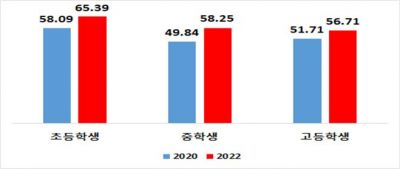
An official from the Ministry of Economy and Finance said, "The score increase is due to strengthened learning feedback following the transition from mainly online classes in 2020 to face-to-face classes in 2022," adding, "Despite an increase of about 10% in average scores, they remain around 60 points, so continuous efforts are needed to improve academic achievement."
The main source of economic knowledge for elementary and middle school students was 'school classes,' exceeding 50% (elementary 51.5%, middle 52.2%). For high school students, the response rates for 'news and TV broadcasts (47.1%)' and 'social media (45.6%)' were higher than for 'school classes (44.0%).'
About 45.4% of middle school students and 51.4% of high school students responded that economic education time was insufficient, and both middle and high school students selected financial products and basic concepts and principles of economics as their first and second preferred learning contents.
Accordingly, the Ministry of Economy and Finance plans to steadily implement the 'Plan to Enhance School Economic Education,' confirmed through the 12th Economic Education Management Committee (December last year), based on the recognition that school economic education is important for nurturing future talents with economic literacy.
First, to expand economic education programs, they will develop educational materials with high field acceptance and provide student-participatory programs centered on real-life that can be used in cross-curricular learning such as the free semester system.
To improve the teaching capabilities of economic education teachers, customized teaching materials for teachers and enhancement of economic education training will be promoted. The 'Digital Economic Education Platform,' scheduled to be established in 2023, will significantly expand the teacher teaching materials database (DB) and systematically classify it to actively provide it for use in classes. Additionally, economic teacher training will be reorganized, and incentives will be given to encourage participation in job training.
© The Asia Business Daily(www.asiae.co.kr). All rights reserved.
![Clutching a Stolen Dior Bag, Saying "I Hate Being Poor but Real"... The Grotesque Con of a "Human Knockoff" [Slate]](https://cwcontent.asiae.co.kr/asiaresize/183/2026021902243444107_1771435474.jpg)















