US 'Exchange Tower' Nears Completion
'Safety, Cost Reduction, and Shortened Construction Time' Advantages
When constructing a building, the common practice is to stack floors from the bottom up (bottom-up method). However, a building in the United States is about to be completed using a method that reverses this convention by filling from the top floor downwards.
The 16-story (63m) tall "Exchange Tower" being built in Detroit, Michigan, is the subject. After lifting the 453-ton roof for the first time in May last year, the construction is proceeding downward one floor at a time using a top-down method. According to the website of the parent company of the construction firm, Barton Malow, the building is scheduled for completion this spring with tenant move-in planned for summer.
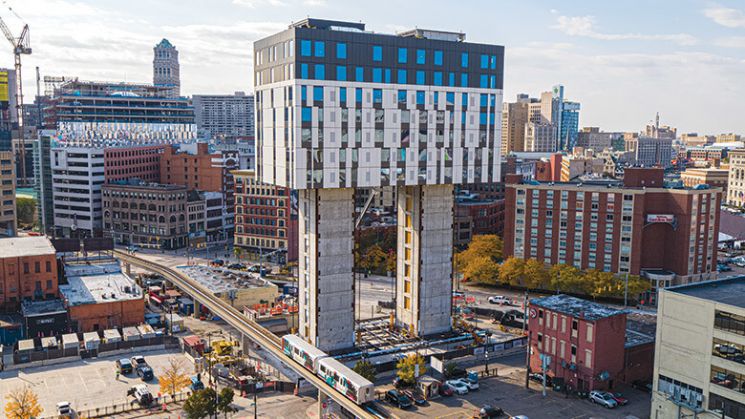
The method, called Liftbuild, involves manufacturing each floor on the ground and then lifting it up to fix it to the central column. Each floor weighed up to 500 tons, and the average lifting speed was 6 to 9 meters per hour.
The reason for using this unconventional method was that the construction site is adjacent to a monorail operation section, making it difficult to use the traditional tower crane method.
However, it is reported that the remaining ground floors 1 and 2 will be constructed using the conventional method.
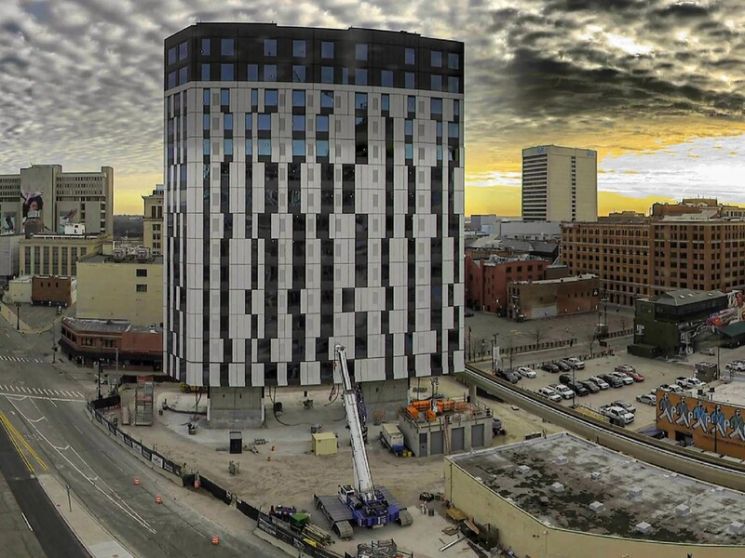
The construction company stated that this method offers three advantages: safety, cost reduction, and shorter construction time.
First, since all floors are manufactured on the ground and then lifted up, it prevents accidents involving falling construction materials or workers during high-rise work, making it safer.
Additionally, the company claims that Liftbuild requires 10 to 20% fewer workers than traditional methods and can reduce construction time by up to 50%. This is because workers do not need to climb cranes or stairs as frequently during construction. Consequently, it also leads to reduced construction costs.
On the other hand, there are disadvantages. Since the process involves lifting heavy floor slabs, any mistake during construction could lead to a major accident. In 1987, a similar method was used to build an apartment in Connecticut, USA, but the building collapsed during construction, resulting in 28 deaths. However, as this is a challenge after 35 years, the Exchange Tower construction company claims to have conducted four years of safety research and has filed patents related to this method.
© The Asia Business Daily(www.asiae.co.kr). All rights reserved.
![Clutching a Stolen Dior Bag, Saying "I Hate Being Poor but Real"... The Grotesque Con of a "Human Knockoff" [Slate]](https://cwcontent.asiae.co.kr/asiaresize/183/2026021902243444107_1771435474.jpg)
















