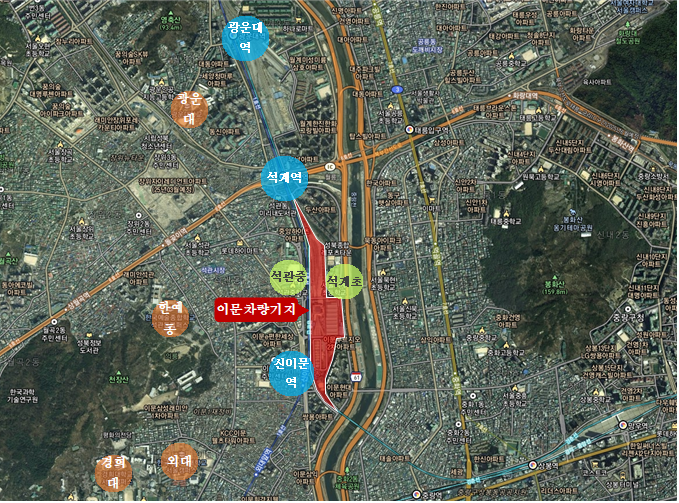
[Asia Economy Reporter Ryu Tae-min] The Seoul Metropolitan Government is promoting a basic conceptual study for the development of approximately 200,000㎡ of the Imun Vehicle Depot site.
The Imun Vehicle Depot is a large-scale vehicle depot managed by Korea Railroad Corporation (KORAIL), located in Seokgwan-dong, Seongbuk-gu, and the Dongdaemun-gu area of Seoul. It is responsible for the maintenance and housing of railway vehicles such as KTX. Until now, the area around the Imun Vehicle Depot has frequently experienced resident complaints due to squeal noise generated by electric trains in the depot and dust emissions, which have been cited as factors causing regional disconnection and hindering development.
Seoul is promoting the complex development of infrastructure to create new urban spaces as one of the seven major goals of the ‘2040 Seoul Urban Basic Plan.’ The city plans to introduce insufficient local resident convenience facilities in Seokgwan-dong and Imun-dong areas in connection with nearby projects such as the Kwangwoon University Station area development, large-scale residential improvement projects under the Imun-Hwigyeong Redevelopment Promotion Plan, and the Jungnangcheon stream parkification. Additionally, it aims to establish a development direction to revitalize the Shin-Imun Station area, which is less active compared to other station areas.
Furthermore, by applying a world-class eco-friendly building certification system, the plan is to create an eco-friendly green city centered on public transportation and walking, a compact city, and a complex city integrating various uses. The city expects this study to present a vision for establishing a comprehensive development plan that aligns with large-scale development projects in the surrounding area, creating a pleasant and eco-friendly waterfront complex city that responds to climate change, and reorganizing intensive and complex urban spaces centered on station areas.
The city intends to secure connectivity within the previously disconnected area through the complex development of the vehicle depot, utilize land in a multifaceted way to create new spaces, and derive development plans to solve the shortage of available land. The main tasks include basic surveys of the target site and plans related to the relocation of the vehicle depot, reviewing types of complex development and utilization methods, and examining commercialization strategies such as appropriate business methods. A comprehensive development concept linked with surrounding area plans, such as the Jungnangcheon stream parkification plan following the undergrounding of the Dongbu Expressway, will also be established.
Additionally, the city plans to review the introduction of uses that foster industries linked to the characteristics of the entire northeastern area, such as strengthening business and industrial functions for employment bases. It will consider introducing facilities that connect with natural environments and historic sites like Jungnangcheon, Cheonjangsan, and Uireung, and support university facilities located nearby in Seongbuk-gu, Dongdaemun-gu, and Nowon-gu, aiming to become a center for regional development.
Once the basic concept is established and the development plan is detailed, the city will closely collaborate with KORAIL, the landowner, to develop the Imun Vehicle Depot, which is a major cause of east-west axis regional disconnection and a long-standing issue for local residents.
Hong Seon-gi, Director of Future Space Planning at Seoul City, said, “The complex utilization of railway facilities is a groundbreaking method to resolve regional disconnection and foster new hubs by leveraging the locational advantage of being at a metropolitan transportation node. Through the complex development plan for the Imun Vehicle Depot, we will work to resolve regional imbalances and present an innovative model linked with surrounding areas.”
© The Asia Business Daily(www.asiae.co.kr). All rights reserved.
![Clutching a Stolen Dior Bag, Saying "I Hate Being Poor but Real"... The Grotesque Con of a "Human Knockoff" [Slate]](https://cwcontent.asiae.co.kr/asiaresize/183/2026021902243444107_1771435474.jpg)















