Completion of Liquefied Hydrogen Production Plant in Second Half of This Year and Expansion of 14 Hydrogen Refueling Stations
Establishment of Hydrogen Transportation Complex Including Liquefied Hydrogen Refueling Station at Incheon Airport
[Asia Economy Reporter Park Hyesook] By next year, 700 city buses in Incheon will be converted to hydrogen buses, and a hydrogen transportation complex base will be established at Incheon International Airport Terminal 2, marking Incheon's full-scale leap as a hydrogen leading city.
On the 22nd, five organizations including Incheon City, the Ministry of Environment, the Ministry of Land, Infrastructure and Transport, Hyundai Motor Company, and SK E&S signed the "Incheon Hydrogen Bus Leading City Creation Implementation Agreement" at Songdo Convensia in Incheon.
According to the agreement, the Ministry of Environment will provide subsidies to replace LNG buses currently in operation with hydrogen buses, the Ministry of Land will support fuel subsidies, and Hyundai Motor Company and SK E&S will undertake the production of hydrogen buses and the establishment of liquefied hydrogen production and charging infrastructure.
As the new government promotes the spread of large mobility in the power generation and transportation sectors, which are among the three major growth strategies of the hydrogen economy, Incheon City has continuously consulted with central government ministries such as the Ministry of Environment and the Ministry of Trade, Industry and Energy to lead the hydrogen public transportation system, resulting in this agreement.
Accordingly, the city will actively convert buses currently based on fossil fuels to clean hydrogen buses. The plan is to introduce 200 hydrogen buses, the largest scale nationwide, by the end of this year and increase the number to 700 by next year.
Incheon also introduced the nation's first hydrogen metropolitan bus (low-floor bus) this year and is currently operating it. Last month, Shin Baekseung Travel, a local transportation company, introduced one hydrogen low-floor bus for the first time in the private sector in Korea and is operating it as a shuttle bus for POSCO Construction. Starting this month, Mani Transportation introduced three buses and assigned them to metropolitan bus route 1400, which operates between Incheon Terminal and Seoul Station.
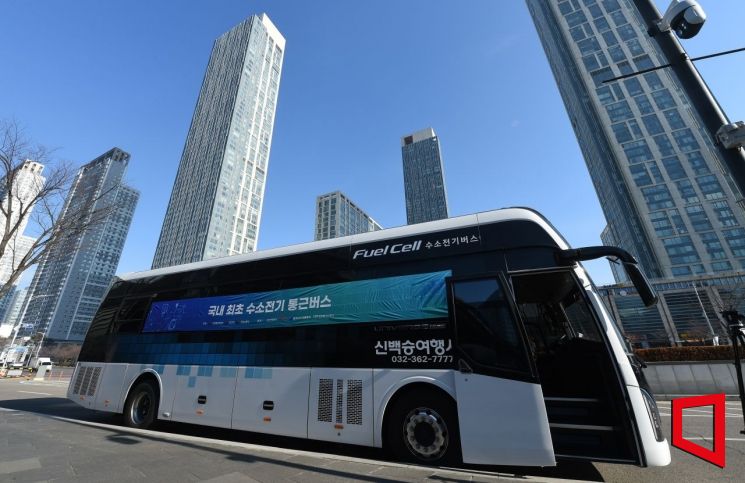
Since the number of hydrogen charging stations, which had been the biggest obstacle to the introduction of hydrogen buses, is expanding from six to 14 this year, the city expects that a large-scale transition to hydrogen buses will be possible.
In particular, when the liquefied hydrogen production plant in Wonchang-dong, Seo-gu is completed in the second half of this year, a large-scale stable supply of hydrogen will be possible, accelerating the establishment of Incheon's hydrogen public transportation system. The liquefied hydrogen production plant is a facility being constructed by SK E&S with the world's largest annual capacity of 30,000 tons.
Incheon City also signed an "Eco-friendly Airport Infrastructure Creation Business Agreement" on the same day with the Ministry of Land, Infrastructure and Transport, Incheon International Airport Corporation, SK PlugHybus, and Korea Gas Technology Corporation to build a hydrogen transportation complex base and promote the transition to hydrogen mobility.
According to the agreement, related organizations will jointly invest about 13 billion KRW by next year to build a liquefied hydrogen charging station within the bus garage of Incheon Airport Terminal 2 (T2).
The complex base is meaningful in that it will not only convert public transportation operating on Yeongjong Island to hydrogen buses but also establish the foundation for a hydrogen mobility revolution starting with 450 buses that regularly enter Incheon International Airport Terminal 2 nationwide, the city explained.
An official from Incheon City stated, "To expand the spread of hydrogen mobility, one of the core means of the hydrogen economy, we will strengthen the collaborative network with the government, industry, and related organizations."
© The Asia Business Daily(www.asiae.co.kr). All rights reserved.
![Clutching a Stolen Dior Bag, Saying "I Hate Being Poor but Real"... The Grotesque Con of a "Human Knockoff" [Slate]](https://cwcontent.asiae.co.kr/asiaresize/183/2026021902243444107_1771435474.jpg)
















