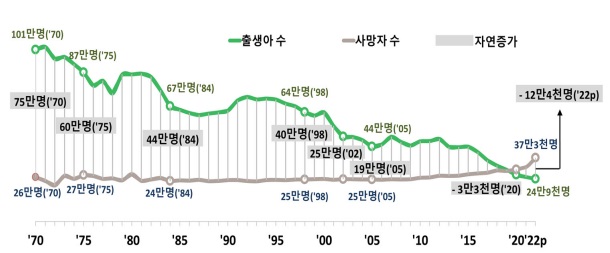
[Asia Economy Sejong=Reporter Dongwoo Lee] The number of births last year was only 249,000. During the same period, the number of deaths reached a record high of 372,800, resulting in a natural population decrease of 123,800. This natural population decline was the highest since related statistics began being compiled in 1970.
According to the "2022 Birth and Death Statistics" released by Statistics Korea on the 22nd, the number of births last year decreased by 11,500 (-4.4%) compared to the previous year. The total fertility rate, which is the average number of children a woman is expected to have in her lifetime, dropped from 0.81 to 0.78. The total fertility rate has remained in the 0 range for five consecutive years since 2018.
Last year, the average age of women at childbirth was 33.5 years, an increase of 0.2 years from the previous year. The average age at childbirth for the first child was 33.0 years, for the second child 34.2 years, and for the third child 35.6 years, with the average age of mothers rising by 0.1 to 0.3 years compared to the previous year. The proportion of elderly mothers aged 35 and over was 35.7%, up 0.7 percentage points from the previous year. The number of births decreased across all age groups except for women in their early 40s. During the same period, first births increased by 8,000 (5.5%) to 156,000, while second births and third births decreased by 16.8% and 20.7% to 76,000 and 17,000, respectively.
The number of births within two years of marriage was 76,000, down 5,000 (-6.4%) from the previous year. Births occurring within 2 to 5 years after marriage were 99,000, and those after more than 5 years were 66,000, decreasing by 5,000 (-5.1%) and 3,000 (-4.7%) respectively compared to the previous year. By region, Sejong had the highest fertility rate at 1.12, while Seoul had the lowest at 0.59. Except for Daejeon (3.6%), all 16 other metropolitan cities and provinces saw a decrease in the number of births compared to the previous year.
Among OECD member countries, South Korea is the only country with a total fertility rate below 1. As of 2020, Italy recorded 1.24, Greece 1.28, and Japan 1.33, ranking just after South Korea in terms of low fertility rates. Considering that developing countries generally have higher fertility rates than developed countries, South Korea’s fertility rate is analyzed to be among the lowest in the world.
Meanwhile, the number of deaths last year was 372,800, a 17.4% increase from the previous year (317,700), marking the highest since statistics began in 1970. The crude death rate, which indicates the number of deaths per 1,000 people, was 7.3, up 1.1 from the previous year. The increase in deaths was mainly among the elderly aged 60 and above, with the highest number of deaths among both men and women in their 80s.
Monthly death counts were highest in March last year (12.0%), followed by April (9.8%), June (6.7%), and July (7.0%). Lim Young-il, head of the Population Trends Division at Statistics Korea, said, "The high number of deaths in March and April last year is believed to be due to the rapid increase in COVID-19 cases during those months and the aging population."
With the ongoing trends of low birth rates and aging population, the natural population decline is expected to continue to widen. In its future population projections last year, Statistics Korea forecasted that this year’s total fertility rate will be 0.73 and the number of births will be 233,000, decreasing by 0.05 and 16,000 respectively from the previous year.
© The Asia Business Daily(www.asiae.co.kr). All rights reserved.
![Clutching a Stolen Dior Bag, Saying "I Hate Being Poor but Real"... The Grotesque Con of a "Human Knockoff" [Slate]](https://cwcontent.asiae.co.kr/asiaresize/183/2026021902243444107_1771435474.jpg)















