Production of Ambarella's Latest SoC Using 5nm Process
"Expanding Mobile and Other Product Segments Through Technological Innovation"
[Asia Economy Reporter Kim Pyeonghwa] Samsung Electronics is increasing its foundry (semiconductor contract manufacturing) business by producing autonomous driving vehicle semiconductors from the U.S. AI semiconductor company Ambarella using advanced processes. By expanding its customer base in the automotive sector, it plans to raise the proportion of non-mobile product lines to over 50% by 2027.
Producing Autonomous Driving Semiconductors with Advanced Processes
Samsung Electronics announced on the 21st that it will produce Ambarella's latest system-on-chip (SoC) 'CV3-AD685' for advanced driver-assistance systems (ADAS) using its 5-nanometer (nm, one billionth of a meter) foundry process.
The CV3-AD685 is equipped with Ambarella's next-generation AI engine (CVflow) and serves as the brain of autonomous vehicles. It independently judges and controls driving situations inputted through cameras and radar. With Samsung Electronics' advanced 5nm process, AI performance improves more than 20 times compared to the previous generation.
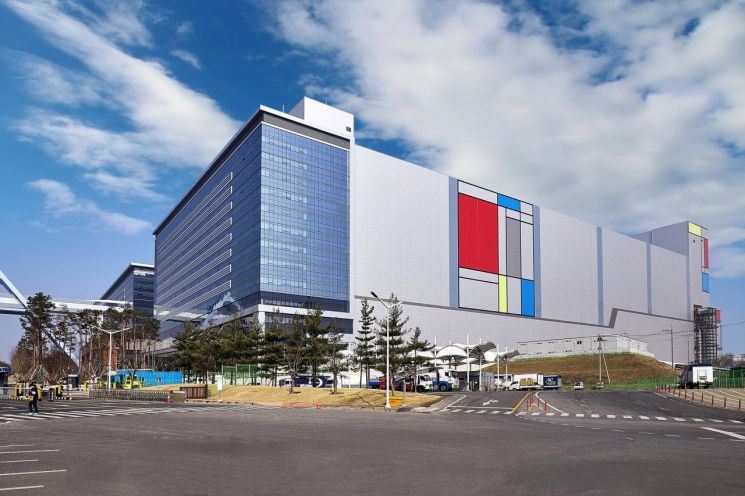
Samsung Electronics integrates automotive-dedicated IP, packaging technology, and expertise to produce high-performance, low-power semiconductors for autonomous vehicles. The company explained that through collaboration with Ambarella, it has enhanced the safety level of next-generation driver assistance systems based on high-performance, low-power AI semiconductors in the autonomous vehicle sector.
Shim Sangpil, Vice President of Samsung Electronics' Foundry Business Division, said, "Samsung's 5nm process brings unprecedented performance improvements to autonomous vehicles," adding, "We hope many automotive industry customers will experience the outstanding performance of the CV3-AD SoC."
"Expanding Foundry Business by Strengthening Technological Leadership"
Samsung Electronics plans to strengthen its technological leadership by expanding the latest 4nm process to automotive applications. Through this, it aims to continuously increase fabless customers in the autonomous vehicle sector, such as Ambarella. The company also announced a goal to raise the sales proportion of non-mobile product lines, including automotive and 5th generation mobile communication (5G), to over 50% in the foundry business by 2027.
Samsung Electronics currently operates and plans foundry lines in five locations, including Hwaseong, Giheung, and Pyeongtaek in Korea, as well as Austin and Taylor in the U.S. It plans to strengthen its foundry business competitiveness by leading technological innovation, providing optimized processes for each application, offering customer-tailored services, and securing stable production capacity (capability). In this process, it aims to increase foundry production capacity by 3.3 times compared to last year by 2027.
According to market research firm Omdia, the global foundry market continues to grow despite the semiconductor industry's downturn. Omdia forecasts the market size this year to be $125.2 billion, an approximately 2.7% increase from last year's $121.9 billion. The compound annual growth rate from this year to 2028 is expected to be 10.8%.
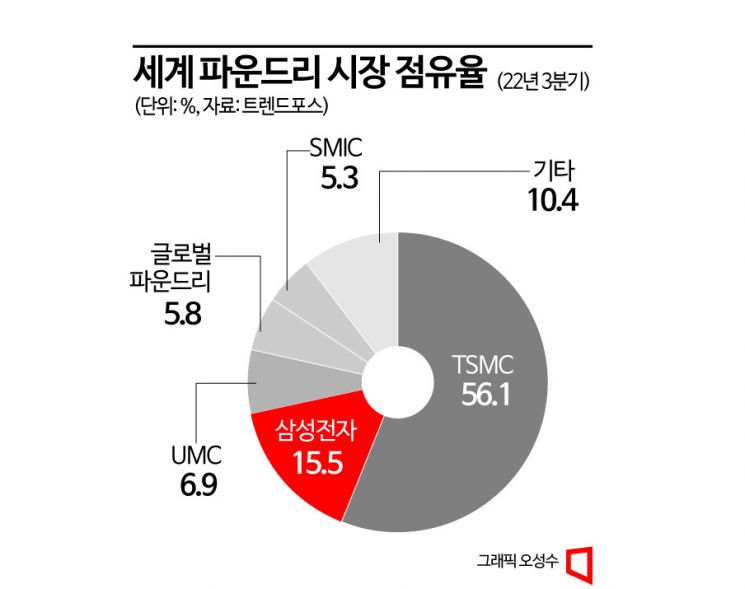
Samsung Electronics aims to narrow the gap with its competitor, Taiwan's TSMC, and increase its market share in the foundry market. According to statistics from market research firm TrendForce, Samsung's market share in the third quarter of last year was 15.5%, ranking second after TSMC (56.1%).
© The Asia Business Daily(www.asiae.co.kr). All rights reserved.
![Clutching a Stolen Dior Bag, Saying "I Hate Being Poor but Real"... The Grotesque Con of a "Human Knockoff" [Slate]](https://cwcontent.asiae.co.kr/asiaresize/183/2026021902243444107_1771435474.jpg)
















