Samyang Group Utilizes Isosorbide
Maintains Consistent Temperature of Electric Vehicle Batteries
Key Material for Managing Energy Efficiency
[Asia Economy Reporter Choi Seoyoon] Samyang Corporation is partnering with Nano Team, a specialist in thermal management solutions for electric vehicles, to develop eco-friendly thermal management materials used in electric vehicle batteries.
On the 20th, Samyang Corporation, a chemical and food affiliate of Samyang Group, held a joint development agreement ceremony for eco-friendly thermal interface materials (Thermal Interface Material·TIM) for electric vehicle batteries at Nano Team’s headquarters in Daejeon.
Electric vehicle thermal management materials are substances applied between the battery module and cooling panel to regulate battery temperature. They are recognized as key materials for improving electric vehicle battery performance and safety, and active research and development have been underway recently.
In electric vehicles, the battery is the sole energy source for the vehicle, and its efficiency is influenced by heat, so battery temperature management greatly affects performance. If the high heat generated by the battery is not properly managed, electrical energy is wasted as thermal energy. This slows charging speed, reduces efficiency, and can cause thermal runaway during accidents. Conversely, in cold winter temperatures, battery discharge accelerates, making the role of thermal management materials in maintaining a consistent battery temperature crucial.
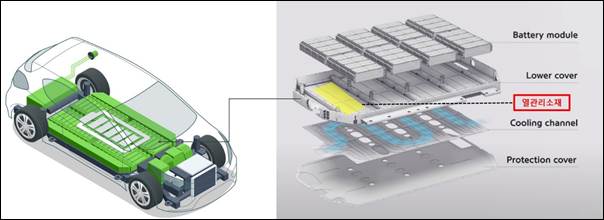
Driven by the popularity of electric vehicles, demand for thermal management materials is continuously increasing, but most currently used products are petroleum-based. The thermal management materials that the two companies plan to develop combine Samyang Group’s self-developed white bio-based material Isosorbide with the development technology of Nano Team, a specialist in eco-friendly thermal management materials, resulting in an eco-friendly bio-based thermal management material. Samyang will modify Isosorbide to be applicable to electric vehicle batteries, and Nano Team plans to utilize this to develop eco-friendly thermal management materials.
Samyang Group has recently been actively pursuing the development of eco-friendly electric vehicle materials using Isosorbide. Last year, it was selected as the lead company for a national project led by the Ministry of Trade, Industry and Energy to develop biodegradable polycarbonate using Isosorbide and to commercialize automotive interior parts made from it. It is also mass-producing eco-friendly adhesives necessary for electric vehicle motor production. By entering the battery thermal management material sector this time, the group aims to further expand its presence in the growing electric vehicle materials market.
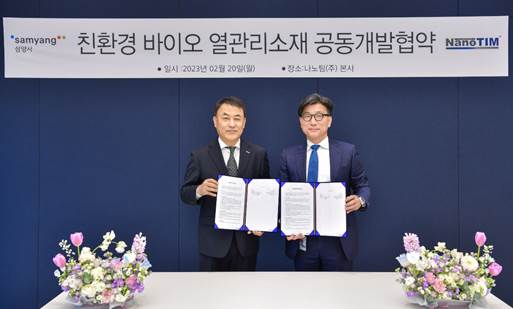 Kang Hoseong, CEO of Samyang Corporation (left), and Choi Yoonseong, CEO of Nanoteam, are posing for a commemorative photo on the 20th at Nanoteam headquarters in Daejeon after holding a joint development agreement ceremony for eco-friendly bio thermal management materials for electric vehicle batteries.
 [Photo by Samyang Corporation]
CEO Kang said, “As the global electric vehicle market rapidly grows, interest and demand for eco-friendly materials used in electric vehicles are also gradually increasing. Samyang plans to proactively respond to these market demands and expand its eco-friendly material portfolio to practice ESG management.”
Nano Team, established in 2016, is a domestic specialist company in thermal management materials for electric vehicles. Through localization of materials, it supplies battery thermal management materials to Hyundai Kia electric vehicles such as the Ioniq 5 and EV6, demonstrating strong technology and competitiveness. It possesses core technologies in material modification and compounding for thermal management materials and has excellent price competitiveness, enabling rapid growth in the related market. Recently, it has attracted attention in the market by launching thermal runaway suppression materials, which have emerged as a major safety issue in electric vehicles.
© The Asia Business Daily(www.asiae.co.kr). All rights reserved.
![Clutching a Stolen Dior Bag, Saying "I Hate Being Poor but Real"... The Grotesque Con of a "Human Knockoff" [Slate]](https://cwcontent.asiae.co.kr/asiaresize/183/2026021902243444107_1771435474.jpg)
















