Seocho-gu Proposes Reconstruction Project Models Including Creation of External Connecting Streets for Reconstruction Apartments
Public, Rapid, and Business Feasibility Execution Standards Presented in ‘Seocho-type Residential Maintenance Guidelines’... First among Seoul Autonomous Districts
Connecting Points (Apartments) as Lines (City) to Share Reconstruction Project Effects with Surrounding Residents is Key
Jeon Seong-su, Seocho-gu Mayor: “Seocho-type Residential Maintenance is not about individual points, but a process connected as lines that improves the entire region and develops the whole city”
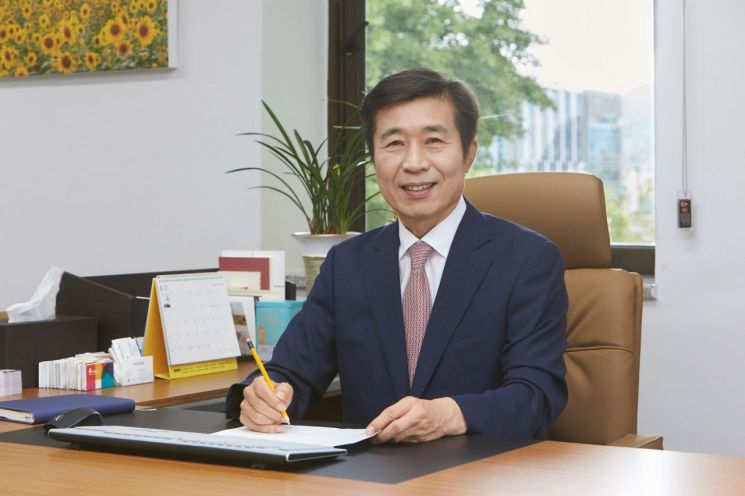
[Asia Economy Reporter Park Jong-il] From now on, reconstruction projects in Seocho-gu will be carried out by creating streets (街路) that connect reconstruction complexes with the outside as ‘Living Shared Streets’ and placing community facilities there.
This strengthens public contributions so that the benefits of reconstruction projects are enjoyed not only by residents but by the entire region. In addition, to expedite project progress, a specialized team supported by the district office will be dispatched to each project site to actively engage.
Seocho-gu (Mayor Jeon Seong-su) has prepared the ‘Seocho-type Residential Maintenance Guidelines’ (hereinafter referred to as the Guidelines) centered on these contents. It is Seocho’s unique residential maintenance standards and directions to build a harmonious and high-quality residential environment, reflecting the key pledges and philosophy of Mayor Jeon Seong-su’s 8th term.
After conducting the ‘Seocho-type Residential Maintenance Management Plan Establishment Service’ and expert consultations, the district completed the Guidelines and will apply them from this month to all project sites establishing residential maintenance plans such as reconstruction and street housing maintenance projects within the region. The Guidelines incorporate the framework and directions of Seoul city’s apartment complex formation standards (2020), the 2040 Seoul Urban Basic Plan, and the New Town Planning Guidelines, among other related Seoul city plans.
The Guidelines are based on three major principles: ‘publicness,’ ‘rapidity,’ and ‘business feasibility,’ and present four goals: ▲enhancing quality through strengthened public contributions in reconstruction maintenance projects ▲creating harmonious residential areas with adjacent complexes ▲active administrative support for rapid maintenance project promotion ▲improving living environments in old and low-rise residential areas.
The district pursues a project direction and value that breaks away from the existing perception where only a few residents benefit from reconstruction and maintenance projects, aiming for neighbors to share and enjoy those benefits, which ultimately leads to a virtuous cycle where the entire region develops into a ‘better place to live.’
From the early stages of maintenance project planning, the district presents such systematic standards to induce residential environments linked with the local community and promotes rapid and efficient project progress by dispatching specialized support teams at each stage.
Accordingly, the district divided the Guidelines into three fields by project type: ▲reconstruction maintenance projects ▲street housing maintenance projects ▲station area youth housing, containing a total of 14 detailed standards across 17 chapters.
Especially, the detailed standards for the core ‘reconstruction maintenance projects’ include ▲creation of living shared streets ▲management and operation of open community facilities ▲operation of expert support teams for rapid project promotion.
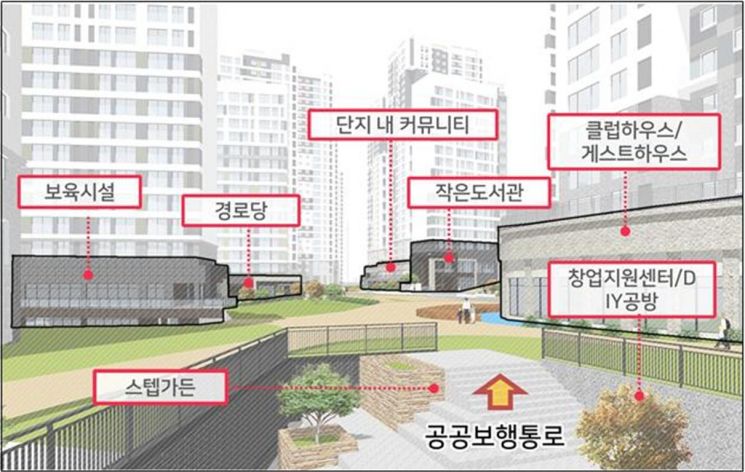
Sharing Maintenance Project Effects with the Region through Creation of Living Shared Streets
First, the district will create major streets (街路) connecting reconstruction complexes and nearby areas as ‘Living Shared Streets.’ This is to increase facility accessibility to share the benefits of reconstruction with nearby residents. Also, when community facilities are placed inside the complex, only residents of that complex use them, causing inconvenience for outsiders; this aims to improve that and promote activation.
Living Shared Streets are pedestrian-centered roads that become the community core connecting complexes and the local community, where (open-type) resident joint facilities and community facilities are concentrated.
The ‘Living Shared Streets’ proposed by the district are planned to be pedestrian-centered as much as possible, with a width of about 15 meters. Along these streets, open community facilities such as community centers, small libraries, senior centers, and childcare facilities are concentrated along the street front. Additionally, near the Living Shared Streets, open community facilities and neighborhood commercial facilities are concentrated to activate commercial areas and induce living spaces.
Along with this, detailed opening standards for open community facilities were also prepared. It is recommended that at least one-third of open community facilities be accessible to the public, and when two or more apartment complexes plan and open facilities together, at least 20% per complex should be open. Furthermore, the Guidelines classify the creation standards for community spaces (public facilities, resident joint facilities) by location, planning standards, and securing methods, providing tables and illustrative examples.
Guidance and Strengthened Public Management of Open Community Facilities
Also included are operation plans for open community facilities to revitalize the local community. When a project implementer installs open community facilities, they must specify this in advance in resident recruitment announcements and sales contracts to provide sufficient guidance and information to residents beforehand.
Moreover, the association or residents’ representative meeting must specify this in the apartment management regulations, and a separate open facility operator responsible for the operation and management of these facilities must be appointed. The Guidelines also include the roles of the operator.
Regarding the operation of open community facilities, the district specifies semiannual monitoring such as management and supervision, as well as support for open facility operators.
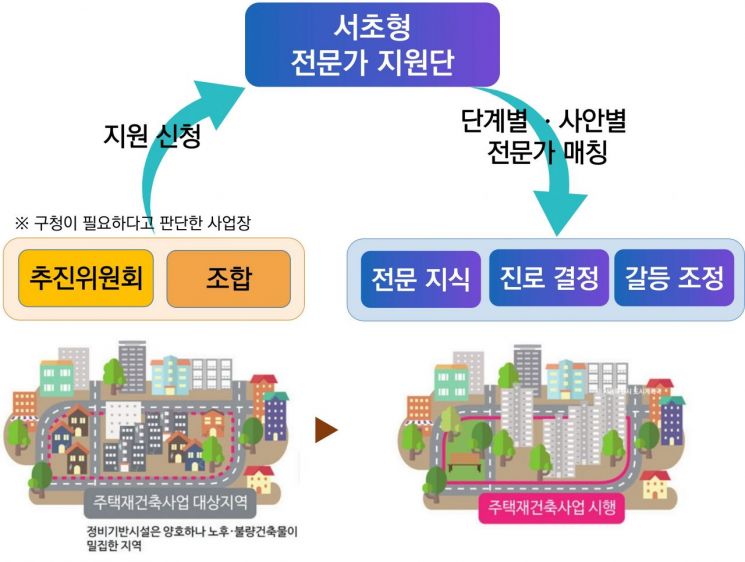
Operation of Expert Support Teams for Rapid Promotion of Reconstruction Maintenance Projects
The Guidelines also include content where the district supports experts from the project initiation stage through construction and completion, tailored to each stage and issue, to promote rapid progress of reconstruction projects.
For example, at the start of the maintenance project, experts explain the overall maintenance plan including procedures for plan establishment, safety diagnosis, and project methods. At the designation of maintenance zones and plan decision stages, they provide advice on development profits and contributions. At the association establishment approval and project implementation approval stages, they offer consultation for approval and authorization. At the management disposition approval, construction start, and completion stages, they advise on disposition plan verification and ways to shorten construction periods.
From this month, the district integrated the existing Seocho-gu Urban Planning Committee, Dispute Mediation Committee, and Special Arbitration Team?composed of lawyers, architects, appraisers, and accountants?into the ‘Seocho-type Expert Support Team.’ They perform roles such as coordinator matching, providing professional consulting, and mediating resident conflicts.
In addition to the above three reconstruction maintenance project contents, standards are also presented for △prioritizing expansion of insufficient public and infrastructure facilities when the maximum floor area ratio is achieved, and △improving the residential environment quality of rental housing as a Seocho-type public housing model.
To support the publicness, professionalism, and rapid promotion of residential maintenance, the district reorganized its organization in January this year, separating the existing Residential Improvement Division into Reconstruction Project Division and Apartment Management Division.
Seocho-gu Mayor Jeon Seong-su said, “Seocho-type residential maintenance is not about individual points (apartment complexes), but about connecting these points as lines (city), improving the entire region and developing the whole city. We will continue to add publicness between complexes so that the entire Seocho-gu becomes a ‘better city to live in.’”
© The Asia Business Daily(www.asiae.co.kr). All rights reserved.
![Clutching a Stolen Dior Bag, Saying "I Hate Being Poor but Real"... The Grotesque Con of a "Human Knockoff" [Slate]](https://cwcontent.asiae.co.kr/asiaresize/183/2026021902243444107_1771435474.jpg)

















