[Asia Economy New York=Special Correspondent Jo Seulgina] Resembling an espionage operation, U.S. President Joe Biden's visit to Ukraine on the 20th (local time) concluded after a packed schedule of more than five hours in the capital Kyiv. It was confirmed that the U.S. informed Russia of Biden's visit to Ukraine a few hours before departure to avoid conflict with Russia.
According to the White House, President Biden visited Kyiv, Ukraine without prior notice on the day marking one year before Russia's invasion of Ukraine, meeting with President Volodymyr Zelensky and pledging additional military aid. This is the first time a U.S. president has set foot on Ukrainian soil since Russia's invasion on February 24 last year. It is also a reciprocal visit about two months after President Zelensky visited the U.S. in December last year for a bilateral summit.
◆Over 5 hours in Ukraine... Walking through Kyiv city while hearing air raid alarms
This visit was carried out in utmost secrecy under tight security. In recent weeks, speculation spread that President Biden might visit Ukraine around February 24, but the White House repeatedly denied the possibility of a Ukraine visit while announcing plans to visit neighboring Poland. On the day, news of Biden's entry into Ukraine was reported through the local newspaper Novosti Donbasa. From early morning, major streets and central roads in downtown Kyiv were controlled without notice, and videos began circulating among citizens showing a long convoy of vehicles believed to be U.S.-owned moving along the controlled roads.
President Biden secretly left Andrews Air Force Base at 4:15 a.m. Eastern Time on the 19th aboard Air Force One. He then passed through Ramstein Air Base in Germany before entering Poland. From Poland to Kyiv, he traveled by train, which reportedly took about 10 hours according to The New York Times (NYT). Biden entered Ukraine around 8 a.m. local time that day.
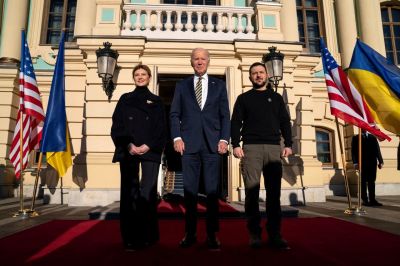
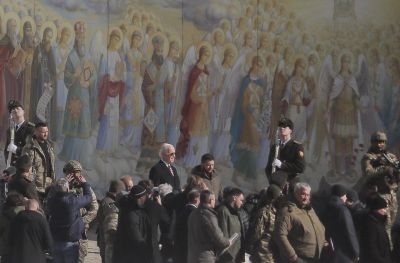
Wearing a blue and yellow diagonal striped tie symbolizing the Ukrainian flag, President Biden was greeted by President Zelensky at the Mariinsky Palace in Kyiv around 8:30 a.m. They then walked along controlled roads to St. Michael's Cathedral located in the city center. When they arrived near the cathedral, air raid sirens sounded. The two leaders then proceeded to a nearby memorial wall to observe a moment of silence.
The two leaders later moved to the meeting venue. There, President Biden announced a new military aid package worth $500 million. The aid includes shells, anti-armor systems, and air defense radars to counter Russian missile attacks. Biden also confirmed that additional sanctions against Russia would be announced within the week. He stated, "I thought it was important that there be no doubt about the United States' support for Ukraine in this war," reaffirming unwavering support.
President Biden visited the U.S. Embassy around noon and left Kyiv between 1 and 2 p.m. Before departing, he left a message in the Mariinsky Palace guestbook. He wrote, "It is an honor to be welcomed in Kyiv, a city of people who love freedom, to share solidarity and friendship." To President Zelensky, he expressed "deep respect for your courage and leadership," and wrote in Ukrainian, "Slava Ukraina (Glory to Ukraine)."
◆"Unprecedented"... Confirmed last week, Russia notified hours before
The unannounced visit to Kyiv by President Biden was meticulously planned in secret over several months and only finalized on the 17th, according to the U.S. administration. The goal of the visit was to send a strong message of U.S. support for Ukraine to the world, including Russia.
Jake Sullivan, U.S. National Security Advisor, said in a video briefing immediately after Biden's departure from Ukraine, "President Biden's visit to Kyiv is historic and unprecedented." He explained that there has never been a case of a U.S. president visiting the capital of a country at war where U.S. forces do not control key infrastructure in modern times. Sullivan added, "President Biden thought it was important to take the risk and visit. He wanted to deliver a clear and unmistakable message about the United States' ongoing support for Ukraine."
For this visit, the U.S. administration prepared with a very small group from the National Security Council, the White House staff, the Department of Defense, and intelligence agencies starting months ago. President Biden gave final approval during a briefing in the White House office on the 17th. John Finer, Deputy National Security Advisor, explained, "Only a very few were involved in the planning, and the president was carefully briefed on each stage and possible emergencies." He added, "Key security officials were informed by phone on the 17th." To maintain secrecy, the number of senior aides accompanying the president and the press pool was minimized. The accompanying journalists reportedly surrendered their phones and signed nondisclosure agreements beforehand.
Originally, the visit was to be embargoed until the Kyiv schedule was completed, but it was revealed after vehicle convoys were spotted locally and reported by local media. The White House also focused on security by announcing in a press release sent the previous afternoon that President Biden would depart Andrews Air Force Base for Poland at 7 p.m. on the 20th.
However, to avoid conflict with Russia, the U.S. notified Russia of Biden's visit to Ukraine a few hours before departure. Sullivan confirmed, "We informed them of the plan to visit the Ukrainian capital for conflict resolution purposes." However, he did not disclose Russia's response citing the sensitivity of communication. Regarding specific transportation details of Biden in Ukraine, the U.S. stated it would reveal them later for security reasons.
Russian state media and politicians immediately reacted with opposition upon learning of Biden's surprise visit. Russia's state-run RIA Novosti claimed that Biden's visit proves the West is conducting a "proxy war" against Russia. Sergey Mardan, a journalist known as President Putin's "mouthpiece," also described the visit on Telegram as "a blatant humiliation from Russia's perspective."
There are also claims that the visit was a deliberate act to anger Russia. Mikhail Seremet, a member of the Russian Duma (lower house of the Federal Assembly), called it "a provocation" and said, "It cannot be seen otherwise." Sergey Chekov, a senator from Crimea, criticized, "The West is giving Ukraine a glimmer of hope to continue the armed conflict."
© The Asia Business Daily(www.asiae.co.kr). All rights reserved.
![Clutching a Stolen Dior Bag, Saying "I Hate Being Poor but Real"... The Grotesque Con of a "Human Knockoff" [Slate]](https://cwcontent.asiae.co.kr/asiaresize/183/2026021902243444107_1771435474.jpg)
















