Presidential Office: "Unilateral Passage of Livelihood Bills... Citizens Will Be Disappointed"
Following the Grain Management Act, Direct Submission of the Yellow Envelope Act to the Plenary Session Planned
Veto Possible Even on the Broadcasting Act... Presidential Office: "Law and Principles"
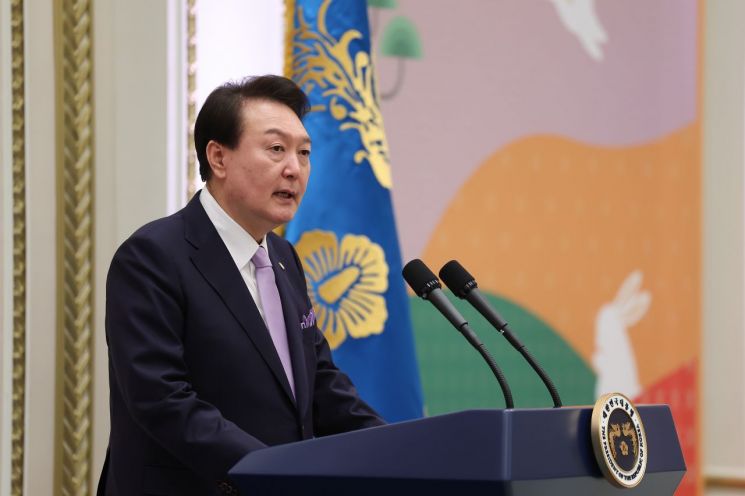
[Asia Economy Reporter Baek Kyunghwan] The Presidential Office expressed that the legislative forceful processing procedure led by the opposition party will "disappoint many citizens." Although it is officially premature to comment as the matter is ongoing in the National Assembly, there is clear concern about the public inconvenience arising from legislation that differs from the Yoon administration's governance policy and President Yoon Seok-yeol's principles.
On the 17th, a Presidential Office official met with reporters at the Yongsan Presidential Office building and conveyed this stance, saying regarding the possibility of the president exercising veto power on some bills, "There seems to be a basic principle."
That afternoon, the so-called 'Yellow Envelope Act,' which limits excessive damage claims by companies against striking workers, passed the National Assembly's Environment and Labor Committee's agenda adjustment committee (AAC) led by the opposition party. The 'Yellow Envelope Act,' which collectively refers to amendments to Articles 2 and 3 of the Trade Union Act, broadens the concept of employers to strengthen the primary contractor's responsibility for subcontracted unions and limits excessive damage claims arising from strikes. People Power Party members left the AAC meeting within 10 minutes of its start.
A senior Presidential Office official told Asia Economy in a phone interview, "It is not appropriate to comment on each bill being promoted in the National Assembly," but criticized, "The situation where various bills are being pushed unilaterally without consensus procedures is concerning." Regarding the possibility of the president's reconsideration request, the official emphasized, "Considering that the government and the president have repeatedly stressed principles, it is natural to request reconsideration." This indicates the intention to exercise the veto power stipulated in Article 53 of the Constitution in a situation where the Democratic Party is pushing bills with a majority of seats. If the president requests reconsideration, the National Assembly must reapprove the bill with a majority of the total members present and at least two-thirds of those present for it to be finalized as law.
The Presidential Office's stance on the Yellow Envelope Act is firm. This is because it creates conditions where illegal strikes are effectively guaranteed as legal, and even if employers suffer losses due to strikes, the path to compensation is blocked. President Yoon has already expressed concerns about "considerable side effects." Above all, the act is far from the 'labor reform' that President Yoon prioritizes as a key reform task. Another Presidential Office official pointed out, "Transparency in labor-management relations and fair compensation among regular and irregular workers, and between primary and subcontracted employees, are the core, but the Yellow Envelope Act undermines both transparency and fairness."
The Grain Management Act and the Broadcasting Act are also expected to face presidential vetoes. The Grain Management Act has already been directly submitted to the plenary session, increasing the likelihood of its passage in the National Assembly. The ruling and opposition parties plan to hold a plenary session on the 24th to handle livelihood-related agendas, and the Grain Management Act amendment may be put to a vote that day. However, President Yoon has repeatedly expressed opposition to the Grain Management Act. The act mandates government rice purchases if rice production exceeds demand by more than 3% or if harvest prices fall by more than 5% compared to the previous year. President Yoon has pointed out that "it does not help farmers." The logic is that it should be left to government discretion, and gradually reducing the supply-demand gap cannot prevent waste of finances and agricultural products. Ultimately, mandating purchases by law is judged to widen the gap further.
The Broadcasting Act has already been discussed within the Presidential Office regarding whether to exercise veto power. The main content of the Broadcasting Act amendment is to expand the boards of directors of public broadcasters such as KBS and MBC from the current 9-11 members to 21 members. The ruling party is opposing this, claiming it is an attempt to permanently seize public broadcasting by the left by granting certain organizations the right to recommend directors.
The Presidential Office plans to maximize the use of presidential powers guaranteed by the Constitution until next year's general election to establish a governance foundation centered on reform. A Presidential Office official said, "The repeated legislative pushes by the opposition leading to mentions of veto power ultimately show the public the intensifying political conflict between the ruling and opposition parties," but added, "However, the Presidential Office will always maintain a firm stance based on law and principles."
© The Asia Business Daily(www.asiae.co.kr). All rights reserved.
![Clutching a Stolen Dior Bag, Saying "I Hate Being Poor but Real"... The Grotesque Con of a "Human Knockoff" [Slate]](https://cwcontent.asiae.co.kr/asiaresize/183/2026021902243444107_1771435474.jpg)















