Extension of Pension Special Committee Activities Unavoidable, Final Reform Plan This Year Also Uncertain
Early Hardline Approach Fails... Concerns Over "Repeating Moon Government's Failure"
"Remember That Today's Decisions Affect Children 30-40 Years in the Future"
[Asia Economy Reporter Kim Jong-hwa] Discussions on National Pension reform are becoming complicated. The National Assembly's Special Committee on Pension Reform plans to report a recommendation without concrete figures to the National Assembly, and the political circles are creating an atmosphere to postpone pension reform until after next year's general election.
According to political circles on the 18th, the National Assembly's Special Committee on Pension Reform recently coordinated proposals such as gradually raising the National Pension contribution rate to 15%, maintaining the current 40% income replacement rate, or increasing it to 50%, but failed to reach an agreement.
The Pension Special Committee was inevitably conscious of public backlash questioning whether raising the contribution rate to 15% was excessive given the soaring inflation, and it seems they judged that further discussion would be difficult. Ultimately, the committee decided to compile and report to the National Assembly early next week only the discussed contents, excluding key parameters of reform such as the contribution rate, mandatory enrollment and pension commencement age, and income replacement rate.
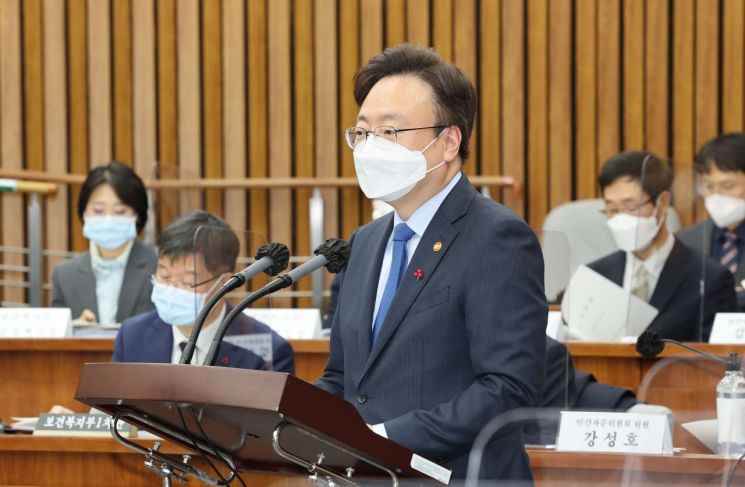 Minister of Health and Welfare Cho Kyu-hong is reporting on work at the Special Committee on Pension Reform held at the National Assembly.
 [Photo by Yonhap News]
Pension reform without knowing how much contributions will rise or how much pension will be received
A representative of the National Assembly's Special Committee on Pension Reform said, "What the public is most curious about is how much the contributions they pay will increase and how much pension they will receive, but it is difficult to persuade the public without presenting such figures," adding, "There is concern that this could dampen the enthusiasm for pension reform."
The National Assembly seems to welcome the stalemate of the Pension Special Committee. Since political schedules such as next year's general election are burdensome, especially for the political circles and the Presidential Office, the view that pension reform can be postponed is gaining strength.
Kang Ki-yoon, the ruling party's secretary of the Pension Special Committee and a member of the People Power Party, said, "Now is not the time to discuss parameter reform of the National Pension," and added, "The National Assembly will pursue long-term structural reform plans." This implies that although raising the contribution rate to stabilize the National Pension's finances is inevitable, no politician will actively push for it ahead of the general election, which requires careful vote calculations.
Accordingly, the Pension Special Committee's activity period, scheduled to end in late April, has entered an extension phase. According to the plan, a reform proposal should be announced before May after collecting opinions from pension stakeholders and representatives of the general public based on the advisory committee's recommendations, but this is now impossible.
The government must submit a comprehensive National Pension operation plan to the National Assembly by the end of October based on the financial projection results conducted every five years under the National Pension Act, regardless of the National Assembly's discussions. If the private advisory committee and the special committee proceed smoothly, a final reform proposal could be announced within the year, but currently, this is uncertain. A Ministry of Health and Welfare official, the relevant department, said, "We plan to prepare the government proposal according to the legally set schedule while monitoring the National Assembly's discussion process."
Not to reconsider after the general election, but to make it an election issue
Some criticize that "the National Assembly is shifting responsibility to the government." There is concern that the possibility of successful reform increases if a drive is launched early in the administration, but if things continue as they are, the government may follow the footsteps of the Moon Jae-in administration, which failed to push through pension reform.
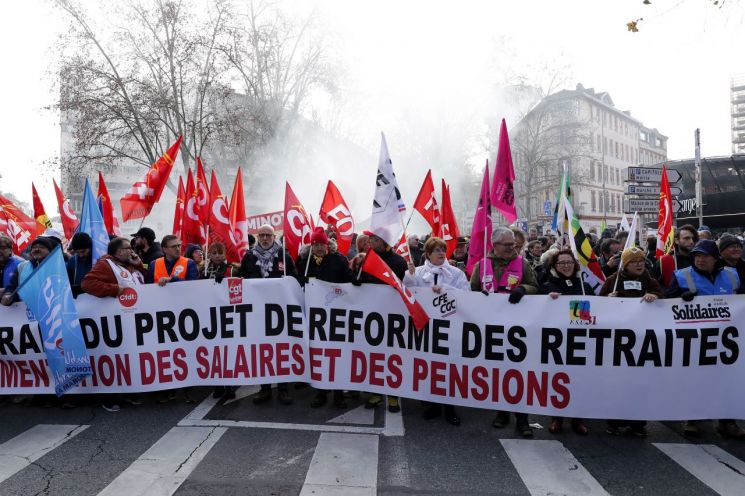 Labor unions opposing the French government's pension reform plan began a nationwide strike on the 19th of last month (local time), and in the southern French city of Toulouse, people are marching while holding a banner that reads "Withdraw Pension Reform."
 [Photo by Toulouse EPA/ Yonhap News]
The domestic pension reform discussion contrasts with France, where pension reform is being pushed forward despite strong opposition from the opposition parties. French President Emmanuel Macron is pushing a pension reform bill, including extending the retirement and pension receipt age, just five months after his re-election.
There is also an argument that the upcoming general election can be an opportunity for pension reform. Oh Geon-ho, policy director of "The Welfare State I Make," recently said in an interview with CBS, "The general election can be made an issue of pension reform," and predicted, "If the procedures to collect public opinions such as public hearings are expedited and the pension reform proposal is submitted to the National Assembly before the election, each party will have no choice but to reflect pension reform in their election pledges."
Oh also said, "France is a country where people pay a 28% contribution rate and receive a 62% income replacement rate. The public is currently protesting the plan to delay the pension receipt age from 62 to 64," adding, "Pension reform is the first topic that can cause intergenerational conflict. We must design the system keeping in mind that our decisions now will affect children 30 to 40 years in the future."
© The Asia Business Daily(www.asiae.co.kr). All rights reserved.


















